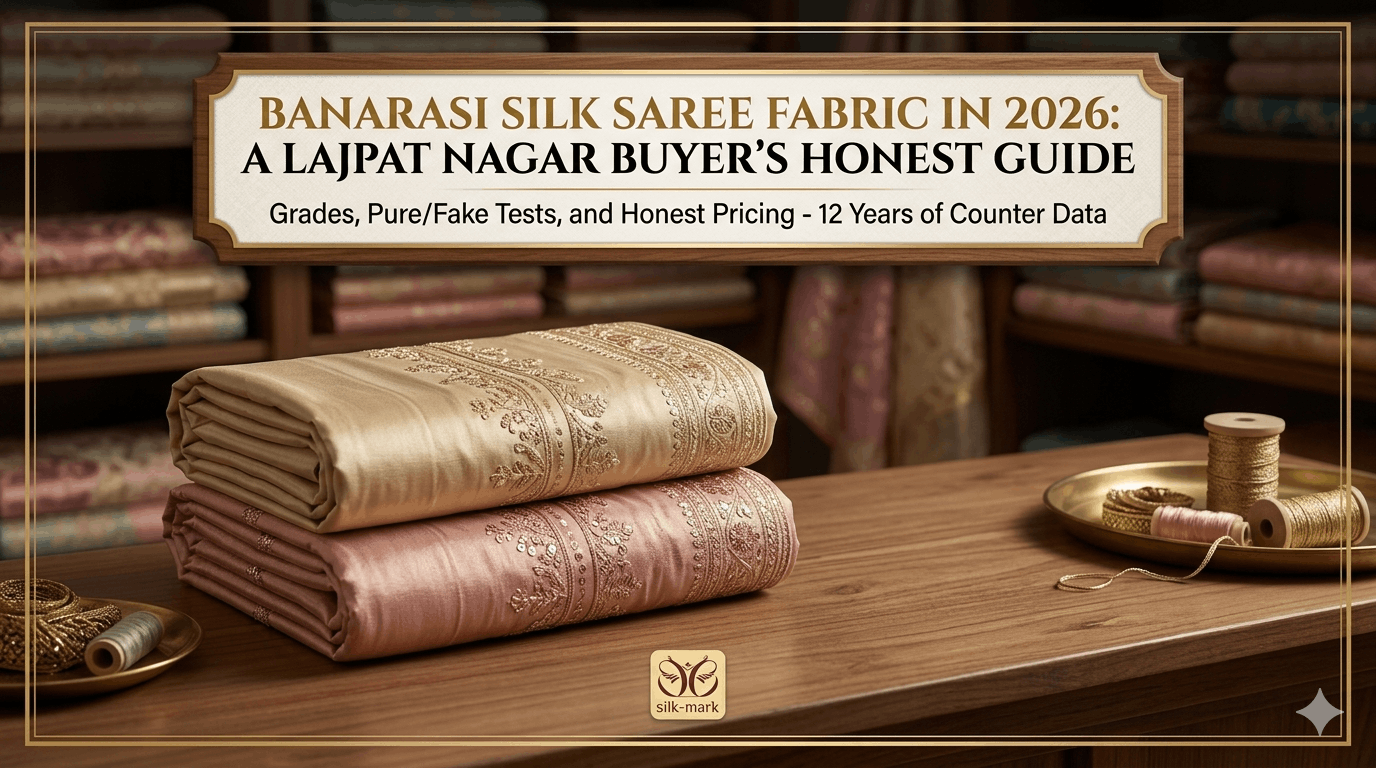
Banarasi Silk Saree Fabric in 2026: A Lajpat Nagar Buyer's Honest Guide
Banarasi Silk Saree Fabric in 2026: A Lajpat Nagar Buyer's Honest Guide
Banarasi silk saree fabric is a handwoven cloth from Varanasi made with pure silk warp and zari weft. In 2026 the four common grades are katan, organza tissue, georgette, and shattir. Katan is the heaviest at 200 to 280 GSM. Pure katan runs Rs 1,800 to Rs 6,500 per metre.
Twelve years now I am sitting at this counter in Lajpat Nagar. By now I can spot a first-time banarasi buyer the second they walk through the shutter. They say the word slow. Almost careful. Like they don't want to mispronounce it in front of the shopkeeper. Phone comes out. Pinterest screenshot of Vidya Balan, or sometimes Alia from a recent shoot. Then the question every single time. Bhaiya, kitne ka hai? And the face changes.
Last Tuesday a customer came in with a screenshot of a Manish Malhotra red bridal. Asked me the price. I told her the actual katan version would be around Rs 48,000 for the cloth alone before stitching. She thought I was overcharging. Walked out. Came back forty minutes later from the next gali shop carrying a polyester copy she paid Rs 6,500 for. That is the whole problem with this fabric in one afternoon.
Banarasi silk saree fabric is genuinely one of those cloths people want before they know what they are buying. Most of what is being sold around Delhi right now? Synthetic copies dressed up as pure banarasi. The actual handloom version costs three to ten times more. Every single week this same conversation happens at my counter, sometimes twice in a day.
So let me just write down what I tell people across this counter. Grades, price bands, how to spot a fake (this part nobody asks about and they should), which type works for which function. Twenty minutes of reading. You save maybe thirty thousand rupees. Worth it I think.

The best banarasi silk fabric in 2026 is pure katan silk for bridal sarees because the warp holds heavy zari without sagging. Organza tissue banarasi is lighter for sangeet and reception. Georgette banarasi drapes softer for daytime functions. Always check for handloom mark and real silver zari before buying. Pure katan starts at Rs 1,800 per metre.
What banarasi silk saree fabric actually is
Banarasi is a geographical indication cloth. Woven in and around Varanasi, Uttar Pradesh. That much the government has settled with a tag. Original cloth uses a pure silk warp with a zari weft. Zari means gold or silver thread wrapped around a silk core. Simple definition on paper. Problem is the market has stretched it sideways over twenty years until the word means almost nothing without checking.
You walk into ten shops in Karol Bagh you will be shown ten different cloths under the same banarasi label. Pure katan silk in the bridal section at the top of the price ladder. Organza tissue much lighter, all the young brides are picking it. Georgette banarasi, the soft-drape version working women keep buying for cousin's sangeet functions. And then shattir at the bottom, coarser silk-mix you see in every daily-wear saree shop. Each grade has its own price band. Its own stitching behaviour. Its own occasion where it makes sense. Mixing them up is where customers lose their money.
You can see the full silk fabric collection where every bolt is tagged by weave type and zari content.
The four banarasi silk saree fabric grades I keep on the shelf
Pure katan silk
Katan means the silk yarn is twisted from multiple silk filaments. Yarn ki spinning is tighter than other grades. That tightness gives the cloth its weight, its structure, that sculpted column drape brides keep asking for from our bridal fabric collection. GSM sits between 200 and 280. Per metre cost? Rs 1,800 to Rs 6,500 depending on how dense the zari work is. Pure katan bridal banarasi saree, fabric alone before tailoring and blouse, lands you somewhere between Rs 18,000 and Rs 65,000.
November to February weddings, almost every bride picks katan. Cloth photographs heavy under warm halogen lighting, zari catches and holds the light beautifully on camera. Daytime summer brides usually shift to lighter grades because heat does what heat does. A finished katan saree weighs 800 grams to 1.4 kilos. Sounds light on paper. By the third hour of the function, that weight is very real.
Organza tissue banarasi
Light. Sheer. Almost weightless on the shoulders. Tissue banarasi has a silk warp with metallic zari weft that catches light from every angle, gives that liquid shimmer effect on reels and reception videos. GSM drops sharply, around 60 to 90. Cost is friendlier too at Rs 800 to Rs 2,200 per metre. The full tissue fabric range is sorted by GSM upfront so you can pick what suits the occasion.
This grade has practically taken over the sangeet outfit fabric market in 2026, and the mehendi function crowd is right behind. Younger brides want light sarees they can dance in. Not heirloom cloth they have to manage all evening. Last December alone I sold maybe forty tissue banarasi bolts to bridal parties. Katan number was twelve. Five years back that ratio was completely flipped. Times changing fast on this counter.
One caution though, and this nobody tells you. Skip tissue banarasi for monsoon weddings. Zari oxidises faster in humidity, comes back looking dull within months. Indoor air conditioned venues, no problem.
Georgette banarasi
Soft drape, lighter body, more modern silhouette. Pure silk georgette base with banarasi zari motifs woven in. GSM around 80 to 120. Cost runs Rs 950 to Rs 2,800 per metre. The full georgette fabric collection has both plain and zari-worked options.
This is the everyday banarasi at my counter. Women who want the heritage look without the heritage weight. Working women picking up something for a colleague's wedding next month, sangeet guests, festival gifting between jethanis and sisters-in-law, all of them default to georgette banarasi. The cloth drapes in soft folds not sculpted pleats. Pleating wants a starched fall though otherwise the pallu just sits flat, which nobody wants in their photos.
Shattir and silk mix
Coarse silk blended with cotton or polyester. GSM around 130 to 170. Cost is Rs 350 to Rs 850 per metre. Honestly? This is the grade most online sellers are shipping under the banarasi label without telling the customer it is actually a mix. Nothing wrong with the cloth itself for daily office wear or budget gifting. Just do not pay pure katan prices for it. Every single week one customer walks in who paid Rs 12,000 thinking it was katan. Same bolt sells at Rs 4,500 retail two galis from here. They never want to hear it.
How much banarasi fabric you actually need for a saree
Standard saree length, this is the question I get every second day. Quick answer first because you came for numbers not stories. For exact requirements based on your blouse style and pallu length, the fabric estimator tool calculates everything in under a minute.
|
Component |
Fabric requirement |
|
Saree body (5.5 metre standard) |
5.5 metres |
|
Saree body (6.3 metre with pallu) |
6.3 metres |
|
Stitched blouse cloth |
0.8 to 1 metre |
|
Fall and edging |
4.5 metres of fall cloth |
|
Lining for sheer tissue |
5.5 metres |
|
Petticoat cloth |
2 metres |
Gifting unstitched fabric to someone? 6.3 metres plus a 1 metre blouse piece, that is your safe bridal package. Daily wear gifting, 5.5 metres plus matching blouse cloth covers you. Always buy slightly extra, never extra-tight, because cloth shrinks roughly 2 to 3 percent on first dry cleaning.
How to spot a fake banarasi silk fabric
This is the section I genuinely wish more buyers would ask about before paying. Most just hand over money on the seller's word. Then come back six months later when the zari has turned green.
Three checks. None of them needs a lab. Each one takes under a minute if you know what to look for.
Burn test first. Pull a tiny thread from the selvedge, light it with a matchstick over the kitchen sink. Pure silk smells like burnt hair, leaves behind a soft ash that crushes between your fingers, flame self-extinguishes within seconds. Polyester smells like burning plastic. Leaves a hard bead instead of soft ash. Flame keeps burning longer than it should. Clearest test there is honestly, and the one most sellers will absolutely refuse to let you do in their shop. Refusal itself is the answer.
Now the handloom mark. Government issued sticker or hangtag with a numbered code. Real handloom banarasi carries it. Power loom synthetic copies cannot get one because they are not handlooms. If the seller tells you they lost the tag bhabhi mere bachche kha gaye, walk away. I am not joking, I have heard that exact excuse three times this year. That is the red flag every textile head in Delhi will tell you about.
Last one, zari rub test. Take a small section of the zari work, rub the surface lightly with a soft cotton cloth, maybe twenty rubs. Real silver or gold zari shows a yellow-gold tone underneath where the coating gets thinned. Synthetic zari shows white or copper-red underneath because what is sitting under the coating is just plastic film over a copper wire. Cannot fake this one. Physics does not allow it.
For verified handloom banarasi with the certification paperwork, our imperial brocade collection tags every bolt with handloom mark documentation included.
How banarasi fabric choice changes the saree price
Two sarees with the same motif, same border, same overall design, can sit at completely different prices on two shelves of my own shop. People assume it is the karigari labour difference. It is not. Varanasi workshop labour is roughly similar across the board, give or take ten percent depending on workshop reputation. The price swings on what the warp, weft and zari embroidery fabric thread are actually made of underneath all that beautiful surface work.
Bridal banarasi in pure katan with heavy meenakari and silver zari? Typically Rs 35,000 to Rs 1,20,000 in fabric plus weaving cost. Same exact motif design on tissue base lands at Rs 12,000 to Rs 38,000 because the base cloth is lighter and the zari is metallic film not real silver. Georgette banarasi with allover buti work, Rs 8,500 to Rs 22,000. Same motif drawn by same karigar in same workshop. Three completely different price tiers. That is the entire lesson of this section.
What is trending for summer to winter wedding 2026
Pastels in banarasi are everywhere this season. Sage green, dusty pink, ivory cream, butter yellow katan sarees are outselling traditional red and maroon for the first time in maybe a decade. Designers are pairing oxidised silver zari with pastel base. That muted heritage look. Very Sabyasachi-influenced honestly, but the boutique-walas of Delhi caught on fast and now even the chandni chowk wholesale is moving pastel-first. Whole market shifted in eighteen months. If you want the broader context, our roundup on most popular bridal lehenga fabrics in India right now covers what is moving across the wedding category, not just banarasi.
Contrast pallu is also back in a big way. Body in one tone, pallu in a coordinating shade with heavy zari. Mehrunisa pink body with ivory pallu. Sage green body with rust pallu. If you are ordering, plan for two coordinated bolts not one because the karigar weaves them separately and then joins. This works especially well for reception outfit fabric where you want a stronger pallu statement under stage lighting.
Cutwork borders, this is the other big one. They are quietly replacing solid kinari borders this year. Lighter visual weight matches the softer pastel palette better. Most Varanasi karigars are now offering cutwork as a standard upgrade for bridal commissions without extra wait time, which is unusual. Usually anything custom adds three weeks to delivery.
Banarasi silk fabric care and storage that actually works
Banarasi care, this is where customers cause most of their own damage. Genuinely. The fabric outlasts the owner if you treat it right.
Dry cleaning first. People do it every season out of habit because that is what they do with all sarees. Please do not. Chemicals strip the silk gloss over time and you cannot get it back once it is gone. Once every three years is plenty for a katan banarasi. For spills, spot clean with a damp muslin cloth instead of detergent. Water alone usually pulls a fresh stain.
Storage matters more than people realise. Wrap your saree in unbleached cotton muslin. Not plastic covers. Plastic traps moisture and the silk yellows over years. Muslin lets the cloth breathe properly through Delhi's seasons.
Folding lines, this one people miss completely until it is too late. Refold the saree every six months. Folding lines weaken at the crease over years. A katan banarasi from 1998 actually split right in front of me last Diwali when the customer opened it for her daughter's roka. She almost cried. Rotating the fold pattern keeps the cloth from splitting along weak lines later.
For more on draping and styling once the saree is ready, our piece on how to style silk fabrics for different occasions covers the wedding-to-reception transitions.
FAQ Section
Which banarasi silk saree fabric is best for a wedding in 2026?
For the main wedding ceremony, pure katan silk is the strongest pick because the warp carries heavy zari without sagging through a six-hour function. Sangeet and reception, tissue banarasi makes more sense because of the lighter weight and shimmer on reels. This season the top-selling bridal banarasi at our counter is pastel katan in sage green or dusty pink, not the traditional red.
What is the price of pure banarasi silk fabric per metre?
Depending on zari density: pure katan banarasi runs Rs 1,800 to Rs 6,500 per metre. Organza tissue banarasi sits at Rs 800 to Rs 2,200. Georgette banarasi will run you Rs 950 to Rs 2,800 per metre. Shattir silk mix is the budget grade at Rs 350 to Rs 850.
How can I tell if a banarasi silk saree is real or fake?
Three quick tests work. Burn a thread from the selvedge: real silk smells like burnt hair, the flame self-extinguishes within seconds. Look for the government handloom mark tag with a numbered code, that is non-negotiable proof. Rub the zari lightly for twenty seconds: real silver zari shows gold tone underneath, synthetic shows white or copper.
How many metres of fabric do I need for a banarasi silk saree?
Body fabric needs 5.5 metres for a standard saree, plus 0.8 to 1 metre for the blouse, plus 4.5 metres of fall cloth. Bridal banarasi with longer pallu, you should budget 6.3 metres of body fabric to be safe.
Is georgette banarasi pure silk?
Sold as pure georgette banarasi, yes it is silk. Base cloth is pure silk georgette with banarasi zari motifs woven in by hand. Some sellers do mix polyester georgette and pass it off under the same banarasi name, so always check the GSM tag and ask for the silk content percentage in writing before paying anything.
Can banarasi silk fabric be machine washed?
Never. A banarasi silk saree should be dry cleaned by a heritage textile specialist who actually knows the fabric, or spot cleaned at home with a damp muslin cloth. Machine washing kills the zari and shrinks the silk warp permanently. No recovery from that mistake, the saree is finished.
The honest takeaway from the shop counter
Banarasi is the one cloth where the gap between the cheap version and the authentic one is wide enough to drive a truck through. Pure katan saree costs ten times what a synthetic copy costs. From the shop rack honestly they can look similar enough to fool an untrained eye, especially under shop lighting. The difference shows up later. In the fall. The weight on your shoulders by hour three. The way the colour holds up over years. How the zari survives that first careless dry cleaning.
If you are buying a banarasi for a wedding you will photograph for the rest of your life, this I will tell you straight, no shopkeeper sales pitch: do not save money on the base cloth. Buy less zari work if budget is tight. Skip the meenakari upgrade. Drop the cutwork border. Pick a simpler pallu. But the cloth grade itself is what makes a banarasi feel like an heirloom rather than a single-season piece your daughter cannot wear at her own wedding.
For boutique owners stocking heritage cloth, our imperial brocade collection carries handloom mark verified bolts in pure katan, tissue and georgette grades. Boutique resellers can request wholesale pricing directly through the bulk order page with documentation provided on every bolt before dispatch.
Conclusion
Walk through the live banarasi silk saree fabric collection sorted by katan, tissue and georgette grades. Pair with matching zari brocade for blouse coordination. WhatsApp for handloom mark documentation and swatch dispatch before placing bulk orders. Honest grading at every step. Twelve years of heritage fabric experience behind every bolt. One counter. One promise. No sales drama