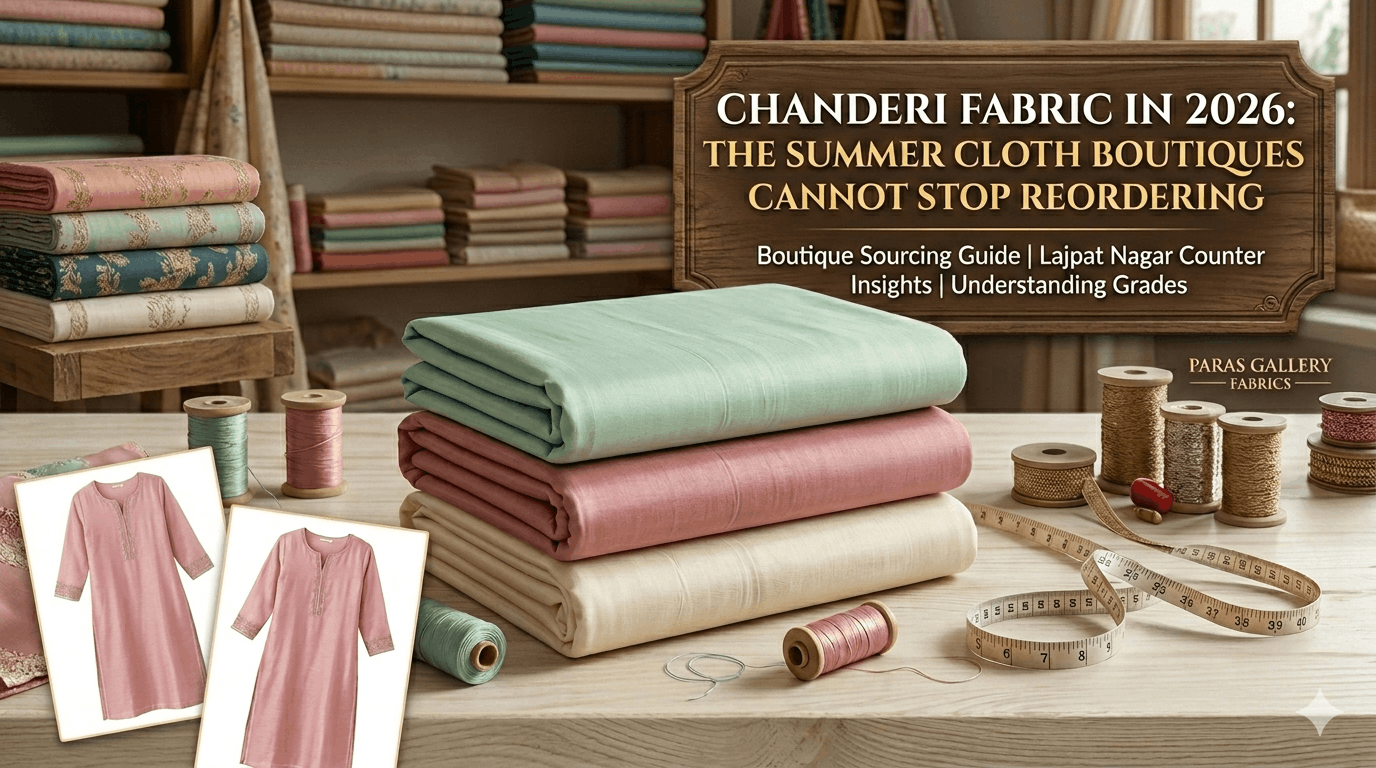
Chanderi Fabric in 2026: The Summer Cloth Boutiques Cannot Stop Reordering
Chanderi Fabric in 2026: The Summer Cloth Boutiques Cannot Stop Reordering
Chanderi fabric is a lightweight handwoven cloth from Chanderi town in Madhya Pradesh. The cloth is woven with pure silk warp and either silk or cotton weft. In 2026 the three main grades are pure silk chanderi, chanderi cotton, and chanderi silk cotton blend. Pricing starts at Rs 380 per metre.
Every June I watch the same thing happen at this Lajpat Nagar counter. Boutique owners from Karol Bagh, South Extension, sometimes all the way from Chandigarh, Ludhiana, even one regular from Jaipur. They walk in asking for chanderi. Place an order. Two weeks pass. They are back. Doubling it. One Karol Bagh boutique owner started with 80 metres in May last summer. Ended the season at 340 metres by mid-August. That kind of pattern. Every year. Same June rush.
Honestly nothing else handles 42°C Delhi heat with the same grace. Sticky organza is what customers keep returning. Silk feels heavy on the shoulder by hour two. Pure cotton wrinkles into a mess by lunchtime, then the customer is irritated, then we hear about it. Chanderi just sits in the middle of all that and works. Quietly. No drama.
Chanderi has been around centuries. Mughal court favoured it. Maratha royalty before that. Itni purani cheez hai. But the 2026 chanderi market, this is a different animal from what my father used to stock. Three grades on the shelf. Two of them being sold as the same thing in most shops, deliberately. Price gap between pure handloom and power loom version, wide enough to drive a Karol Bagh autorickshaw through. So let me just write down what I tell every boutique buyer who walks in asking for chanderi the first time. Grades. Prices. Fall behaviour. Suit cuts. Saree applications. Care notes. And how to avoid the duplicates that everyone is happily selling under the chanderi label.

The best chanderi fabric in 2026 is pure silk chanderi for sarees because the sheer body holds zari buti beautifully. Chanderi cotton is the favourite for summer suits because it breathes in heat. Silk cotton blend chanderi is the middle option for everyday wear. Pure silk chanderi starts at Rs 950 per metre with handloom certification.
What chanderi fabric actually is
Chanderi is a geographical indication cloth woven in and around Chanderi town. Madhya Pradesh. That much the government settled with a tag long back. Original handloom version uses a pure silk warp running lengthwise, paired with either silk or cotton weft running across. That specific construction is the whole reason the cloth behaves the way it does. The transparency you notice in daylight. That soft sheen. That floating drape brides keep showing me on Instagram saves at the counter.
Three things make a chanderi recognisable from across the shop floor honestly. You have the buti work, those small motifs woven straight into the cloth using gold or silver zari, traditionally peacocks or mango motifs or geometric stars (and now modern florals are creeping in, which I have mixed feelings about but customers want what customers want). You have the sheer ground that lets light pass through the weave, which is exactly why pastel chanderi photographs the way it does in daytime mehendi and haldi videos. And then you have that slight stiffness that comes from the silk warp itself, holds the pleats without ironing them every wear. That last quality is genuinely what separates a chanderi saree that looks crisp on a bride at the function from one that goes slack and tired by hour two. Same colour. Same buti. Different cloth behaviour. Cannot fake it.
You can see the full chanderi range in our silk fabric collection where pure handloom chanderi is tagged separately from the power loom versions. No mixing on the shelf at this shop, that I can promise.
The three chanderi fabric grades I stock heavy
Pure silk chanderi
Pure silk warp. Pure silk weft. No shortcuts at all. Heaviest most authentic version on the shelf. GSM stays low for silk, around 60 to 90, because the weave is intentionally sheer. Out of all three grades this one has the highest sheen, the kind you notice from ten feet away in normal shop lighting. Per metre cost runs Rs 950 to Rs 2,200, depending entirely on how dense the zari buti work is. Pure silk chanderi is what goes into wedding guest saree fabric, festive lehengas, the high-end boutique suits made for clients who notice cloth quality from across a room.
One thing nobody mentions. Pure silk chanderi creases slightly more than the cotton blend because silk has memory, remembers every single fold. Roll the unstitched bolt instead of folding for boutique storage. Saves you an iron job later, sometimes saves the customer wondering why the bolt arrived with lines.
Chanderi cotton
Pure silk warp paired with cotton weft. Most popular summer grade by a long margin, not close. GSM is around 70 to 100. The cotton weft adds breathability the customer can actually feel after twenty minutes of wear, and it brings the cost down significantly. Per metre pricing sits at Rs 380 to Rs 850. This is the working woman chanderi suit cloth. Bread and butter of the boutique kurti fabric shelf. Sold in stripes, scattered butis, plain dyeable bases for custom palettes.
April through September? Chanderi cotton is the absolute workhorse. Summer collections in Delhi and Mumbai both run on this one grade more than any other single cloth in the shop, no exaggeration. I have boutiques that buy literally nothing else from April to August.
Chanderi silk cotton blend
Mixed warp, mixed weft, both silk and cotton woven in varying proportions, no fixed ratio. Honestly this is the grade that gets sold ambiguously as chanderi silk in the market when it is actually a blend. Online marketplace listings especially, this is the standard scam. GSM lands around 75 to 110. Pricing runs Rs 280 to Rs 650 per metre. Powers most of the budget chanderi listings sold under generic chanderi labels on every online platform.
Look. Nothing is wrong with the cloth itself, not really. For daily office wear, college festival kurtas, summer travel sarees you do not want to baby, the blend is fine cloth. Just please do not pay pure silk chanderi prices for it. Check the GSM card on the bolt. Ask for silk content percentage in writing before paying. Sellers who refuse to give a written percentage are telling you the answer without saying the answer.
For boutique owners stocking summer collections, the dyeable embroidery section carries chanderi base cloths ready for custom dyeing in your boutique palette. White base. You dye yourself. You brand your own colourway. Margin works out better that way for serious boutique operations.
How much chanderi fabric you actually need
Standard requirements, based on what I ship to boutique stitchers every single week of the year. Quick reference table coming up because honestly that is what you opened this section for, not my chai-counter philosophy. For garment-specific requirements with shrinkage already built in for cotton blends, the fabric estimator tool handles the maths in under a minute.
|
Garment |
Fabric requirement |
|
Chanderi saree (5.5 metre standard) |
5.5 metres |
|
Chanderi saree (6.3 metre bridal) |
6.3 metres |
|
Stitched blouse cloth |
0.8 to 1 metre |
|
Anarkali kurta (knee length) |
3 metres |
|
Anarkali kurta (floor length) |
3.5 metres |
|
Straight kurta with palazzo |
4.5 metres |
|
Suit dupatta (2.5 metre standard) |
2.5 metres |
|
Long jacket layering piece |
2 metres |
Now if you are buying for resale, add 10 percent wastage for cutting losses on busy patterns and stripe alignment specifically. The stripe-alignment problem catches new boutique stitchers every single season without fail, I have seen it. Do not skip the wastage allowance. The metre you save will cost you a full kurta later when the stripe does not match across the front panel.
Why summer 2026 boutiques are reordering chanderi
Few different patterns I am hearing from boutique buyers at the counter this June, and none of them are happening in isolation.
Sage green pastel pure silk chanderi sarees are walking out of this shop within seven days of arrival. The dusty pink and butter yellow versions are right behind, sometimes outselling sage actually depending on the week. Brides picking these for mehendi function fabric and haldi outfit fabric requirements specifically, because the cloth photographs soft in daylight, and the colour reads true on camera without that washed-out tone pastel polyester gives. We covered the broader summer wedding fabric situation in our piece on breathable lehenga fabrics for summer weddings 2026, and chanderi shows up there too as one of the top three picks. Not by accident.
The working woman chanderi cotton suit, this is the second pattern, and it has surprised me honestly. The chanderi cotton kurta has crossed from formal Indian wear into everyday office wear in maybe the last eighteen months. Did not see it coming. Working women are buying these now because the cloth handles office air conditioning, then the brutal Delhi heat at lunchtime, then the auto rickshaw ride home, without wilting at any stage. Cotton alone cannot do that. Polyester suffocates. Chanderi cotton just keeps going.
Then sheer chanderi dupattas, this is the third one. Quietly replacing organza in sangeet outfit fabric combinations across the boutique market. The chanderi dupatta has more drape weight than organza, meaning it actually stays on the shoulder during dance functions instead of sliding off mid-step into someone's plate. A bride from Greater Kailash asked me about this specifically last October during her sangeet shopping. Now it is a standard recommendation at the counter, hundred percent.
For pastel-ready boutique stock, the imported fabric collection adds chanderi pairings with Korean digital prints and modern florals for boutiques wanting something past the standard zari buti vocabulary.
How chanderi fabric choice changes the final garment price
Here is where customers often get confused. Two chanderi sarees can look almost identical from across a counter, but the prices written on them sit at completely different planets. Why? Because grade decides cost more than design does.
Pure silk chanderi with allover zari buti work retails somewhere between Rs 6,500 and Rs 18,000 for the cloth plus weaving cost. Now take the same exact design, same buti density, weave it on chanderi cotton instead, the same saree drops to Rs 2,800 to Rs 6,500. Switch the base to the silk cotton blend? Rs 1,800 to Rs 4,200. You are looking at three completely different price universes for what visually appears to be the same product from a Pinterest distance. The hand feel when you actually pick up the bolt tells you everything though. Pure silk has weight that the blend cannot fake.
For chanderi fabric by the metre we keep all three grades on the shelf with GSM cards and silk content percentages written on every bolt. Boutique buyers can compare grades side by side before placing the bulk order. No surprises later. No grading drama at delivery.
Chanderi suit fabric versus chanderi saree fabric
The same chanderi base cloth gets used differently for suits and for sarees, and most first-time buyers do not realise this until they have placed the wrong order at least once. Painful learning.
Saree chanderi is bought in 5.5 or 6.3 metre pieces, with the woven zari buti or pallu pattern built straight into the cloth length itself. Pre-woven motif distribution is the thing. Heavy buti is positioned for the pallu end, lighter scattered buti runs along the body. You cannot just cut a saree chanderi for a kurta because the buti will land wrong on the chest panel. Looks strange. Customer notices immediately.
Suit chanderi comes in 2.5 to 3.5 metre kurta cuts plus matching dupatta. Usually scattered butis or stripes here rather than dense saree-style allover work. Lighter motif distribution keeps the suit body comfortable for actual daily wear. You are not weighing down a working woman's everyday kurta with bridal-density zari work, that defeats the entire point.
One tip for boutiques stitching custom kurtas. Buy chanderi cotton in 50-metre rolls for cost efficiency. The roll quantity discount brings per-metre cost down by 12 to 18 percent. You either add that to your margin or pass it to the customer, that part is your call to make.
Care, lining, and stitching notes for chanderi
Chanderi care is where boutique stitchers cause most of their own damage actually. The fabric is forgiving but it has rules, and breaking them costs money.
Lining is the first one. Use a soft cotton lining for chanderi suits. Please. Do not use stiff polyester lining because the polyester completely kills the soft drape that makes chanderi worth the price in the first place. Mulmul or fine voile lining works best, you keep the floating quality intact that way. Last August a boutique returned three full kurta lots because the stitcher had used a synthetic lining and the drape went completely flat across all three colours. Three lots. Refunds. Whole batch lost. Stitcher fired apparently. Painful all round.
Now ironing. Avoid steam ironing pure silk chanderi at high heat, this is non-negotiable. The zari buti can flatten under steam and lose its dimensional finish, after which there is genuinely no fixing it. Iron on the reverse side. Place a thin cotton cloth between the iron plate and the fabric as a buffer. Low to medium heat setting only. Never high.
Pre-washing chanderi cotton matters more than people realise. The cotton weft shrinks 4 to 6 percent in the first wash, every time. Stitch first without pre-washing the bolt, and you lose fit at the bust and the waist after the customer does her first laundry round at home. Then she is back at your boutique. Then you are re-stitching at your own cost. Margin gone. Pre-wash. Every single time. No exceptions.
Storage tip last. Fold pure silk chanderi sarees in unbleached muslin and tuck silica gel sachets into the wardrobe corners. Delhi humidity dulls the zari over months if you skip the silica step. We covered the full styling and care logic for silk-base sarees in our guide on how to style silk fabrics for different occasions if you want the longer version of this conversation.
FAQ Section
What is the difference between pure silk chanderi and chanderi cotton?
Big difference actually, in cost and behaviour both. Pure silk chanderi has silk in both warp and weft, costs more, carries higher sheen you can spot from across the shop. Chanderi cotton uses silk warp with cotton weft, breathes much better in summer heat, costs noticeably less per metre. For everyday wear suits, the cotton version is the boutique favourite by a wide margin, no contest.
How much does pure chanderi silk fabric cost per metre in 2026?
Per metre price depends entirely on zari buti density. Pure silk chanderi sits at Rs 950 to Rs 2,200 per metre. Chanderi cotton runs Rs 380 to Rs 850. The silk cotton blend chanderi drops to Rs 280 to Rs 650 per metre, which is why budget online listings keep showing up at those numbers.
Is chanderi fabric good for summer wear?
Genuinely yes, very. Chanderi cotton specifically handles Indian summer heat very well because the cotton weft breathes properly while the silk warp keeps the cloth from sticking to skin the way pure cotton does after an hour outdoors in 38°C weather. Pure silk chanderi is also summer-friendly because the weave is sheer enough to allow airflow through the cloth.
How many metres of chanderi do I need for an anarkali kurta?
Plan for 3 metres of chanderi cloth for a knee-length anarkali. Floor length will need 3.5 metres. Add 2.5 metres of dupatta if buying the matching set, which most boutique customers want anyway because mix-matching later rarely lands the right tonal pairing.
Can chanderi fabric be machine washed?
Chanderi cotton, yes, you can machine wash in cold water on the delicate cycle, the cotton weft is forgiving enough. Pure silk chanderi, no machine wash ever. Dry clean it or hand wash cold with mild detergent and air dry in shade. Direct sun fades the zari over repeated wash cycles, that is something nobody tells you.
Is chanderi fabric the same as maheshwari?
Different cloths entirely. Both are handloom traditions from Madhya Pradesh, true. But maheshwari uses cotton and silk in different proportions, and it carries reversible border designs you can actually flip over and wear the other side. Chanderi has the signature sheer ground and woven buti motifs that maheshwari simply does not carry.
The honest takeaway from the shop counter
Chanderi is the cloth I recommend most often to first-time boutique buyers, and I have specific reasons for that. The price entry point is friendly enough that mistakes do not destroy a boutique's quarter. The cloth carries enough heritage backstory to justify a proper boutique markup. Summer demand is genuinely consistent year over year, not seasonal in the unpredictable way some festive cloths are. And customers come back for refills because chanderi suits and chanderi sarees become favourites within the first wear, not the third or fourth wear like some other fabrics where the customer needs convincing every step of the way.
Personal wear buyer? Pick pure silk chanderi for festive functions and chanderi cotton for daily and office wear. Simple split. Honestly that one rule covers ninety percent of personal buyer decisions. For resale stock, the call goes differently. Stock chanderi cotton in pastel solids and basic block prints as your volume mover, then layer in pure silk chanderi in limited-edition colours as the bridal trousseau addition for the premium-end customer. Inventory ratio I usually recommend is 70:30 cotton to silk for a first-year boutique.
For boutique buyers building summer 2026 inventory, our chanderi suit fabric range carries all three grades with bulk pricing tiers starting from 25 metres upwards. Boutique resellers can request wholesale tier pricing through the bulk order page with full documentation provided before dispatch.
Walk through the live chanderi fabric collection sorted by pure silk, chanderi cotton and blend grades clearly. Pair with dyeable embroidery base cloths for custom dye orders in your boutique palette. WhatsApp anytime for swatch dispatch before bulk orders go out. Honest GSM tagging on every bolt at this counter. Twelve years of summer fabric expertise behind every recommendation walking out of here. One counter. One promise. No grading drama later.