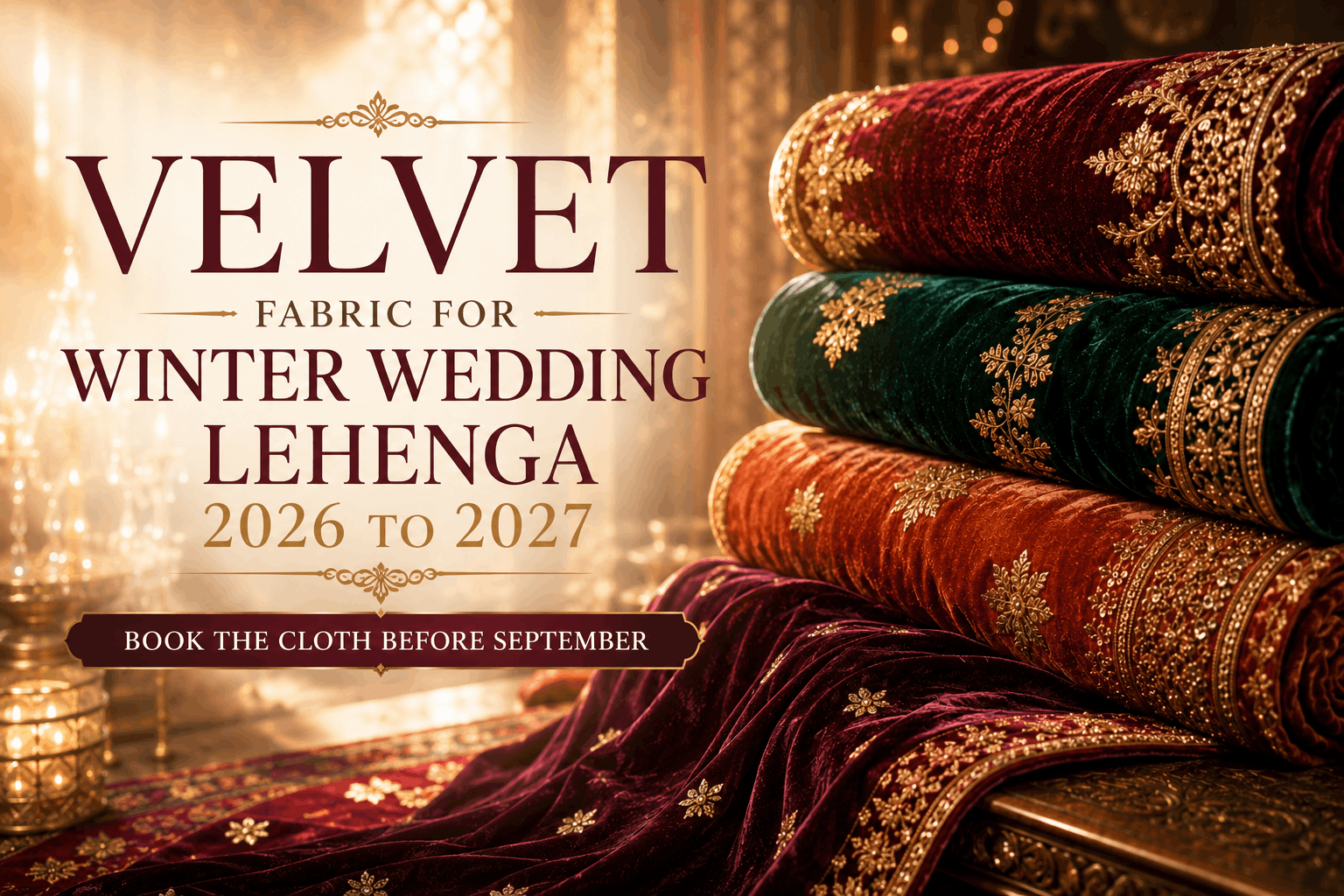
Velvet Fabric for Winter Wedding Lehenga 2026 to 2027: Book the Cloth Before September
Velvet Fabric for Winter Wedding Lehenga 2026 to 2027: Book the Cloth Before September
Velvet fabric for lehenga is a dense pile cloth used as the base for winter bridal and reception lehengas. In 2026 the three main grades are micro velvet at Rs 320 per metre, pure cotton velvet at Rs 850, and imported French velvet at Rs 1,800 to Rs 4,200 per metre.
Every June and July my Lajpat Nagar counter sees the same conversation play out, year after year, no exceptions. A bride walks in. Sometimes the mother first to scout the situation, sometimes both together. December wedding date already booked at some Greater Noida farmhouse, or a destination Udaipur palace setup if the budget allows. Phone comes out. Velvet lehenga screenshot. Usually a Sabyasachi runway shot, sometimes Manish Malhotra, occasionally a recent Aditi Rao Hydari red carpet pull. Then the question. Bhaiya, ye wala chahiye, same to same.
I can get them the same cloth. Hundred percent guarantee. But not in October. Not in November. By then the good imported velvet is genuinely gone, the karigars in Lal Kuan and Daryaganj are booked solid through January, and the bride is paying rush rates that double the cost without doubling the quality. Last October a Vasant Vihar bride paid Rs 78,000 for a French velvet cut that would have cost Rs 38,000 if she had booked in August. She did not believe me until I showed her the August invoice from a different client. Mood at the counter that afternoon, not great honestly.
This is the blog I write every single year and customers still walk in too late. By now it is a tradition almost. If you have a winter 2026 to 2027 wedding on the books, the velvet ordering window is genuinely July through September. After September the supply chain tightens, prices climb, karigar options shrink. So let me write down what I tell every bride and boutique owner who books velvet before the peak season hits this counter. Grades. GSM. Real prices. What works for which function. How to spot the cheap synthetic copies being sold as French velvet across half the markets between Karol Bagh and Chandni Chowk.

The best velvet fabric for a winter wedding lehenga in 2026 is pure cotton velvet for the bridal ghera because the dense pile holds heavy dabka and zari without sagging. Micro velvet works for sangeet and reception sets at a lower budget. French velvet is the imported choice for designer commissions. Book fabric by September for November to February weddings.
What velvet fabric actually is
Velvet is a warp pile cloth. Short loops of yarn cut on the surface to create that dense soft light-reflecting pile we all recognise as velvet from across a wedding hall. Base cloth underneath can be cotton, silk, viscose or polyester. This is exactly why the velvet price spread runs 10x to 15x across the market for what looks like the same fabric in a Pinterest screenshot. Pile density plus base yarn together decide whether you are holding bridal-grade cloth or budget-grade dressed up to look bridal.
Three things swing quality on a velvet bolt, all of them checkable in two minutes at the counter if the seller actually lets you check. Pile density measured per square inch is the first thing to look at. Higher density means more cloth weight in your hand and better photographic shine under stage lighting at the wedding. Then the base yarn matters significantly because cotton and silk completely beat polyester for drape behaviour, no contest there, polyester just sits stiff on the body like a flag. And finally pile height changes the entire visual: shorter pile holds detailed zardozi and dabka embroidery much better, while taller pile reads more dramatic from across a banquet hall but cannot carry fine work without losing the texture detail.
You can see the full velvet fabric collection where every bolt is tagged with base yarn, GSM and country of origin upfront. No mystery on this shelf.
The three velvet fabric grades I stock for winter weddings
Micro velvet, the synthetic blend
Polyester base. Short dense pile. GSM around 220 to 280. The most affordable grade by a wide margin, sold heavily online under maybe twenty different brand names that all mean the same cloth honestly. Per metre cost runs Rs 280 to Rs 450. This is the velvet that powers the entire budget winter wedding market across Tier 2 and Tier 3 cities. Kanpur, Lucknow, Indore, Patna, even Bhopal these days. All of them moving on micro velvet for ninety percent of bridal commissions under Rs 60,000.
Now what works and what does not. Micro velvet handles printed embroidery and digital prints very well, no complaints there. The cloth itself does not breathe though, which is fine for a December Delhi indoor wedding but a real problem for a December Goa or Kerala destination wedding where the bride is going to sweat through the lehenga before the pheras are even done. Best suited for sangeet outfits and reception lehengas where she changes mid-function anyway, or for budget bridal commissions sitting under Rs 60,000 total cost.
Pure cotton velvet, the workhorse
Cotton base, medium pile, much better behaviour overall. GSM around 300 to 380. Per metre cost runs Rs 750 to Rs 1,200. This is the workhorse bridal velvet for the mid-range commissions sitting between Rs 80,000 and Rs 1,80,000. The cotton base actually breathes properly. The pile holds zari work without crushing under the weight. The cloth photographs much richer under warm halogen lighting that wedding photographers prefer for indoor ceremonies.
For winter ceremony lehengas, especially outdoor mandap setups, this is genuinely the right pick. Cloth weighs around 1.2 kilos for a six-metre ghera before any embroidery work touches it. Sounds light written down. Add two kilos of hand embroidery on top and the bride is carrying nearly three and a half kilos through a four-hour function. Plan accordingly.
Imported French and Italian velvet, the designer-tier choice
Silk-viscose blend base, long dense pile, dye depth that genuinely does not exist in Indian-made velvets at any price point. GSM around 350 to 450. Per metre cost runs Rs 1,800 to Rs 4,200 depending on country of origin and pile density. French velvet from Lyon and Italian velvet from Milan are the two most sought-after origins at this counter, with French slightly outselling Italian for bridal commissions. Designer commissions sitting over Rs 2 lakh almost always use this grade, no shortcuts allowed.
This is the velvet that holds those deep wine, oxblood and bottle green tones that immediately distinguish a designer lehenga from a market lehenga across a wedding hall. The pile catches light differently from synthetic copies, in a way even non-textile guests can spot from ten feet away without knowing why exactly. Cannot fake the difference.
For boutique owners stocking designer-tier cloth, the bridal fabric collection includes imported velvet bolts in the limited bridal palettes that move fastest each season.
How much velvet fabric you actually need for a lehenga
Most brides underestimate the requirement. Designers add extra metres for waste protection because they have been burned before. Honest number sits somewhere in between, and for exact panel-by-panel calculation with pile-direction allowances factored in, the fabric estimator tool handles it cleanly without the maths.
|
Component |
Velvet fabric requirement |
|
Bridal ghera (6 kali heavy flare) |
5.5 to 6 metres |
|
Bridal ghera (8 kali fuller flare) |
7 to 8 metres |
|
Choli blouse |
0.8 to 1 metre |
|
Velvet jacket layering piece |
2.5 metres |
|
Border patti for dupatta edges |
1.5 metres |
|
Reception velvet gown |
4.5 to 5 metres |
If your tailor is asking for more than 8 metres for a standard 6 kali ghera, ask why specifically. Sometimes the answer is genuine, matching pile direction across panels eats real extra cloth, no question. Sometimes the extra two metres just go home with the tailor for his cousin's wedding. Both happen at this market, in roughly equal measure I am being honest.
How to spot fake French velvet
This is where the market gets actively ugly. There is a serious amount of mid-grade synthetic velvet being sold under the French velvet label across Karol Bagh, half of Chandni Chowk, ninety percent of online stores. Three quick checks help you avoid getting taken at the counter.
Run your hand against the pile first. Real French velvet shows a dramatic colour depth shift from one direction to the other, almost like two completely different shades of the same colour are sitting on the same bolt. Synthetic copies show a much milder shift because the pile density is lower and the dye does not penetrate the cloth the way silk-viscose blend pile does. Easiest test possible, takes ten seconds, no equipment needed.
Then the weight check. A metre of imported French velvet weighs around 380 to 450 grams genuinely, you feel it the moment you pick up the bolt. A metre of mid-grade synthetic being sold as French velvet weighs around 240 to 290 grams. Meaningful difference. Ask the seller to weigh a single metre on a kitchen scale before you commit to anything. If he refuses to weigh it, that is your answer right there bhaiya saaf-saaf bata do.
Last check, same burn test we use for silk fabrics. Real silk-viscose velvet leaves behind a soft grey ash with a paper-like smell when burned. Polyester or nylon synthetic leaves a hard black bead with a sharp chemical smell that fills the whole shop room. Chemistry does not lie even when sellers do.
For verified imported stock, the imported fabric collection tags country of origin and base yarn percentage on every single bolt before it goes on the shelf at this counter.
How velvet choice changes the lehenga price
Two velvet lehengas with identical embroidery can cost completely different amounts purely because of the base cloth underneath. Embroidery design does not change anything. The cloth changes everything.
A micro velvet bridal lehenga with medium zari work typically lands somewhere between Rs 35,000 and Rs 80,000 in fabric plus labour cost together. Now take the exact same embroidery design, do it on pure cotton velvet instead, suddenly you are looking at Rs 75,000 to Rs 1,60,000 because the base cloth costs three times as much per metre alone. Now move the same embroidery to imported French velvet from Lyon, the total jumps to Rs 1,80,000 to Rs 4,50,000 because the imported cloth alone costs Rs 25,000 to Rs 50,000 for the six metres needed for a single ghera. Three completely different price universes. Same embroidery design floating across all three. That is the lesson nobody at the counter explains until billing time.
For velvet fabric by the metre we keep all three grades on the shelf with per-metre pricing visible upfront. Boutique buyers can compare side by side before placing any bulk orders. No billing surprises later.
Why book velvet by September for winter 2026 to 2027 weddings
Few real supply chain reasons that nobody at the counter explains until October when it is already genuinely too late.
Imported French and Italian velvet ships from European mills with 45 to 60 day lead times consistently, sometimes longer if there is a port strike anywhere along the route. Bookings made after September almost always miss the November dispatch window from Lyon and Milan, which means the cloth lands at Indian ports in mid-December, clears customs by end-December, reaches the karigar workshop somewhere around Christmas week. Lehenga delivery then slips into late January at the earliest. Wedding in early January? Forget it entirely.
Karigari workshops in Delhi and Mumbai book embroidery slots six to eight weeks in advance regardless of how senior the client is. A bridal lehenga with heavy hand embroidery genuinely needs the cloth physically in the workshop by early October to finish the work by December. Late bookings push everything into compressed timelines, which usually means either quality drops noticeably or labour rates literally double overnight as the workshop charges premium-rate surcharge for rush work. And honestly you cannot really blame the karigar for the rates because he is staying up until 3am every single night to finish your lehenga in time for the wedding date. Man has to eat.
Indian mill cycle is the third thing. Pure cotton velvet from Indian mills is stocked seasonally, very strictly. Most mills run velvet production June through September for winter wedding fulfillment specifically, no other window. After September the dyeable bases sell out first within two weeks, then the pre-dyed colour stock follows by mid-October, then by November only odd colours and damaged bolts are sitting on the floor. We covered the broader bridal cloth situation in our piece on the most popular bridal lehenga fabrics in India right now which gets into the seasonal sourcing rhythm across categories beyond just velvet.
For winter pre-bookings specifically, the bulk order page allows boutique buyers to lock pricing tiers from June onwards before the September surge hits the market hard.
Velvet care and stitching tips for bridal commissions
Velvet care is where tailors and brides cause most of the lehenga damage honestly. The fabric is forgiving until you break the rules, after which it is unforgiving completely with no recovery path.
Pile direction first, this is the big one. Stitch velvet with the pile running in the same direction across every single panel of the ghera, no exceptions ever permitted. Mismatched pile direction reads as patches of different colour shade under wedding photography lights, ruining the photos no matter how good the embroidery work was. I have seen brides actually cry over this specific mistake at the lehenga trial appointment. Tailor swore he checked. He absolutely did not check. Cost the family Rs 40,000 in re-stitching that time and the photos still came out uneven.
Sewing machine setup is the second issue. Use a roller foot or a walking foot for velvet always, this is non-negotiable for proper bridal work. A standard presser foot crushes the pile flat completely and leaves shiny tracks running along every seam line, which then catch light wrong in photographs from any angle. If the machine does not have a roller foot setting available, lift the standard foot manually and reposition every four to five inches as you stitch. Slow tedious work but worth it for a six-figure lehenga.
Ironing third. Never iron velvet directly under any circumstances, please. Steam from the underside using a press cloth on top of the velvet, very gently. Iron-on direct contact flattens the pile permanently and there is no recovery from that mistake ever, which means the lehenga loses its dimensional finish before the wedding day even arrives. Storage between functions, hang the velvet lehenga on a padded broad hanger always, never fold for storage even temporarily. Folding compresses the pile along the fold line, and the compression usually does not bounce back for weeks even with professional steaming. We covered the styling and care logic for silk-base bridal pieces in our guide on how to style silk fabrics for different occasions which carries over for velvet handling in most respects.
FAQ Section
Which velvet fabric is best for a bridal lehenga in 2026?
For the main ceremony lehenga, pure cotton velvet is the strongest mid-range pick because the pile holds zari work without sagging through a six-hour wedding function. Designer-tier commissions sitting above Rs 2 lakh, the answer shifts to imported French velvet from Lyon for the dye depth and the photographic shine you cannot replicate in Indian cloth. Micro velvet works well for sangeet and reception functions at a friendlier budget point.
How much does velvet fabric cost per metre in 2026?
Per metre price varies sharply by grade. Micro velvet sits at Rs 280 to Rs 450 per metre at most counters. Pure cotton velvet runs Rs 750 to Rs 1,200. Imported French and Italian velvet runs Rs 1,800 to Rs 4,200 per metre depending on pile density and country of origin paperwork.
How many metres of velvet do I need for a bridal lehenga?
Plan for 5.5 to 6 metres of velvet for a standard 6 kali bridal ghera. An 8 kali fuller flare ghera needs 7 to 8 metres. Add 1 metre for the choli blouse and another 1.5 metres if a matching velvet border patti is needed for the dupatta edges, which most bridal sets these days require.
When should I book velvet fabric for a winter wedding?
For a November to February wedding, book the velvet by September at the very latest. Imported velvet carries 45 to 60 day shipping lead times from European mills, sometimes longer with port delays. Karigari workshops book embroidery slots six to eight weeks ahead. Late bookings push lehenga delivery into late January consistently with rush surcharges layered on top.
Is micro velvet good for bridal lehenga?
Acceptable for sangeet, reception and budget bridal commissions, yes it is fine cloth for those. Avoid micro velvet for the main ceremony lehenga though, because the synthetic base does not breathe properly through a long function and the pile crushes under heavy embroidery much faster than cotton or silk-viscose velvet does. Crushed pile means uneven photo finish at the wedding.
How can I tell real French velvet from a copy?
Three checks at the counter, none of them needing equipment. Pile direction colour shift is dramatic on real French velvet, much milder on synthetic copies. Weight per metre sits at 380 to 450 grams for real versus 240 to 290 grams for the copies. Burn test on a thread pulled from the selvedge shows soft grey ash with paper-like smell for real silk-viscose, hard black bead with chemical smell for synthetic.
The honest takeaway from the shop counter
Velvet is the one fabric where the seasonal calendar matters more than the year you are buying in. June through September is the booking window, full stop, no negotiation. After September you either pay rush rates that can sit 40 to 80 percent above standard pricing, or you settle for second-choice cloth in third-choice colours. This applies equally to brides commissioning directly with a designer, designers buying for their clients, and boutiques stocking ready-to-stitch lehenga kits for resale through the festive and wedding season.
Buying for a winter wedding generally? Walk in by August at the very latest. Buying for a December wedding specifically? Walk in by mid-July honestly. Velvet rewards forward planning very generously, and it punishes last-minute decisions also very generously. I have watched both ends play out at this counter for twelve years now and the pattern does not change year over year, no matter how many blogs I write.
For boutique owners stocking winter inventory, our velvet fabric collection carries micro, pure cotton and imported French velvet with bulk pricing tiers starting from June onwards. Boutique resellers can request the wholesale tier pricing through the bulk order page with full documentation provided before dispatch every single time, no exceptions.
Your Next Step...
Walk through the live velvet fabric collection sorted by micro, cotton and imported grades clearly. Pair with matching zari brocade for blouse coordination, or dyeable embroidery bases for custom dye orders in boutique-specific palettes. WhatsApp anytime for swatch dispatch before the September lock-in deadline arrives at the counter. Honest grading on every single bolt walking out of here. Twelve years of winter wedding velvet expertise behind every recommendation. One counter. One promise. No rush-rate surprises waiting in November.