Embroidered Net Fabric in 2026: A Boutique Owner's Honest Sourcing Guide
Embroidered Net Fabric in 2026: A Boutique Owner's Honest Sourcing Guide
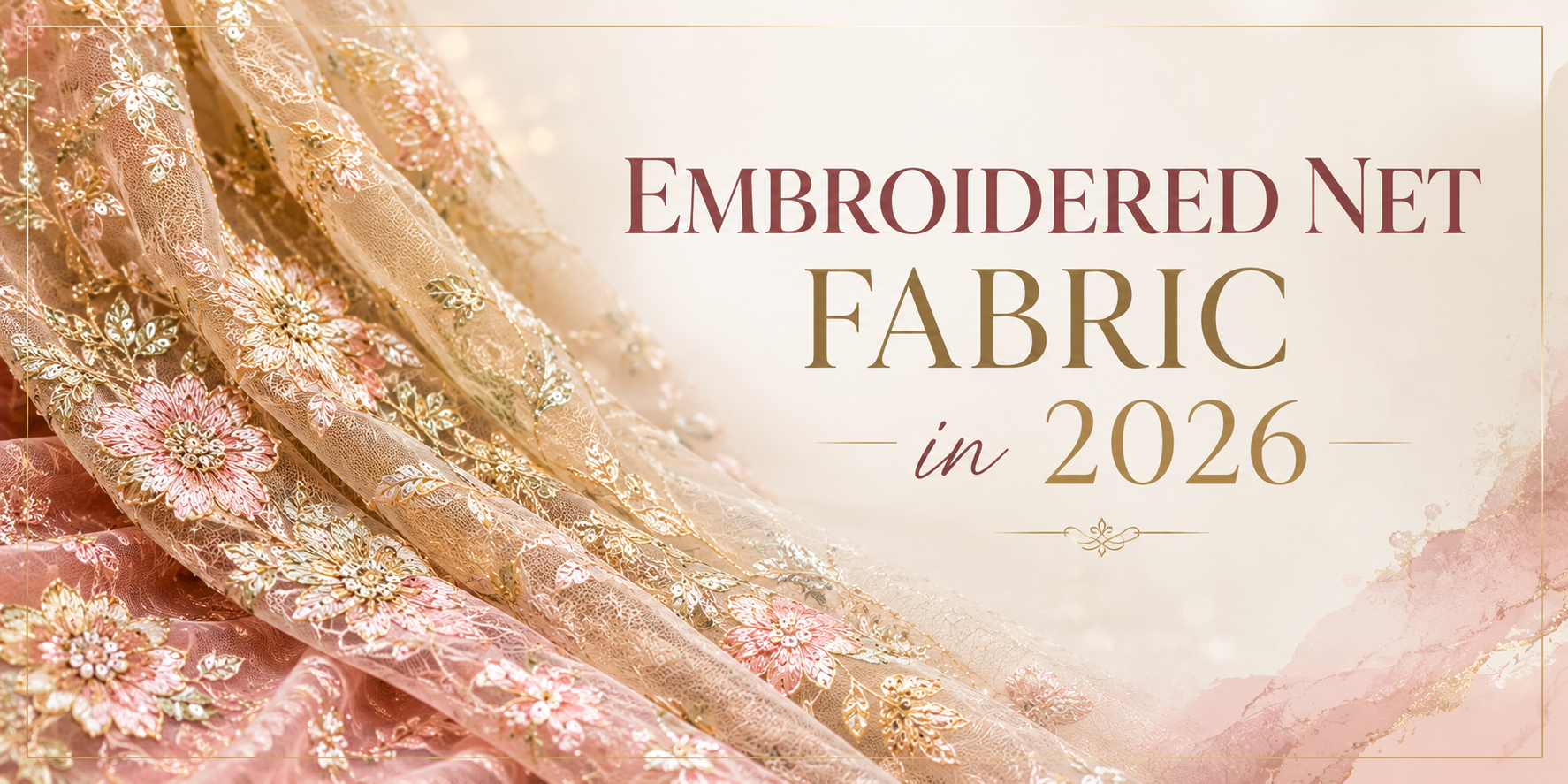
Embroidered net fabric is a sheer mesh base cloth with surface embellishment in zari, sequins, dabka, or thread. Used widely for lehengas, dupattas, suit fabric, and capes, it is light enough for summer wear yet rich enough for bridal use. Pricing in 2026 runs ₹280 to ₹1,800 per metre.
Last Friday afternoon a designer from Pune walked into the shop. She unrolled a swatch she had bought online for ₹850 per metre. The embroidery was uneven. The net base had a slight pull at the join of two panels. She wanted to know if I would take it back. I do not run the shop she bought it from. So I sat her down, gave her chai, and explained what she should have checked before paying.
That conversation became this blog. Embroidered net is the most over-promised, under-delivered fabric in the Indian market. The visuals look stunning on phone screens. The hands tell a different story. Here is what I tell my regular boutique clients before they place a sourcing order.

For 2026, the most-requested embroidered net fabrics are floral zari net for lehengas, sequin net for sangeet outfits, and thread embroidered net for dupattas. Machine embroidered net costs ₹280-₹650 per metre. Hand embroidered net runs ₹950-₹1,800 per metre. Buy embroidered net for daytime weddings where you need a heavy look at low weight.
What embroidered net fabric actually is
Net is a knitted or warp-knitted sheer mesh. The yarn is usually polyester or nylon. Embroidery is applied on top using one of three methods. Schiffli machine embroidery, computerised single-head machine embroidery, or hand karigari work. The price difference between these three is huge. The visual difference is large too, especially in close up photographs.
A buyer who cannot tell schiffli from single-head from hand work will overpay or under-quote regularly. A buyer who can tell the difference picks the right grade for the right end use and protects their margin.
You can compare grades side by side on the embroidered net collection page where each style is tagged by embroidery method.
The three embroidery methods on net, plain English
1. Schiffli embroidery
Big multi-head industrial machine. Continuous design across long rolls. The work is uniform, the stitches are even, the price is the most reasonable. Schiffli net runs ₹280 to ₹520 per metre depending on thread density and zari content. This is the workhorse for budget bridal lehengas, suit fabric pieces, and boutique resellers.
The look is rich enough for most occasions. The hand is slightly stiff because of the dense backing thread used during stitching. Tailors need to be careful at the seam joins because schiffli edges fray.
2. Computerised single-head embroidery
Single computerised head, slower production, designs that look custom because each piece is run individually. Pricing ranges ₹550 to ₹950 per metre. The designs are more intricate than schiffli. The thread tension is tighter. This is where you stock for upper mid range bridal lehengas and designer suit pieces.
The fabric is more flexible than schiffli because the embroidery is not as dense across the whole net. Drapes better, breathes slightly more.
3. Hand karigari work
Aari, dabka, zardozi, sequin, mirror work, applied by hand by karigars. Slow. Expensive. ₹950 to ₹1,800 per metre and easily higher for couture grade. This is what high end designers use for bridal lehengas and statement dupattas. The work is uneven in a way that is desirable because it shows the human hand.
If a vendor sells you hand embroidered net under ₹900 per metre, somebody is cutting corners. The math does not add up otherwise.
How to tell schiffli from single head from hand work
This is the test boutique owners need before paying.
Flip the fabric. Look at the back. Schiffli shows long parallel runs of backing thread crossing the panel. Single head computerised embroidery shows isolated thread paths matching the front design exactly. Hand work shows knotted ends, irregular thread tension, and small starts and stops where the karigar changed needles or threads.
Check the design repeat. Lay out one full metre flat. Schiffli repeats the design every 12 to 18 inches exactly. Single head computerised has slight variation between repeats because each runs separately. Hand work has visible irregularity that no machine can replicate.
Inspect the edge. Schiffli often has a continuous selvedge embroidery border. Single head has a clean cut edge with no border. Hand work has hand-finished edge stitches, sometimes uneven.
What is selling in summer 2026
Three patterns I am tracking from June bookings.
Floral net for lehengas is the leader. Pastel base in mint, oyster, peach, and sage with floral zari work in tonal or contrast. Brides are pairing this with a heavier silk dupatta for weight balance. Wholesale pricing for floral schiffli net runs ₹350 to ₹520 per metre. For floral single-head computerised it goes to ₹650 to ₹880.
Sequin scattered net for sangeet is a strong seller. Net base in champagne, dusty pink, or oyster with hand-applied sequin work in random scatter. Looks party-ready without the weight of full coverage. Pricing ₹480 to ₹780 per metre.
Embroidered net suit fabric is rising for festive season pre-bookings. Three piece sets sold as 2.5 metres top, 2.5 metres bottom, and 2.5 metres dupatta, all matching embroidery. Wholesale per set ₹1,400 to ₹2,800. Boutiques are pre-booking now for Karwa Chauth and Diwali.
For ready-to-style trousseau, layer embroidered net with dyeable embroidery for matching dupattas or capes.
Real pricing across grades for summer 2026
Live counter quotes for my regular boutique clients this June.
|
Fabric grade |
Width |
Wholesale per metre |
Retail per metre |
|
Plain net, dyeable |
58 inch |
₹95-₹160 |
₹180-₹260 |
|
Schiffli floral net, light work |
58 inch |
₹280-₹380 |
₹420-₹580 |
|
Schiffli floral net, dense work |
58 inch |
₹420-₹520 |
₹620-₹820 |
|
Schiffli net with zari border |
58 inch |
₹450-₹650 |
₹680-₹980 |
|
Single head computerised net |
44 inch |
₹650-₹880 |
₹950-₹1,400 |
|
Sequin scattered net |
58 inch |
₹480-₹780 |
₹720-₹1,150 |
|
Hand karigari net |
44 inch |
₹950-₹1,800 |
₹1,400-₹2,800 |
Bulk orders above 50 metres get 8 to 12 percent off. Custom embroidery design from existing motifs available with 100 metre MOQ. See the bulk order page for production lead times.
How much embroidered net fabric to order
The numbers depend on the end product. Here is the practical metreage I quote to my regular clients.
|
End product |
Fabric requirement |
|
Lehenga ghera (full flare) |
5 to 6 metres |
|
Lehenga dupatta (single layer) |
2.5 metres |
|
Suit top with embroidered yoke |
1.5 metres |
|
Suit dupatta |
2.5 metres |
|
Sharara pants |
2.5 to 3 metres |
|
Anarkali dress (full length) |
4 metres |
|
Cape jacket (mid length) |
2.5 metres |
Add 0.5 metres buffer for matching prints across cut panels. Embroidered net does not always match seam to seam because the design repeat may not align with your pattern.
Stitching embroidered net the right way
Tailors have a love hate relationship with this fabric. Three rules that prevent disasters.
Underline every cut piece with a layer of soft net or fine cotton before stitching. This stops the embroidery thread from catching on the needle. Cut around the embroidery motifs at the hem so the design ends with a natural finish, not chopped at a thread.
Use a fine size 70 needle. Lower the presser foot pressure on the machine. Use a Teflon or roller foot if the embroidery is dense because the standard metal foot can drag and damage the work.
For hems on lehenga ghera, baste the embroidered net to a stiff can-can underlayer first. The net stays flat and the embroidery sits properly. For suit hems, use a horsehair canvas tape for structure without weight.
FAQ Section
What is embroidered net fabric used for? Embroidered net fabric is used for lehengas, dupattas, suit fabric pieces, capes, anarkali dresses, and sangeet outfits. It is preferred for occasions where the bride needs a rich look at low weight, especially in summer outdoor weddings.
What is the price of embroidered net fabric per metre in 2026? Schiffli machine embroidered net runs ₹280 to ₹520 per metre wholesale. Single head computerised net runs ₹650 to ₹880 per metre. Hand karigari embroidered net runs ₹950 to ₹1,800 per metre. Retail prices are roughly 50 percent higher.
How do I tell hand embroidery from machine embroidery on net? Flip the fabric. Machine schiffli shows long parallel backing threads. Single head computerised shows isolated thread paths matching the front. Hand work shows knotted ends and irregular tension. Hand work also has slight visible irregularity across design repeats that no machine reproduces.
How much embroidered net fabric is needed for a lehenga? A standard embroidered net lehenga ghera needs 5 to 6 metres for the skirt, plus 6 to 8 metres of can-can underlayer, 1 metre for the choli, and 2.5 metres for the dupatta. Plan a 0.5 metre buffer for matching the design across panel cuts.
Is embroidered net good for summer weddings? Yes. Embroidered net is one of the best picks for daytime summer weddings because the net base stays light and breathes, while the embroidery gives the bridal richness on camera. Pair with a satin or crepe underskirt for opacity.
Can embroidered net be dyed at home? Embroidered net cannot be dyed at home because the embroidery thread may bleed and the polyester net needs disperse dyes with high heat. Buy pre-dyed or order custom dyeable plain net first and embroider after dyeing.
The honest shop counter takeaway
Embroidered net is a category where the price gap between similar looking fabrics is enormous. The difference between a ₹350 metre and an ₹1,500 metre comes down to embroidery method and karigar grade, not the visual at first glance. Boutiques who cannot tell the difference get burned regularly.
If you are new to sourcing, start with schiffli floral net in three pastels. Mint, oyster, peach will cover summer wedding orders. Add a sequin scattered net in champagne for sangeet. Add a single piece of single-head computerised net for your couture client. That is five SKUs.
For made to measure ordering our fabric estimator calculates per piece needs. Send a swatch reference for embroidery matching or custom motif requests.
CTA
Browse the live embroidered net fabric collection sorted by embroidery method and price band. Pair with bridal bliss and zari for matching trousseau pieces. WhatsApp for swatches before placing bulk orders. Twelve years of net sourcing, honest grading, transparent counter.