Pakistani Suit Fabric Trends in 2026: A Shop Counter Sourcing Guide for Indian Boutiques
Pakistani Suit Fabric Trends in 2026: A Shop Counter Sourcing Guide for Indian Boutiques
Pakistani suit fabric refers to unstitched 3-piece or 4-piece sets of suit material inspired by Pakistani lawn, chiffon, and karandi cloth. Each set includes top fabric, bottom fabric, and dupatta. Lawn is the summer favourite, chiffon for evening wear, karandi and khaddar for winter, in 2026 sourcing.
Every June since 2018, same questions arrive on my phone. WhatsApp messages from Chandigarh, Lucknow, Jaipur boutiques start coming around the second week. "Bhai Pakistani lawn collection aa gaya? Photos bhej do. Kya chal raha hai?" Lawn arrived? Send pictures. What is trending.
The answers change every year. Pakistani brands rotate fast, the Indian market follows with a slight lag. Last year was chikankari-inspired pastels. Year before was bold colour blocking. This year the trend shifted again. Most boutiques are still buying based on 2025 reels.
So here is what I am stocking right now in June 2026. What boutiques are actually buying. No Insta hype. Pour your chai.
The most popular Pakistani suit fabrics in 2026 are pastel lawn for daytime summer wear, chiffon embroidered sets for evening occasions, karandi for winter, and silk masuri for festive wear. Indian boutiques stock 3-piece unstitched sets between ₹650 and ₹3,400 per set. Lawn sets are the bestseller in summer at around ₹950 to ₹1,800.

What Pakistani suit fabric actually is
For boutique owners new to the category. Pakistani suit fabric is unstitched cloth sold as 3-piece or 4-piece sets. Top for kameez, bottom for salwar or pant, plus dupatta. Sometimes a fourth piece for inner lining or contrast border.
The cloth varies wildly. Lawn, chiffon, karandi, masuri, jacquard, organza. The defining feature is honestly not the base cloth. It is the print style plus embroidery treatment. That is what makes a "Pakistani suit" Pakistani.
The category borrows from Pakistani mill traditions. Gul Ahmed, Khaadi, Sapphire, Maria B, Sana Safinaz. Indian sellers either buy original mill stock, replicate licensed designs locally, or stock locally produced Pakistani-style cloth.
Browse the imported fabric range for original mill stock grouped by cloth type.
The five fabric families I stock heavy
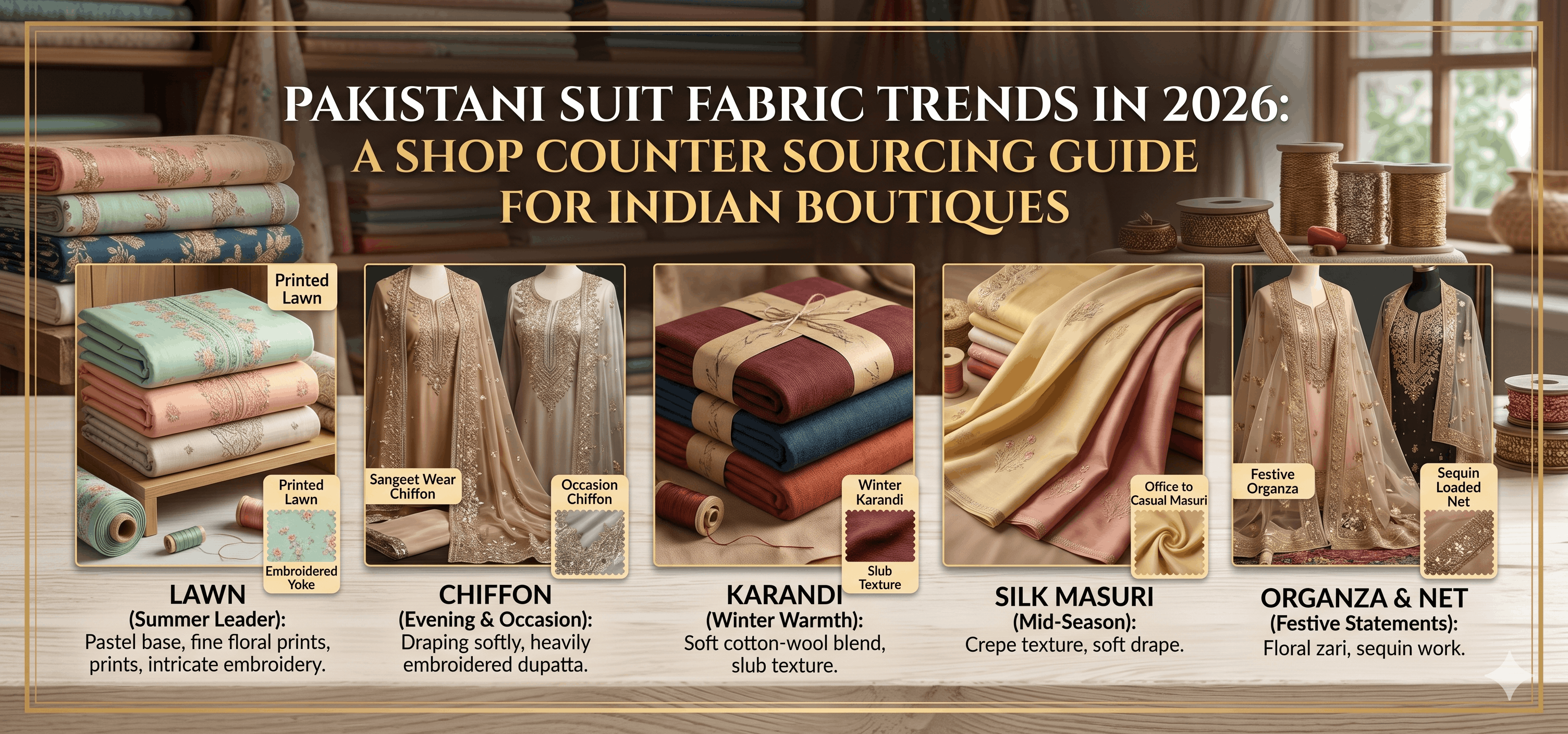
1. Lawn
Summer leader, no debate. Lightweight cotton, 60 to 100 GSM, soft hand, breathable. Comes printed, embroidered, or both. Pakistani lawn is famous for fine print quality and saturated colour. Wholesale per 3-piece runs Rs 650 to Rs 1,400 depending on embroidery density. Honestly 60% of my turnover from March through September.
2026 trends? Pastel base with floral embroidery moving fastest. Then traditional block print with contrast embroidery yoke. Then minimalist solid with sequin border. Most boutiques prefer pastel because it photographs better for Instagram.
2. Chiffon
For evening and occasion wear. Lightweight, slightly sheer, drapes softly. Chiffon sets cost Rs 1,200 to Rs 2,800 per 3-piece. The dupatta is usually the showpiece with heavy embroidery, top and bottom stay simpler.
2026 trend is heavy embroidered dupatta with plain or printed silk top. Sangeet, mehndi, family functions. Punjab and Haryana boutiques especially are pre-booking heavily for wedding season starting around Karwa Chauth.
3. Karandi and khaddar
Winter cloths. Karandi is a soft cotton-wool blend with slight slub texture. Khaddar is heavier handloom-style cotton. Move from October through February. Pricing Rs 950 to Rs 2,200 per 3-piece.
Sourcing for autumn-winter boutique stock? Book karandi from August. Good mills sell out fast. By October the leftover stock is second-grade lots. Learn from boutiques stuck with unsold winter stock last year.
4. Silk masuri
Lightweight silk weave with slight crepe texture. Mid-season cloth for spring and early summer. Rs 1,400 to Rs 3,400 per 3-piece. Drapes softly without weight. Pakistani brands push it heavily for office wear plus casual occasions.
5. Embroidered organza and net
Statement pieces for sangeet and high-end occasions. Pakistani brands have moved seriously into organza embroidery in the last three years. Sheer organza dupatta with floral zari or sequin work. Matching organza top. Contrast inner for the bottom. Rs 2,200 to Rs 4,500 per 3-piece. Pair with organza fabric for matching cape or contrast yoke.
The 2026 trends I am tracking
Three patterns dominating June bookings.
Pastel floral lawn is the bestseller of bestsellers. Mint with peach floral. Oyster with sage. Butter yellow with rust thread work. Read fresh on Instagram, sell out fast at boutiques targeting under-30 buyers. Not stocked? Money on the table.
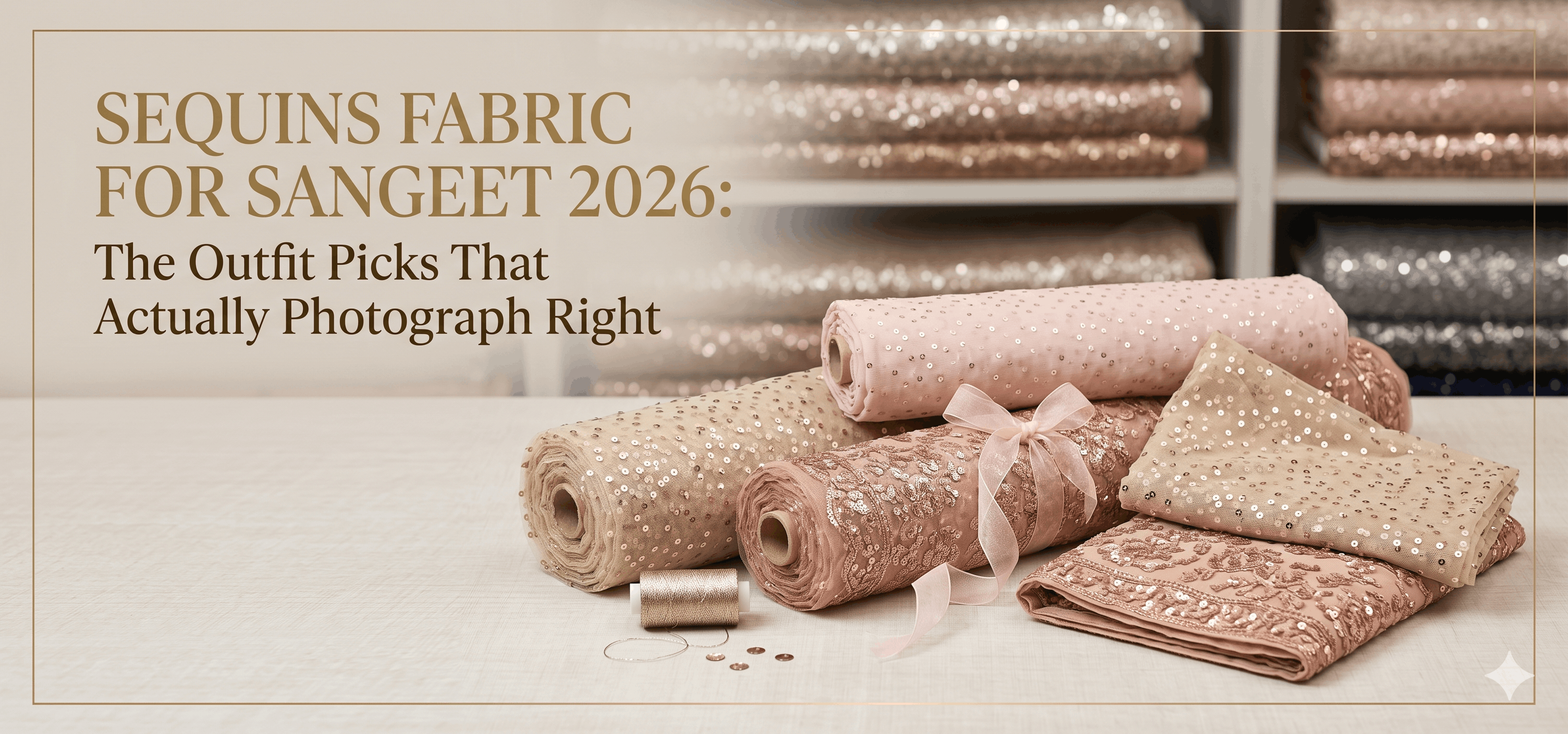
Sequin-loaded chiffon for sangeet is strongest by margin. Plain chiffon top, heavily worked sequin dupatta in champagne or rose gold. Boutiques are pre-booking now for festive season starting Karwa Chauth through Diwali. Pair with sequins fabric for matching cape or contrast piping.
Bold colour blocking is back. Maroon top with mustard dupatta. Indigo top with terracotta dupatta. Brands moved away from pastel-only into bold contrast pairs. Stock at least three SKUs for the statement client tired of mint green.
Real pricing for summer 2026
Live counter rates I am quoting regular boutique clients this June. Per 3-piece unstitched set unless noted.
|
Cloth type |
Style |
Wholesale per set |
Retail per set |
|
Lawn, printed plain |
Daywear |
Rs 650 to Rs 950 |
Rs 980 to Rs 1,400 |
|
Lawn, embroidered yoke |
Daywear |
Rs 1,150 to Rs 1,800 |
Rs 1,650 to Rs 2,500 |
|
Lawn, heavily embroidered |
Occasion |
Rs 1,800 to Rs 2,800 |
Rs 2,500 to Rs 3,800 |
|
Chiffon, plain top + worked dupatta |
Evening |
Rs 1,200 to Rs 1,900 |
Rs 1,750 to Rs 2,650 |
|
Chiffon, heavy embroidered |
Sangeet |
Rs 2,200 to Rs 3,400 |
Rs 3,200 to Rs 4,800 |
|
Karandi or khaddar |
Winter |
Rs 950 to Rs 2,200 |
Rs 1,400 to Rs 3,100 |
|
Silk masuri |
Spring-summer |
Rs 1,400 to Rs 3,400 |
Rs 2,100 to Rs 4,800 |
|
Organza, embroidered |
Festive |
Rs 2,200 to Rs 4,500 |
Rs 3,200 to Rs 6,500 |
Bulk orders above 25 sets typically come with 7 to 10 percent off. Custom colour requests on lawn sets available with 50-set MOQ per shade plus 14 working day turnaround. See the bulk order page for sample procurement, shipping, GST handling.
How to spot real Pakistani brand stock from replicas
This question comes up almost daily. Boutiques want original brand stock because they can charge the price premium. Counterfeits flood the market every season. Last March three different vendors offered me "original Gul Ahmed" at Rs 800 a set when actual wholesale was Rs 1,650. Obviously replicas. Three quick tells.
Selvedge mark. Original Pakistani brand lawn has a printed selvedge with brand name running every two metres. Look carefully. Replicas skip the selvedge or print a generic floral edge.
Hangtag and packing. Original sets ship with a printed hangtag plus labelled inner packaging. Dupatta folded with butter paper between layers. Replicas come in plain polythene with no tag or a photocopied label anyone could print.
Print depth. This one is the giveaway. Flip the cloth over. Colour should show clean and saturated on the reverse. Replicas print mostly on one side, the reverse is faded. Hold it up to light, you will see immediately.
If a vendor offers original brand at half the regular price, it is a replica. The economics do not work otherwise.
How much fabric you need
Standard 3-piece set sizing.
|
Component |
Standard cloth |
Buffer |
|
Top piece (kameez) |
2.5 metres |
0.3 metres |
|
Bottom piece (salwar or pant) |
2 metres |
0.2 metres |
|
Dupatta |
2.5 metres |
None typical |
For an anarkali kameez add another 1 metre to the top. For a flared sharara bottom add another 1 metre to the bottom. Pair extra fabric with dyeable embroidery for matching contrast jacket or cape.
Stitching without disaster
Three things tailors keep missing. Every boutique calls me back about these at some point.
Pre-wash lawn before stitching. Always. Pakistani lawn shrinks slightly in the first wash, around 2 to 3 percent. Boutiques who skip prewash get angry customer calls after first laundry. Customer wants refund, boutique is stuck.
Use French seams or flat-felled seams on lawn for clean finish. Overlock seams show through the sheer cloth and look cheap in close-up Instagram photos.
For embroidered yokes on lawn or chiffon, underline the yoke piece with soft cotton before stitching. Embroidery thread on Pakistani lawn yokes is sometimes longer than the cloth allows. The underlay stabilises the seams, prevents puckering.
FAQ Section
What is the best Pakistani suit fabric for Indian summer? Pakistani lawn. Lightweight cotton breathes well in heat above 35 degrees. Embroidered lawn yokes give daywear richness without losing comfort. Pastel base with floral or thread work is the 2026 trend.
What is the price of Pakistani suit fabric in India in 2026? Unstitched 3-piece lawn sets Rs 650 to Rs 2,800 wholesale. Chiffon Rs 1,200 to Rs 3,400. Karandi or silk masuri Rs 950 to Rs 3,400. Heavily embroidered organza sets go to Rs 4,500 per set.
How many metres are in a Pakistani 3-piece suit set? Standard 3-piece set has 2.5 metres of top, 2 metres of bottom, plus 2.5 metres of dupatta. Anarkali adds a metre to the top. Sharara adds a metre to the bottom.
How do I tell original Pakistani brand fabric from a replica? Check the selvedge for brand name printing every two metres. Look for printed hangtags with labelled inner packaging. Inspect print depth on the reverse. Replicas print mostly on one side with faded reverse.
Is Pakistani chiffon fabric good for sangeet wear? Yes. Heavily embroidered Pakistani chiffon sets are the leading pick for sangeet in 2026. Dupatta is the statement piece. Top stays light for dancing.
Can Pakistani lawn be dyed at home? Yes for plain lawn. Pakistani lawn is cotton based, accepts reactive cold dye well. Pre-wash to remove finishing chemicals. Embroidered lawn cannot be home-dyed because thread may bleed.
Honest sourcing takeaway from the counter
Stocking Pakistani fabric first time? Start with five lawn sets in pastel embroidered yokes. Add two chiffon sets for evening clients. Stock one heavily embroidered organza as high-margin showpiece. Eight SKUs total. Your starter kit for summer 2026. Test response for six weeks before scaling.
One warning. Avoid stocking too much heavily embroidered occasion wear in summer. Volume is in daywear lawn. Save chiffon and organza for autumn-winter wedding season starting October. I have seen boutique owners blow their entire June budget on sangeet pieces. Then watch them sit on the shelf until November. Painful.
For made-to-measure quantity calculations our fabric estimator gives per piece needs by style. Send swatch references for colour matching.
Your Next Step...
Browse the live imported Pakistani fabric range sorted by cloth type and price band. Pair with organza for sheer dupatta replacements or zari fabric for sangeet capes. WhatsApp us before bulk orders, we courier swatches across India. Twelve years of Pakistani fabric sourcing. We are not the cheapest in Lajpat Nagar but the price tag is the price you pay.