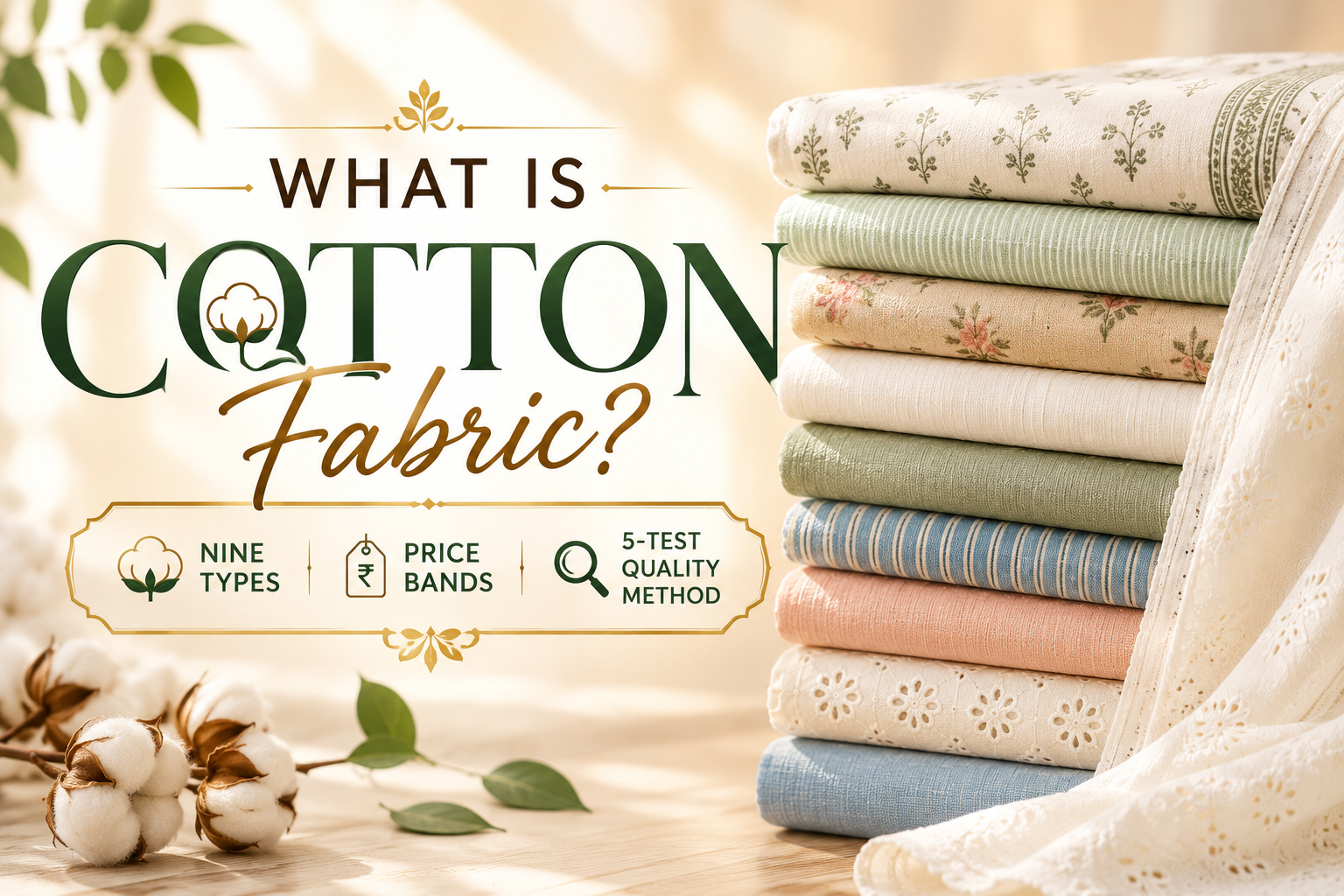
What Is Cotton Fabric? Nine Types, Price Bands and the 5-Test Quality Method
What Is Cotton Fabric? Nine Types, Price Bands and the 5-Test Quality Method
Cotton fabric is a natural plant-fibre cloth woven from the soft fluffy boll of the cotton plant. It is breathable, absorbent, hypoallergenic, soft on skin and the most popular daily-wear fabric in India. Common Indian cotton types include mul, cambric, chanderi, voile, khadi, poplin, slub, satin cotton and chikankari cotton.
Cotton sells more metres than any other fabric on our floor. Any other. Summer, winter, monsoon, festive. Daily kurtas going home in plastic bags. Wedding chooda outfits for the haldi function. Boutique resale stock heading out to Tier-2 cities like Jabalpur and Hubli. Cotton runs through all of it.
But "cotton" is one word for at least fifteen different things. Maybe more if you count regional weaves.
Twelve years now on this counter. The most common mistake I see is people paying mul price for poplin. Or chanderi price for plain cotton. Because nobody told them what to look for. Nobody bothered. So today let me write the cotton explainer the way I'd explain it to my own daughter buying her first set.
What cotton actually is. The varieties that matter in Indian retail. How to spot the real thing. How much you should actually pay. Read all the way through. This one's worth your time.
Cotton fabric is woven or knitted from the fibre of the cotton plant. The fibre is a natural cellulose-based material harvested from the seed pod. Indian cotton varieties include mul (lightweight), cambric (medium plain weave), chanderi (silk-cotton blend), voile (sheer summer), khadi (handspun handwoven), poplin (tight plain weave), slub (textured) and chikankari (Lucknow embroidered). GSM ranges 60 to 220 in the standard apparel category. Indian wholesale prices in 2026 run ₹80 to ₹550 per metre.
What Cotton Fabric Actually Is
Cotton fabric is cloth made from cotton fibre. The fibre comes from the seed pod of the cotton plant. (Yes, the white fluffy ball you've seen in old NCERT science textbooks, that's where it starts.) It's a cellulose-based natural fibre. Once harvested, the fibre is cleaned. Then spun into yarn. Then woven or knitted into cloth.
What makes cotton the everyday fabric of India is its behaviour. It breathes. Absorbs sweat. Does not trap heat. Gentle on skin even in 45-degree Delhi summers (we've all suffered through Delhi May, you know what I mean). Accepts dye well. Softens with every wash, doesn't get worse.
The catch though? Variation. Cotton can be pure or blended. Carded or combed. Handspun or mill-spun. Plain woven or twill or satin or jacquard. Each combination behaves differently. Wears differently. Costs differently too. That is why "cotton" by itself tells you almost nothing.
The Nine Cotton Types You'll See in Indian Retail
These all pass through our floor in real volume. Every single one.
Mul Cotton. The lightest of the lot. Almost sheer when you hold it up. Very soft to touch. GSM somewhere in the sixty to ninety range. Best for summer kurtas, light dupattas, baby clothes (genuinely the only fabric I trust for newborns). Pricing starts around hundred-twenty per metre, climbs to maybe three-fifty for the better mills. Cool to wear in May humidity when nothing else feels bearable.
Cambric Cotton. The workhorse. Plain weave. Smooth surface. Medium weight. GSM hundred to hundred-thirty. Daily kurta-pyjama sets. School uniforms. Kids wear that needs to survive twenty washes a month. Around hundred to two-fifty per metre. The boutique workhorse my Bhopal client orders by the eighty-metre bundle every September.
Voile Cotton. Lightweight. Sheer. Soft drape that flows when you walk. GSM seventy to ninety-five. Summer dupattas. Layered kurtas. Light sarees for daytime functions. Roughly hundred-fifty to three-fifty per metre.
Poplin Cotton. This one's different. Tightly woven plain weave with a slight crosswise rib you can see when you look closely. GSM hundred-twenty to one-sixty. Shirts. Kurtas that need actual structure. Kids party dresses that need to hold a shape. Hundred-forty to three hundred per metre.
Khadi Cotton. Handspun. Handwoven. The yarn is uneven on purpose. That irregularity gives khadi its character (and its slightly higher price). GSM hundred-ten to one-eighty. Daily wear with personality. Festive informal kurtas. Sustainable boutique lines that want to tell a story. Around one-eighty to five-fifty per metre. Sometimes higher for documented village weaves.
Slub Cotton. Similar idea to khadi but mill-made. Cotton with deliberately uneven yarn thickness creating texture across the fabric surface. GSM hundred-thirty to one-eighty. Kurtis. Fusion wear. Anything that needs that handloom feel without the handloom budget. One-sixty to three-eighty per metre.
Chanderi Cotton. Now this one. Silk-cotton blend from Madhya Pradesh. Sheer body. Woven booti or zari border running through. GSM sixty to ninety-five. Festive day events. Daytime weddings. Summer formal occasions where you want to look festive without melting. Four hundred to twelve hundred per metre depending on the booti density. Pairs beautifully with our dyeable embroidered fabrics for custom palette work.
Chikankari Cotton. White or pastel cotton with traditional Lucknow hand embroidery. GSM ninety to one-thirty. Daily summer kurtas. Festive informal wear. Eid and Diwali daytime functions. Five hundred to eighteen hundred per metre depending entirely on density of the kaam. A Lucknow karigar I source from charges by stitch count, not by metre. That's where the price band swings.
Cotton Satin. Cotton woven in a satin weave. Smooth shiny surface on one side. Matte on the other. GSM hundred-thirty to one-seventy. Structured kurtas. Lehenga linings. Choli backing. Two hundred to four-fifty per metre.
For volume sourcing across all nine varieties in one shipment, our bulk order desk covers every category. Custom-dyed cotton with matching embroidery? Browse the dyeable range.
Where Cotton Fits Best in Indian Wardrobes
Daily summer wear. Mul. Cambric. Voile. Three of these on rotation get you through May to August comfortably.
Daily winter layering. Poplin and khadi. Heavier, traps a little warmth.
Office formal. Poplin shirts. Cotton satin kurtas. Chanderi formal kurta sets for client meetings or anything where you want to look put-together.
Festive day events. Chanderi cotton sarees. Chikankari kurta sets. Slub cotton anarkalis. All three photograph beautifully under natural light.
Wedding peripheral wear. Haldi looks. Mehendi looks. Ladies sangeet brunch. Sangeet-day kurtas for relatives who aren't the bride or groom.
Boutique daily-wear line. Cambric, poplin, slub, chikankari. Four fabrics. Build a forty-SKU collection from these alone.
Resale Instagram catalogues. This is interesting. Chanderi and chikankari sell three times faster than plain cotton on Instagram. Three times. The pattern shows up across every reseller I talk to. Dupatta visibility matters too. Always shoot it flat.
How to Judge Cotton Quality. The 5-Test Method
The routine I run before signing off on any roll arriving at our godown. Memorise these. They take ninety seconds total.
First, burn one yarn. Pull a single thread from the cut edge. Light it. Pure cotton burns slowly. Smells like burnt paper. Leaves grey ash you can crumble between fingers. Polyester blend melts to a small hard bead. Smells like plastic. Done in five seconds. The cheapest, fastest test of the lot.
Then, water. Drop one droplet on the fabric surface. Pure cotton absorbs it within three seconds and leaves a dark patch you can see. Polyester blend beads the water. Pushes it off like wax on a leaf. If your fabric beads the water, the seller has lied about the cotton percentage.
Now squeeze. Crush a corner hard for eight seconds. Open your fist. Pure cotton creases sharply (frustrating to iron, brilliant to wear). Blended cotton creases less. Hundred percent polyester does not crease at all. The harder the crease, the higher the cotton content. Counterintuitive maybe, but true.
The light test. Hold the fabric against a torch or window. Real cotton shows yarn irregularity. Tiny slubs along the threads. Slight thickness variation if you look really closely. Polyester blend shows mechanically uniform yarn. Too perfect. Machines never make those tiny mistakes silkworms and cotton plants do.
The GSM check. Lift the fabric off the counter. Heft it in your palm. A daily kurta cotton should feel substantial at hundred-ten GSM or above. If it feels paper-light at the same price as the heavier roll next to it, GSM is below ninety. Durability will be short. Three washes and the fabric will go limp permanently.
Four out of five passes, you're paying fair for pure cotton. Three or fewer? You're paying cotton price for blend. Walk out or negotiate hard.
Common Cotton Buying Mistakes
Three mistakes I correct every single week across this counter.
"All cotton is the same." No. Just no. Mul at seventy GSM behaves nothing like poplin at one-fifty GSM. Same fibre family. Completely different fabric experience. Match the variety to the occasion you're buying for.
"Pure cotton always wrinkles." Haan, it wrinkles. But quality cotton creases sharply and releases over a few hours. Cheap cotton creases and stays permanently crumpled forever. The recovery speed tells you everything about quality. Watch the recovery, not the crease itself.
"Cotton blends are bad." Not true. A sixty-forty cotton-polyester blend reduces wrinkling and shrinkage significantly. Good for daily uniforms. Good for kids wear that needs to survive school playgrounds. Just don't pay pure cotton price for blended cloth. That's the actual problem, not the blend itself.
FAQ
What is the difference between cotton and pure cotton?
Achha, here's the trick. "Cotton" on a label can include blends. Polyester. Viscose. Anything mixed in. "Pure cotton" or "100% cotton" means no synthetic fibre. Always check the label. Or skip the label and run the burn test. The burn test never lies.
Which cotton fabric is best for summer?
Three names worth remembering. Mul. Voile. Chanderi cotton. All sit under hundred GSM. All breathe properly. All absorb sweat instead of trapping it against your skin. Skip cotton satin and poplin for May-July daily wear.
How much does cotton fabric cost per metre in India in 2026?
Depends on the type. Let me list:
Cambric runs hundred to two-fifty.
Poplin sits around one-forty to three hundred.
Mul about hundred-twenty to three-fifty.
Chanderi cotton jumps to four hundred at the entry, twelve hundred at the top.
Khadi one-eighty to five-fifty (documented khadi pushes higher).
Chikankari five hundred to eighteen hundred depending on stitch density.
Slub one-sixty to three-eighty.
Voile hundred-fifty to three-fifty.
Cotton satin two hundred to four-fifty.
Does cotton shrink after the first wash?
Yes. Pure cotton shrinks five to ten percent on the first wash. Sometimes more if the mill skipped pre-shrinking entirely. Always pre-wash cotton fabric before stitching. Or buy ten percent extra metres to compensate. Smart tailors do this automatically. Lazy ones don't, then blame the fabric.
Is khadi different from cotton?
Khadi is a type of cotton. Just a specific kind. Handspun and handwoven cotton, specifically. So all khadi is cotton. Not all cotton is khadi. Most cotton you'll see in any Delhi market is mill-spun, not handspun. Real khadi carries the Khadi Village Industries certification mark somewhere on the bolt.
Can cotton fabric be machine-washed?
Yes. Cold or warm cycle. Gentle setting only. Use mild detergent (no bleach on coloured cotton, never bleach). Iron the fabric while it's still slightly damp for the smoothest finish. Don't tumble dry on high heat. That destroys cotton over time. Air dry whenever possible.
How much cotton fabric do I need for one kurta?
Two to two-and-a-half metres for a standard knee-length kurta. Add half a metre if you want bell sleeves or a longer A-line. Add one metre if you're cutting a churidar bottom from the same fabric. Total of three-and-a-half to four metres for a full suit set including dupatta.
Browse the full edit: Walk through our cotton-blend boutique fabric collection for mul, cambric, voile, poplin, khadi, chanderi and chikankari yardage. Volume sourcing for your boutique line? The bulk order desk handles twelve-piece minimums across all nine cotton categories.