What Is Jacquard Fabric? Six Types, Price Bands and the 5-Test Quality Method
What Is Jacquard Fabric? Six Types, Price Bands and the 5-Test Quality Method
A buyer walked into our counter last Tuesday. She held up a roll she'd brought from somewhere else. Karol Bagh probably. I could tell from the selvedge stamping, those green dots they use over there. "Bhaiya, is this jacquard or brocade or banarasi?" she asked me. Honest question. Most people use those three words like they mean the same thing.
They don't.
Twelve years now across this cutting table. Twelve. Sometimes thirteen if you count my apprentice months in Surat back in 2013. And the confusion never settles. Some weeks I correct the same misunderstanding six times before lunch. Six. Before lunch.
So today let me just clear it. Properly this time. What jacquard actually is. Where it comes from. The varieties I sell every season. How to spot a good piece. How to spot a piece somebody is trying to sell you for triple what it's worth.
You're buying suit fabric for a winter capsule? Read this. Banarasi for a wedding saree? Read this. Jacquard yardage for boutique kurtas? Especially read this. Till the end. This one's worth it.
What Jacquard Actually Is
Here's the part everybody gets wrong on day one. Jacquard is not a fibre. It is a weaving method. Big difference.
The loom was invented by a Frenchman called Joseph Marie Jacquard. Eighteen-oh-four. He designed a punch-card system that could control each warp thread on its own. Each one. Independently. That changed everything in textile manufacturing for the next two centuries. Suddenly you could weave complex motifs into the cloth itself. Large repeats. Floating-thread designs that no plain or twill loom could ever produce.
What does this mean for you, holding a roll at a counter in Lajpat Nagar or Khan Market or wherever? The design is woven into the fabric. Front and back. Flip a real jacquard piece. The same motif shows on the reverse with the colours inverted. Just inverted. That reverse-side check is the easiest way to know you're holding actual jacquard versus a print or an embroidery sewn on top.
The fibre though? Can be anything. Cotton. Silk. Polyester. Viscose. Wool. Most Indian jacquard rolls run on cotton, silk, polyester, or blends across the three.
The Six Jacquard Types Across Indian Retail
These rolls pass through our boutique fabric edit every season. Different price bands. Different uses. Same loom technology underneath.
Cotton Jacquard. Hundred percent cotton or a cotton-poly blend with a woven motif. Matte finish. Soft hand. GSM somewhere in the one-forty to two-twenty range. The everyday workhorse for daily kurtas, structured anarkalis, summer suit sets that need to actually breathe. Pricing? Starts around two-twenty per metre, climbs to maybe five-fifty if the motif is denser. A boutique in Pune orders sixty metres of pastel cotton jacquard from us every February for her spring collection. Sells every piece by April end. Without fail.
Silk Jacquard. This is where the festive money goes. Pure silk or silk-blend warp with jacquard motif woven through. Soft sheen. Heavier drape than cotton (obviously). GSM one-eighty to two-sixty depending on weave count. Used for festive sarees, anarkalis, lehenga cholis where you want texture without the cost of separate embroidery. Pricing runs anywhere from six-fifty per metre at the entry to nearly three thousand at the top.
Polyester Jacquard. Most affordable category in the whole lineup. Synthetic top to bottom. Easy maintenance. You can throw it into a washing machine. Try that with silk, see what happens. GSM one-fifty to two-twenty. Budget festive wear. Decor pieces. Boutique sample lines where you're testing a design before going to actual silk yardage. Around one-fifty to four-fifty per metre.
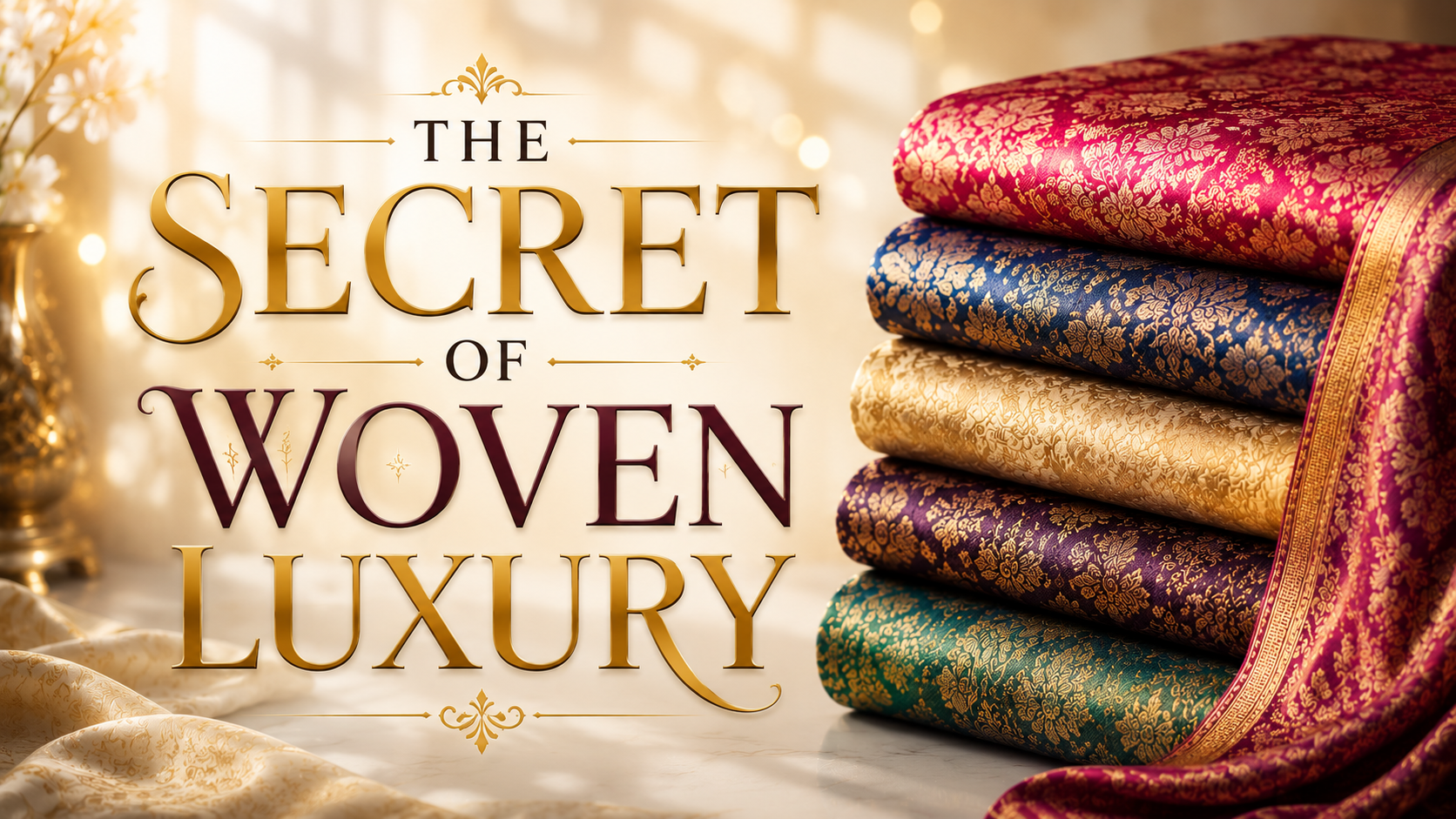
Banarasi Jacquard. Now this one. The pride of Varanasi. Silk or silk-mix warp loaded with zari motifs in floral, paisley, kalga, jangla designs. The motifs follow centuries-old patterns the karigars in Banaras pass down through families. Some patterns go back four hundred years. Maybe more. GSM two hundred to two-eighty. For bridal sarees. Lehenga skirts. Heirloom dupattas your daughter will wear at her own wedding. Pricing? Roughly eight hundred to three thousand per metre. The swing depends entirely on whether the zari is imitation or pure. Pure zari banarasi sometimes crosses five thousand at retail. Sometimes six. Browse matching silks in our silk fabric collection.
Brocade Jacquard. Heavier than regular jacquard, considerably so. Has floats of zari or contrast yarn raised on the surface forming the motifs. Reversible technically. But it has a clear "right" side you can spot in two seconds. GSM two-forty to three-twenty. Sherwanis. Lehenga borders. Formal jackets that need to hold structure through long evenings of dancing and standing. Pricing five hundred to roughly twenty-two hundred per metre.
Stretch Jacquard. A newer entrant. Came into the Delhi market properly around 2020. Lycra or spandex blend woven with the jacquard motif. Used for fusion wear, structured cholis that need to fit precisely, festive trousers some brides ask for these days. Three-fifty to eight hundred per metre give or take.
Jacquard vs Brocade vs Banarasi. The Confusion Settled
This is the part everybody gets wrong. Even some sellers genuinely don't know the difference.
Jacquard is the umbrella term. Any fabric woven on a jacquard loom. Cotton. Silk. Polyester. Anything that comes off that punch-card-controlled loom is jacquard. The end.
Brocade is jacquard with extra weft floats. Usually metallic yarn floating on the surface to form raised motifs you can almost feel with your fingertip. So all brocade is jacquard. Not all jacquard is brocade. Got it? Read it again if not.
Banarasi is a regional style of brocade. Woven in Varanasi. Specific motifs. Specific zari traditions handed down generations. So all banarasi is brocade. All banarasi is jacquard. Not the other way around.
Remember this triangle. You'll never get tricked on a price tag again. Salesman tells you "this is banarasi jacquard" at four hundred per metre? Walk out. That price doesn't exist for real banarasi. Doesn't exist.
Where Jacquard Fits in Indian Outfits
Daily kurta sets. Cotton jacquard or polyester jacquard. The motif gives texture without screaming colour. Works for office. Works for casual evenings out.
Bridal sarees. Banarasi jacquard with documented pure zari content. Heirloom investment piece. A Bhopal customer of mine bought one in 2019 for her own wedding. Her younger sister wore it in 2024. Same saree. Two brides. Five years apart. Looked equally fresh both times. The mother-in-law cried both times too.
Lehenga skirts. Silk jacquard for the skirt panel. Plain silk or organza for the choli. Don't double-jacquard a lehenga. The texture fights with itself. Looks busy on camera.
Sherwanis. Brocade jacquard for the body. Plain silk for the inner kurta. The contrast between heavy outer and smooth inner is what makes the silhouette work properly.
Festive dupattas. Banarasi jacquard or stretch jacquard with light embroidery added later. Stretch jacquard makes a brilliant dupatta for buyers who hate stiff drapes wrapping around their shoulders.
Boutique anarkali line. Cotton jacquard in soft pastels for spring. Silk jacquard in jewel tones for winter. Two collections built from one fabric category.
Sourcing across categories in one shipment? Our bulk order desk bundles cotton jacquard, silk jacquard and banarasi jacquard together with verified zari content noted on every invoice.
How to Judge Jacquard Quality. The 5-Test Method
This is the routine I run before signing off on any roll arriving at our godown. Memorise these. They'll save you money in week one.
Reverse test first, always first. Flip the fabric. Look at the back. If the motif appears on the reverse with colours inverted, you're holding real woven jacquard. If the reverse is blank, or has loose floating threads only, it's a print. Or it's embroidery sewn on top. Not jacquard. Doesn't matter what the seller calls it. Doesn't matter what the label says.
Then, the burn one. Pull a single thread from the cut edge. Light it. Cotton smells like burnt paper. Silk smells like burnt hair (yes, that smell when you've accidentally singed your own hair near a diya, exactly that). Polyester melts to a hard bead. Plastic smell. Match the fibre to the price you're being quoted. Two thousand per metre for something burning like polyester? You know what to do. Walk.
Now, weight. Lift the roll. Feel it in both hands. Cotton jacquard under one-thirty GSM will stitch limp. Just limp. The kurta will lose shape after one wash. Silk jacquard under one-seventy GSM won't hold the anarkali structure you're buying it for. Light roll equals thin yarn equals short wear life. Doesn't matter how good the motif looks under shop lighting.
The motif edge test. Get close to the fabric. Phone torch if needed. Good jacquard has sharp, clean motif boundaries you can almost trace with your eye. Poor jacquard has loose floats. Visible thread tails sticking out. Sometimes whole picked sections where the weave skipped entirely during production. The boundary tells you everything about loom tension and karigar attention.
The pull test. Last one. Tug a warp thread gently. Tight weave doesn't loosen. The thread refuses to come out easily. Cheap weave starts opening at the motif edge after one soft tug. Try this on the very corner of the roll. Not the middle. Please not the middle.
Four out of five passes, you're getting what you paid for. Three or fewer fails, walk out. Or negotiate the price down by half. Your call entirely.
FAQ
What is the difference between jacquard and brocade?
Think of it as Russian dolls. Jacquard is the outer doll. Brocade is the smaller doll inside. Brocade is a specific type of jacquard. The one with extra weft floats forming raised motifs. Usually in zari or metallic yarn that catches light. All brocade is jacquard. Not all jacquard is brocade. Simple rule. Remember it next time.
Is jacquard fabric the same as banarasi?
No. Not at all. Banarasi is a regional style of brocade jacquard woven specifically in Varanasi with traditional motifs passed through generations. So banarasi is always jacquard. But most jacquard you'll see in any Delhi market is not banarasi. Different cities, different weaves, different traditions.
How do you know if a fabric is jacquard?
Flip it. That's it. Look at the back. If the woven motif appears on the reverse with colours inverted (red front, dark patch back, or gold front, brown back) it's jacquard. If the reverse is plain or smooth or shows white thread, it's a print sewn or pressed on top. The flip test takes two seconds. Faster than reading the label. Way faster.
Can jacquard fabric be washed at home?
Depends on the fibre underneath. Cotton and polyester jacquard, yes. Gentle cold cycle. No spin. Use a mesh laundry bag if you have one. Silk jacquard and banarasi jacquard, absolutely not. Dry clean only. Never compromise on this. One hot wash will destroy a two-thousand-rupee silk jacquard saree in one cycle. Seen it happen. More than once.
What is the price of jacquard fabric in 2026?
Depends entirely on the type. Polyester jacquard sits at the bottom around one-fifty per metre. Cotton jacquard slightly higher, two-twenty upward. Silk jacquard jumps to six-fifty minimum and climbs to twenty-eight hundred at the top end. Banarasi jacquard runs eight hundred to three thousand (pure zari pushes it higher still). Brocade jacquard five hundred to twenty-two hundred. Stretch jacquard three-fifty to eight hundred.
Is jacquard fabric good for summer?
Yes and no. Depends which one. Light cotton jacquard around one-forty GSM works fine for summer kurtas. Breathes well enough through Delhi May heat. Silk jacquard and brocade are heavier. Way heavier. Better for winter and festive occasions where you actually want the warmth and the drape working in your favour.
Does jacquard fabric shrink?
Some do. Cotton jacquard shrinks three to five percent on first wash. Pre-wash before stitching if you can. Polyester jacquard doesn't shrink at all (one of its few real advantages). Silk jacquard shrinks four to seven percent and should always be pre-washed by the tailor before cutting. Always.
Browse the full edit: Walk through our boutique fabric collection for cotton, silk, polyester and banarasi jacquard running yardage. Volume sourcing for a boutique line? The bulk order desk handles twelve-piece minimums with zari content verified on every invoice.