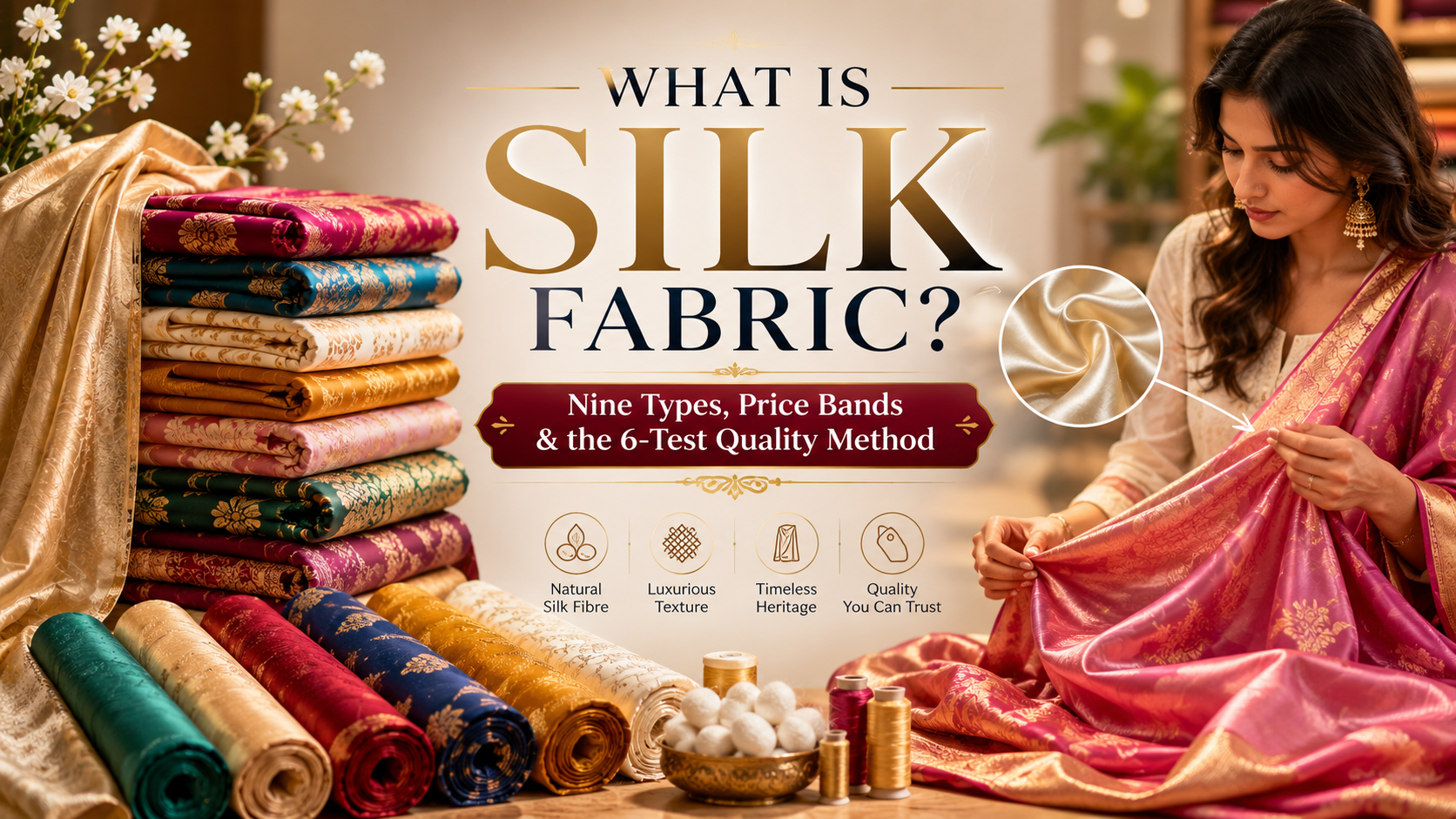
What Is Silk Fabric? Nine Types, Price Bands and the 6-Test Quality Method
What Is Silk Fabric? Nine Types, Price Bands and the 6-Test Quality Method
Silk fabric is a natural protein fibre woven from filaments produced by silkworms, primarily the mulberry silk moth. Real silk is breathable, lustrous, hypoallergenic and stronger than steel by weight. In India, silk is graded by source, like mulberry, tussar, eri, muga and by weave, like banarasi, kanjeevaram, paithani.
Silk is the one fabric where the noise is loud. Truth is quieter. Much quieter.
Everybody claims silk. I mean everybody. Walk into any saree shop in Chandni Chowk on a Saturday afternoon. Half the rolls labelled "pure silk" are art silk. Sometimes polyester satin with a good finish. The seller knows. Sometimes he doesn't even know. Either way the customer pays for protein fibre and walks home with petroleum.
So when somebody asks me what is silk, I don't give the textbook answer. I give the shop-floor version. The one I learned the hard way in 2014. Or maybe 2015. I bought a "Banarasi katan" lot from a vendor in Surat. Sixty-two pieces. Looked like silk. Felt like silk. Burned like a candle. Full refund took four months and one trip to Athgaon. Never again.
This guide. Read it once. Save it somewhere. The next time a salesman swears his roll is 100 percent silk, you'll have the tools to call his bluff.
Silk is a natural protein fibre from silkworm cocoons. Pure silk burns to ash, smells like burnt hair, has irregular yarn thickness and shows a deep diagonal sheen when tilted in light. India produces 4 commercial silks. Mulberry, tussar, eri and muga. Average GSM ranges from 35 to 120 depending on the weave. Trade prices in 2026 run ₹400 per metre for blended silk and up to ₹15,000 per metre for handloom banarasi katan.
What Silk Fabric Actually Is
Silk is a protein fibre. That's it. The silkworm secretes liquid silk through its mouth. The filament hardens into a cocoon. We unwind that cocoon (one cocoon can give you 600 to 900 metres of usable thread, by the way) into long thread. Twist several together. You get yarn. Weave the yarn. You get cloth. That cloth is silk. Nothing else qualifies. Not viscose. Not modal. Not "art silk" no matter how shiny it looks.
The protein structure is why silk does what it does. Breathable in summer. Warm in winter. Hypoallergenic for sensitive skin (my niece can't wear synthetic kurtas, gets rashes within hours, silk she handles fine). Absorbs dye deeper than any other natural fibre. Catches light at angles cotton or linen never will.
The catch? Price. One silk saree can need cocoons from over 3,000 silkworms. Think about that for a second. Three thousand. That is why pure handloom silk costs what it costs. That is also why fakes flood the market every single wedding season.
The Nine Silk Types Every Indian Buyer Should Know
I see all nine across our silk fabric collection. Each one solves a different problem.
Mulberry Silk. This is the standard. Smooth. Even yarn. Forms the base for most banarasi, kanjeevaram, paithani sarees. ₹600 to ₹3,500 per metre depending on weave count. Silkworms eat only mulberry leaves. That diet matters because it gives you longer continuous filaments.
Tussar Silk. Wild silk. Coarse to the touch. Natural golden colour without any dye. The boutique-wala in Indore I mentioned, he orders 80 metres of this every March for his Holi collection. Sells out by April every year. Price band ₹450 to ₹1,800.
Eri Silk. The "peace silk." Cocoon doesn't get boiled with the moth still inside. Texture comes out matte. Woolly almost. Soft. Excellent for winter shawls or dupattas. ₹700 to ₹2,500 per metre.
Muga Silk. Now this one. Assam exclusive. Sualkuchi specifically. Natural golden sheen that gets brighter with each wash. Yes, brighter not duller, I'll say it again because nobody believes it the first time. Costliest Indian silk by a margin. ₹2,500 to ₹6,000 per metre for handloom muga. Reserved for heirloom pieces. My saas has a muga mekhela from 1989. Looks newer today than it did in our wedding photos.
Banarasi Silk. Heavy zari brocade weave from Varanasi. Mulberry base loaded with gold or silver thread motifs. Wedding category. Pure zari versus imitation zari makes the price swing wildly. ₹1,200 at the low end. ₹15,000 plus at the top. We keep them separate so customers don't get confused.
Kanjeevaram. South Indian heavyweight from Kanchipuram. Thick yarn. Contrasting border. Temple motifs woven straight into the body of the cloth. Not printed. Woven. Big difference. Lasts generations. I'm not exaggerating. ₹2,000 to ₹12,000 per metre.
Chanderi Silk. Lightweight silk-cotton blend from Madhya Pradesh. Sheer body. Woven booti scattered through. Festive day wear. Karva Chauth lunch. Diwali brunch. That kind of occasion. ₹550 to ₹2,200 per metre.
Raw Silk. Slubbed texture. Matte finish. Structured drape that sits well on the body. Anarkalis love raw silk. Structured kurtas too. ₹400 to ₹1,500. Honestly the easiest entry point if you've never bought silk before. Start here.
Art Silk (Artificial Silk). Made from viscose. Or polyester. Not protein fibre. Cheaper. Easier to maintain at home. ₹120 to ₹400 per metre. Look, art silk sold honestly is fine. I sell it myself. Art silk sold as silk is fraud. There's the line.
How to Judge Silk Quality. The 6-Test Method
Memorise these six. Saves money. Saves heartbreak. Saves you from buying my 2014 lot all over again.
The burn test. Pull one yarn from the cut edge. Light a match. Hold the flame to the yarn for two seconds. Pure silk burns slowly. Leaves behind crushable black ash you can rub between your fingers. Smells like burnt hair (yes, like the smell when you accidentally singe your own hair near a diya). Polyester or viscose? Different story. It melts. Forms a hard bead at the tip. Smells like burnt plastic. The whole test takes 5 seconds. Five.
The sheen test. Tilt the fabric under a single light source. A tube light works, phone torch works, sunlight works. Real silk shows two colours depending on the angle. We call it diagonal sheen. Watch the fabric closely as you tilt it. The colour shifts. Art silk just flashes. One flat shine. No shift. No depth.
The crush test. Squeeze a corner hard. Ten seconds. Open your fist. Real silk creases sharply. The crease then releases slowly over a minute or so. Polyester bounces back instantly. Like nothing happened. No memory of being crushed. That instant recovery is the giveaway.
The hand-feel test. Rub the fabric between your palms for 8 seconds. Real silk warms up. Feels almost dry to the touch by the end. Polyester stays cool. Always cool. No matter how long you rub.
The yarn-thickness test. This one needs a phone torch and good eyes. Look closely at the weave. Real silk yarn has tiny irregularities along its length. Slubs. Variation. The thread is alive. Art silk yarn is mechanically uniform. Too perfect. Machines don't make mistakes. Silkworms do. That's how you tell.
The water test. Drop one droplet of water on a corner. Just one. Real silk absorbs it slowly. A small dark patch forms. Fades in 20 seconds or so. Coated synthetic? The droplet beads up. Sits there like rain on a raincoat. Wipes off completely.
Five out of six passes, you have real silk. Three or more fails, it's a blend or full art silk. Negotiate the price down. Or walk away. Both are valid moves. I do both myself.
Where Each Silk Fits Best
Bridal saree. Banarasi katan. Kanjeevaram. Or muga if budget allows. No substitutes here, this is not the place to compromise.
Reception lehenga. Raw silk choli with an organza skirt overlay. Lighter on the body. Photographs better under harsh banquet hall lighting.
Festive daytime kurta. Chanderi or tussar. Anything heavier and you'll regret it by lunch.
Wedding guest. Raw silk anarkali. Or a georgette saree with a silk border.
Office formal. Tussar kurta with cotton bottom. Pairs cleanly with juttis or kolhapuris.
Heirloom gift. Muga. Always muga. Or pure mulberry banarasi with documented zari.
Boutique sourcing? Route the order through our bulk order desk. We bundle banarasi, raw silk plus chanderi in one shipment with verified zari content on the invoice. Doing custom dyeing for your label? Our dyeable embroidered fabrics range covers raw silk and tussar in greige form.
FAQ
What is the difference between pure silk and art silk?
Pure silk is a natural protein fibre from silkworms. Art silk is viscose or polyester pretending to be silk. Pure silk burns to ash. Art silk melts to a plastic bead. Burn test settles it in 5 seconds. No expert needed. No tester needed. Just a matchstick.
Which silk is the costliest in India?
Muga from Assam. Then handloom pure-zari banarasi. Both cross ₹10,000 per metre at retail. Sometimes ₹15,000 if the zari is certified pure. The muga from Sualkuchi cooperatives goes higher in retail showrooms in Guwahati or South Delhi.
How do I wash silk fabric at home?
Cold water. Hand wash only. Mild soap. Never detergent. No twisting. Roll the wet fabric in a dry cotton towel to soak out water. Dry flat in shade. Iron on the reverse side at low heat. Easy. Just don't try shortcuts.
Does silk shrink after the first wash?
Yes. Real silk shrinks 3 to 8 percent on the first wash. Always factor this into your stitching measurements. Smart boutiques pre-wash silk before they cut for stitched orders. The not-so-smart ones don't. You can guess what happens next.
Is silk hot or cold for the body?
Both. Silk regulates temperature. Cool in summer because of breathability. Warm in winter because the protein structure traps body heat. Same cloth. Two seasons. This is why silk survived 5,000 years.
What is the cheapest pure silk in India?
Raw silk and tussar. Both start around ₹400 to ₹500 per metre at trade. Honest entry into pure silk. Just confirm it passes the burn test before paying. Always before paying. Never after.
Can I trust online silk sellers?
Depends. Look for sellers who publish zari purity on the listing. Allow returns on uncut fabric. Name the weave region (Varanasi for banarasi, Kanchipuram for kanjeevaram, Sualkuchi for muga). Anything labelled vaguely as "designer silk" without fibre breakdown? Be cautious. Ask questions. Walk if answers don't come.
Browse the full edit: Walk through our silk fabric collection for mulberry, tussar, raw silk and chanderi running yardage. Boutique sourcing? The bulk order desk handles 12-piece minimums with zari content verified on every invoice.