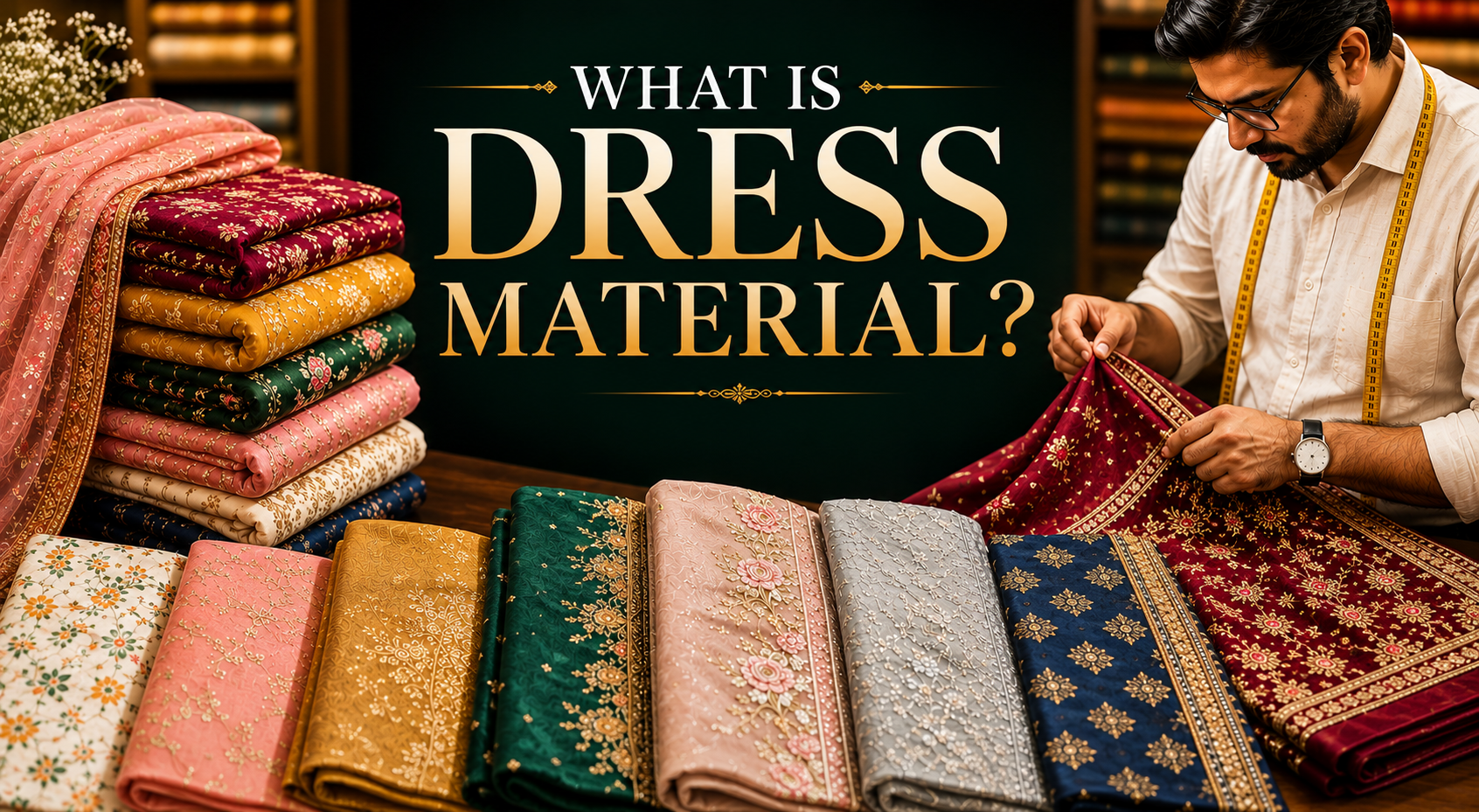
What Is Dress Material? Eight Types, Price Bands and the 5-Test Quality Check
What Is Dress Material? Eight Types, Price Bands and the 5-Test Quality Check
Dress material is an unstitched fabric set sold together as one unit, usually a top piece, a bottom piece and a dupatta, meant to be stitched into a salwar suit, anarkali, or kurta set. The buyer picks the tailor. The buyer picks the fit. The buyer controls the final look.
Almost every week somebody walks into our Lajpat Nagar counter holding a phone. The screen shows a salwar suit. Sometimes a screenshot from Instagram. Sometimes a forwarded WhatsApp image with the resolution gone to pieces. They ask, "Bhaiya, is this a dress material or readymade?"
Twelve years now I am sitting on this floor. This question never stops. Not in summer. Not in wedding season. Not even on a slow Tuesday afternoon when nobody else is buying.
So today let me answer it properly. Once for all. Not the brochure version. The real one. The one I give to customers who stay back after the rush ends.
Dress material is the unstitched fabric set. Ready-made is the stitched outfit. Sounds simple. It is not. Because once you start digging into fabric types. Price gaps. Embroidery layers. Dupatta logic. The question gets much bigger than it looked.
If you are a first-time buyer planning a Karva Chauth or Raksha Bandhan outfit. If you own a small boutique in Pune or Jaipur sourcing for Tier-2 customers. If you are a reseller building an Instagram catalogue from your living room. This guide is for you. Let me explain it the way I explain it at the cutting table.
A dress material in India means a coordinated unstitched fabric set, generally including 2 to 2.5 metres of top fabric, 2 metres of bottom fabric and 2.25 metres of dupatta. Common varieties include cotton, chanderi, silk, georgette, organza, jacquard and embroidered net. Quality depends on GSM, weave tightness, dye colour-fastness, embroidery finish and shrinkage behaviour after the first wash.
What Dress Material Actually Means
In Indian retail vocabulary, dress material is the term for an unstitched suit length. Coordinated package. Not stitched. Not finished. The customer takes it to a tailor or master-ji and gets it cut to her own measurements.
A standard pack carries three pieces. The top fabric, usually 2 to 2.5 metres. The bottom fabric for the salwar or pant, around 2 metres. The dupatta, usually 2.25 to 2.5 metres. Some sets skip the dupatta. Some carry an extra patch for a yoke or sleeves. Last week I sold one set to a lady from Karol Bagh which had a separate matching patch for the back yoke. She didn't even notice till I pointed it out.
Why does this concept survive in the age of fast fashion? One word. Fit. Indian body types vary wildly. Ready-made sizes work for some. For most, the bust pulls. Or the waist is tight. Or the kameez ends two inches too high. A dress material removes that headache. You stitch to your own body, not to a size chart somebody in Tirupur designed.
The Eight Dress Material Types You Should Know
Short version of what actually sells across our boutique fabric range.
Cotton. The everyday choice. Breathable. Light. Stitches easy. Best for summer and daily wear. GSM range 90 to 140. Plain. Printed. Light chikankari sometimes. Price band ₹250 to ₹800 per set. The boutique-walas in Lucknow keep cleaning us out of these.
Chanderi. Soft sheen. Light weight. Slight stiffness from the silk blend. Sits well for festive day events. Karva Chauth lunch territory. GSM 60 to 90. Price ₹600 to ₹2,200 per set.
Silk. Pure silk or silk blend tops paired with santoon or silk bottoms. The festive heavyweight. Falls beautifully when you stitch it as an anarkali. Price ₹1,500 to ₹8,000 depending on whether it is raw silk, tussar or banarasi. The running yardage version sits in our silk fabric edit.
Georgette. Flowy. Semi-transparent. Fluid drape. Sangeet and cocktail looks. Often comes with sequin or thread embroidery already done so the tailor's job becomes simpler. Price ₹800 to ₹4,500. Pairs with santoon inner. Always santoon. Don't let anyone sell you crepe lining at the same price point.
Organza. Crisp. Sheer. Structured. Festive. Eid and Diwali sell this fabric for us every single year. GSM 50 to 80. Price ₹900 to ₹3,500. Full range in our organza collection.
Net. Embroidered net top with a lining plus santoon bottom. Wedding-guest territory. Heavy zari or sequin work. Price ₹1,200 to ₹6,000. Our net fabric edit carries the sourcing version for boutique buyers.
Jacquard. Woven motif fabric. The pattern is part of the weave, not a print. Stiffer hand. Lasts decades. Genuinely decades. My mother still has a jacquard suit from 1998. Price ₹700 to ₹3,000. Autumn-winter looks mostly.
Pakistani. Three piece unstitched with heavy embroidery. Typically chiffon or jacquard top with embellished borders. Best for receptions. Price ₹1,500 to ₹8,000 depending on work density. The Lahore-style cutwork ones at the top of that range move fast in November.
How to Judge Quality. The 5-Test Shop Floor Method
This is the part most buying guides skip. Memorise these five checks. They take 90 seconds together. Less if you've done it before.
Hand-feel. Rub the fabric between thumb and forefinger. Good quality feels alive. Soft but not slippery. Cheap synthetics feel papery. Or oily. You'll know.
Light test. Hold the top piece against a window or your phone torch. If you can read the weave clearly, the GSM is too low for stitching. You'll need lining. Factor that into the cost before you buy.
Crush test. Grab a corner. Squeeze hard for 10 seconds. Open it up. Natural fibres like cotton and silk crease. They also recover. Bad synthetics either do not crease at all (suspicious) or stay permanently crumpled (worse).
Thread test. Pull one yarn from the cut edge. If you can pull a long, even, continuous thread, the weave is tight. If the yarn snaps in 2 cm, the fabric is loose. It will pill within three washes. This I can promise.
Dye test. Rub a damp white cloth on the fabric for 20 seconds. Good dye does not bleed. Cheap pigment leaves colour. This matters most for dark shades. Maroon. Navy. Black. The expensive-looking ones, often.
Clears all five, pay full price. Fails two or more, walk away. Or negotiate hard. Your call.
When Dress Material Beats Ready-Made
For brides and the groom's family during a wedding. Always dress material. Tailor-fit matters too much to risk. For office wear and daily kurtas, ready-made is fine. Honestly fine.
Boutique owners running a private label. Dress material is the cheaper way to test designs. Stock the unstitched sets. Take orders. Stitch on demand. Lower inventory risk. Cleaner cash flow.
For resellers, here is the trick nobody tells you. The dupatta. Buyers care about it more than they say. Always show the dupatta clearly in your listing photo. The SKU moves 30 percent faster. Maybe more. I have seen this happen across three reseller accounts last year alone.
Sourcing in volume? Our bulk order desk puts together coordinated sets across cotton, chanderi or organza in one shipment.
Questions People Always Ask Me Across the Counter
So what is the difference between "dress material" and "suit material"? Same thing. Different cities use different words. Suit material is what you'll hear in Punjab plus Delhi. Dress material is more common in Mumbai. Hyderabad. Bengaluru.
How many metres in a set? Around 6.5 metres total usually. Top 2 to 2.5. Bottom 2. Dupatta 2.25 to 2.5. Some sellers shrink the dupatta to 2 metres for a stole-style finish. Just so you know.
Is it cheaper than ready-made? Usually yes. You pay for fabric only. Not for design or stitching margins. Add ₹500 to ₹2,500 for tailoring depending on city plus complexity. Delhi is on the higher side. Surat surprisingly cheap.
Best fabric for summer? Cotton. Mul. Chanderi. Light georgette. Stay under 100 GSM. Net or heavy organza for May to September daily wear is a mistake. Save those for the evening function.
How to check if silk is real? Burn one yarn. Pure silk burns to fine ash. Smells like burnt hair. Polyester melts into a hard bead. Smells like plastic. Takes 5 seconds. Faster than reading the label.
Can you return it after cutting? No. Once cut, genuinely nothing comes back. No Indian seller will take it. So run the 5-test check first. Every single time.
Browse the full unstitched edit: Walk through our boutique fabric range for the latest cotton, chanderi, silk and organza sets. Sourcing in bulk? Drop your list at the bulk order desk and we'll coordinate the dupatta plus bottom-piece matching at our end.
FAQ
What is the difference between dress material and suit material?
Same thing. Different cities use different words. "Suit material" is what you hear in Punjab and Delhi. "Dress material" is the term in Mumbai. Hyderabad. Bengaluru. Sometimes Kolkata buyers say "fabric set" instead. All three mean the same unstitched package.
How many metres are in a dress material set?
Around 6.5 metres total usually. Top piece 2 to 2.5 metres. Bottom piece 2 metres. Dupatta 2.25 to 2.5 metres. Some sellers shrink the dupatta to 2 metres for a stole-style finish. Worth asking before you pay.
Is dress material cheaper than ready-made?
Usually yes. You pay for fabric only. Not for design or stitching margins on top. Add ₹500 to ₹2,500 for tailoring depending on the city plus complexity. Delhi tailors charge on the higher side. Surat is surprisingly cheap. A Lucknow master-ji once stitched a chanderi anarkali for my cousin at ₹650 including lining.
Which dress material is best for Indian summer?
Cotton. Mul. Chanderi. Light georgette. Stay under 100 GSM. Net or heavy organza for May to September daily wear is a mistake. Save those for the evening function only. Daytime in Delhi crosses 42 degrees. Your fabric needs to breathe.
How do I know if a dress material is original silk?
Burn test on one yarn from the cut edge. Pure silk burns to fine ash. Smells like burnt hair. Polyester melts into a hard bead. Smells like plastic. Takes 5 seconds. Faster than reading the label. Faster than trusting the seller.
Can I return a dress material once I cut it?
No. Once cut, genuinely nothing comes back. No Indian seller will take it. Not online. Not offline. This is why the 5-test quality check matters every single time before you let the scissors touch the fabric.
What is the minimum order for boutique sourcing?
Most wholesale desks start at 10 to 20 pieces per design. Our bulk order desk works from 12 pieces minimum across coordinated sets. Mix-and-match across cotton, chanderi or organza is fine. Single fabric in one colour is the cheapest route.