What Is Organza Fabric? Five Types, Price Bands and the 5-Test Quality Method
What Is Organza Fabric? Five Types, Price Bands and the 5-Test Quality Method
Organza confuses people more than any other fabric I sell. Honestly. More than silk. More than chiffon. More than anything else on this counter.
Same look. Wildly different price. ₹40 in one shop. ₹1,200 in another. Both labelled "organza." Both technically correct. The difference is the fibre. The twist count. The finishing. None of which a salesman ever explains to you.
Twelve years now on this counter in Lajpat Nagar. Every wedding season the same questions come back. "Bhaiya, is this real silk organza?" "Will the zardozi hold?" "Why is your roll double the price of the one across the street?" Today let me just lay it out properly. Plain version. No marketing fluff.
If you are buying organza for a wedding saree. For a boutique festive line. For your own Diwali kurta. This guide is your map.
What Organza Actually Is
Organza is a thin plain-weave fabric. The weave itself is the simplest possible. One thread over. One thread under. Repeat. Nothing fancy about that part.
What makes organza organza is the yarn. The yarn is twisted very tightly before weaving. Like, very tightly. That high twist pulls the woven fabric taut. Gives it that crisp papery see-through quality you can recognise from across a shop floor.
Originally? Pure silk. Hundred percent. Modern organza covers silk. Polyester. Nylon. Viscose. Silk-metallic blends. The visual look is similar across all of them. The behaviour, drape, longevity, price band? Completely different stories.
The fabric sits in the sheer category. You can see through it. Light passes through it. That is exactly why brides love it for dupattas plus overlay skirts in summer or monsoon weddings. The structure adds flare without adding weight. A bride dancing in a polyester organza lehenga at her sangeet versus the same bride in a heavy velvet lehenga? Different person by the end of the night.
The Five Organza Types You Will Meet in Indian Retail
These five rolls pass through our organza collection every single month.
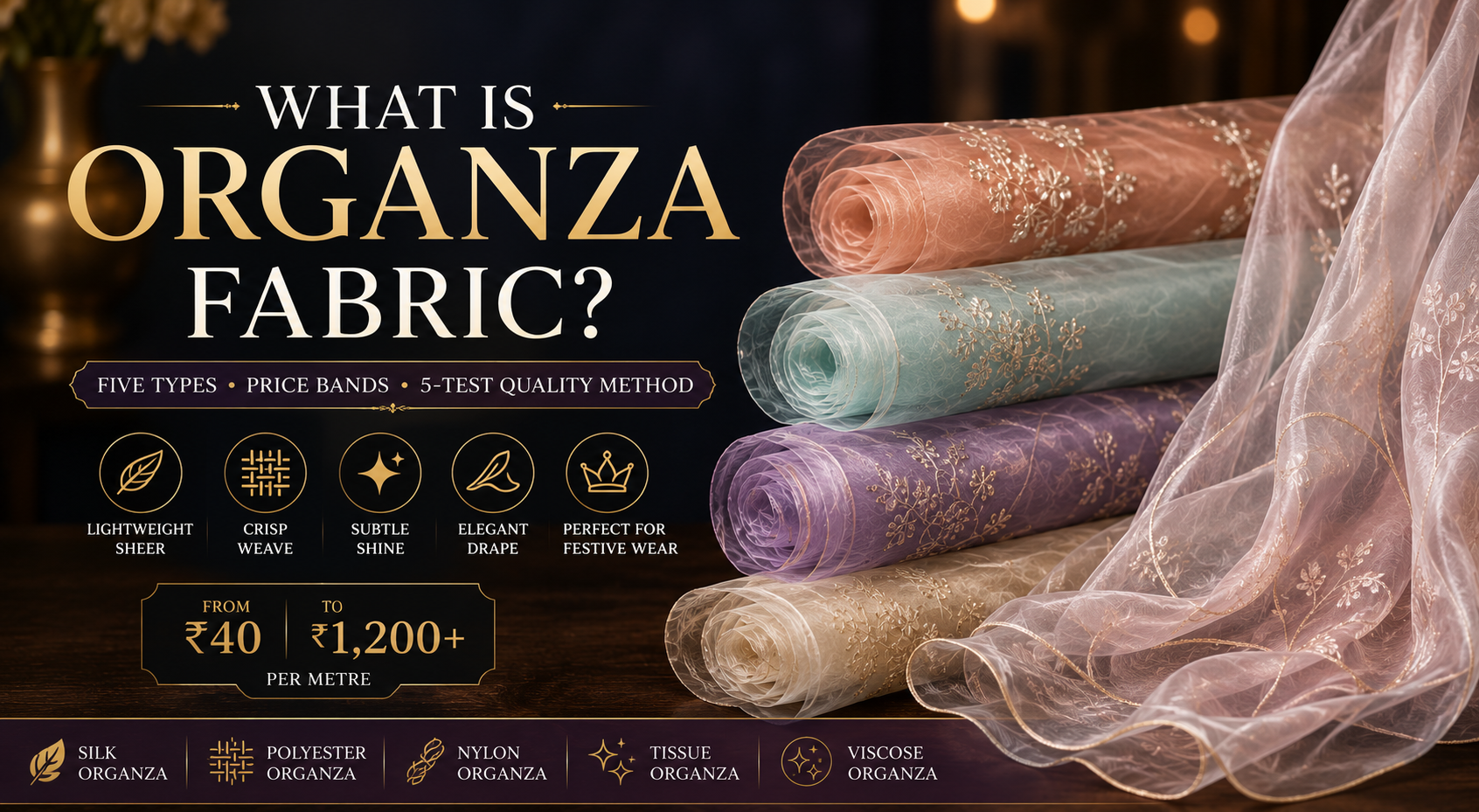
Silk Organza. Pure silk yarn. Tightly twisted. Hand feel is dry and slightly papery. GSM 60 to 75 range. Holds heavy hand embroidery beautifully. Dyes deep. Real deep. ₹700 to ₹1,200 per metre. This is what you use for heirloom bridal sarees. Dense zardozi panels. Designer kurtas a karigar will spend three weeks on.
Polyester Organza. The workhorse. Synthetic filament yarn. Crisper than silk. Slightly shinier too. GSM 50 to 60. Cheaper. Way cheaper. Easier to maintain at home. ₹40 to ₹350 per metre depending on the dyeing finish. Best for budget lehengas, machine sequin work, monsoon weddings where silk would get destroyed by humidity. A reseller in Surat orders 200 metres of plain ivory polyester organza from us every August. Sells out by Karva Chauth without fail.
Nylon Organza. Stiffer than polyester. Sharper crease. Often dyeable. GSM 50 to 65. Price band ₹35 to ₹150 per metre. You'll see this in stage costumes mostly. Decor drapes for wedding mandaps. Structured saree borders that need to hold a shape. Not really meant for the body of a garment.
Tissue Organza. Silk-polyester blend with metallic zari woven straight into the warp or weft. Shimmer is built into the fabric, not coated on. GSM 60 to 75. ₹400 to ₹650 per metre. Tissue sarees. Reception dupattas. Festive overlays that catch chandelier light from across the banquet hall.
Viscose Organza. Newer entrant. Came into the Delhi market properly around 2021. Softer drape than the others. Less stiff. GSM 55 to 70. ₹250 to ₹500 per metre. Works for kurta sets. Semi-formal sarees. Summer festive wear where you want the organza look without the organza scratch.
Where Organza Fits in Indian Outfits
Once you understand the fibre, the use cases become obvious.
Bridal lehenga skirts. Silk or polyester organza. Single layer if the bride is petite. Double layer for fuller flare. Gives volume without bulk. Pair the choli in raw silk for textural contrast.
Sarees. Organza sarees are the bestseller category for 2026. No question. Light enough for an outdoor April mehndi. Sheer enough for the wedding album to catch light properly. Pair with zari work fabric borders for festive looks.
Sheer bridal dupattas. Hand-placed sequin or crystal work on organza dupattas is the 2026 trend that refuses to die. Photographs catch the shimmer through the sheer panel in a way no other fabric does.
Lehenga overlays. Organza overlay on satin or silk base gives the reception drape brides actually ask for by name. Easy to dance in too. Important detail nobody mentions until the sangeet ends.
Festive kurtas. Lightweight organza kurtas with sequin fabric panels for Eid. Diwali. Karva Chauth. Anything festive that runs into the evening.
Decor and lining. Nylon and polyester organza in the lower price bands get used for backdrops. Decor drapes. Inner lining where structure matters more than feel.
How to Judge Organza Quality. The 5-Test Floor Method
This is the routine I run before I sign off on any roll arriving at our godown.
The burn test. Pull one yarn from the cut edge. Light it. Silk burns slow. Leaves crushable ash. Smells like burnt hair. Polyester melts into a hard bead. Plastic smell. Nylon also melts but smells different. More acidic. Sharper. The nylon smell hits the back of your throat in a way polyester doesn't.
The crush test. Squeeze a corner hard for 8 seconds. Open your fist. Silk organza creases sharply. The crease releases over a full minute. Polyester recovers instantly. Like nothing happened. Nylon stays slightly stiff in the middle but recovers at the edges. Three fabrics, three behaviours.
The hand-feel test. Rub the fabric between your palms for 8 seconds. Real silk organza warms up. Feels dry to the skin by the end. Polyester organza stays cool. Slick. Always slick. The temperature thing is what gives it away.
The weave test. Hold the fabric against a window or your phone torch. Real silk organza shows yarn irregularities. Slubs. Tiny thickness variation along the same thread. Synthetic organza shows mechanical uniformity. Too perfect. That perfection is the tell.
The pull test. Pull one corner thread out slowly. Real silk yarn breaks with a soft snap. Leaves a fluffy end you can see clearly. Polyester pulls long. Smooth. Slippery. Shiny. The thread keeps coming. Almost like fishing line.
Pass 4 out of 5, you have what the seller is claiming. Fail 3 or more, you are paying silk price for synthetic blend. Walk out. Or knock the price down by 60 percent. Your choice.
What Buyers Get Wrong About Organza
Three confusions I end up correcting every week.
"Organza means silk." Not anymore. Hasn't meant only silk for decades now. Most organza in Indian retail today is polyester. Both can be called organza honestly. Only the price tells you which one. And the burn test, obviously.
"Heavy embroidery wrecks organza." Only if the karigar gets the backing wrong. Use a fine net or muslin base for hand zardozi above 400 g per square metre. Then the work holds for years. A Karol Bagh boutique I supply has a silk organza saree from 2019 with 600 gsm zardozi panels still going strong. Six years. Three weddings. Still intact.
"Organza is only for summer." Wrong. Just wrong. Heavy zari-loaded silk organza works beautifully for December receptions. Light fabric. Heavy work. Photographs gorgeously under banquet hall lighting. Saw a Patna bride wear an ivory silk organza saree to her vidaai in January 2024. Coldest day of the month. She looked radiant on camera. Stayed warm with a pashmina shawl during the actual outdoor moments.
For volume buyers planning a boutique festive line, route the order through our bulk order page. Or run the math through our fabric estimator before you commit.
FAQ
What is organza fabric made of?
Tightly twisted filament yarn. Originally pure silk. Today the term covers silk, polyester, nylon, viscose and silk-metallic blends. All five behave differently. All five carry the same name on the label. Confusing? Yes. That's why the burn test exists.
What is the difference between silk organza and polyester organza?
Silk organza is a natural protein fibre. Higher price (₹700 to ₹1,200 per metre). Dyes deeper. Holds heavy hand embroidery. Polyester organza is synthetic. Cheaper (₹40 to ₹350 per metre). Easier to care for. Sharper shine. Better suited for monsoon weddings or outdoor functions where humidity would damage silk.
Is organza fabric see-through?
Yes. Organza belongs to the sheer category. Light passes straight through. Inner lining is needed for opaque outfits. Most lehengas use double-layer organza for opacity plus extra flare.
How much organza fabric do I need for a saree?
A standard organza saree needs 5.5 metres of body fabric. Plus 0.8 metres for the blouse piece. Some pre-stitched ruffle sarees can consume up to 7 metres. Check the design before you buy. Easier than buying short.
Can organza fabric be washed at home?
Polyester organza, yes. On a gentle cold cycle with mesh laundry bag protection. Silk organza, no. Dry clean only. Always dry clean. Both should be ironed on the reverse side with low heat and a cotton cloth placed on top. Steam iron settings ruin organza. Don't try it.
What GSM is best for an organza lehenga?
60 to 90 GSM. Below 60 the skirt loses flare. Goes limp. Above 90 it loses that floaty organza behaviour buyers come looking for in the first place. The sweet spot is around 70 to 75 GSM.
Does organza wrinkle a lot?
Silk organza wrinkles sharply but releases over time. Polyester organza resists wrinkles much better. If you're travelling with an organza outfit, polyester is the safer bet. Silk needs a quick steam touch-up before wearing.
Browse the full edit: Walk through our organza collection for silk, polyester, tissue and viscose organza running yardage. Boutique sourcing? The bulk order desk handles 12-piece minimums with fibre breakdown noted on every invoice.