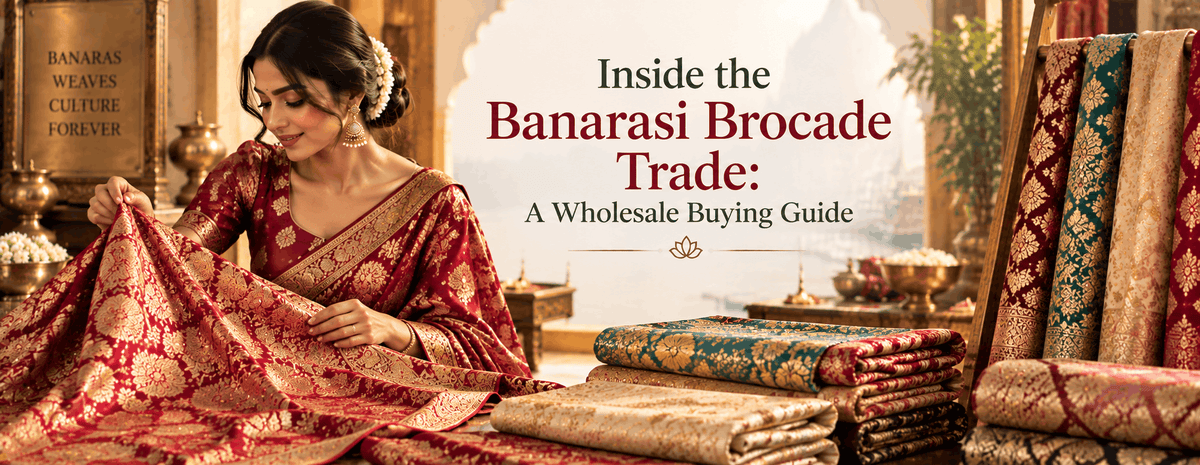
Inside the Banarasi Brocade Trade: A Wholesale Buying Guide
Wholesale Reference Guides · 9 minute read · Updated 13 October 2026
Brocade is the fabric that fools a buyer through the face. Two thaans lie side by side on the counter and both flash gold under the tube light.
One holds that gold through a full wedding season. The other goes black at the folds inside three months and the customer blames your boutique rather than the mill.
Twelve years at a Chandni Chowk counter teaches you to turn brocade over before you ever look at the front.
Judge the zari grade and the base weight and the reverse floats. Never judge the shine on the face.
Four checks before you commit a brocade thaan
- Ask the zari grade out loud. Real or tested or plastic. Rub a corner hard for ten seconds. Plastic squeaks and can crack. Tested zari stays smooth.
- Feel the base under the motif. A firm base carries heavy zari. A thin base puckers the moment a karigar stitches a lined bridal panel.
- Turn the piece over. Short tied neat floats hold. Long loose threads across the back snag on the machine then pull a motif open on the shelf.
- Rub a damp white cloth on the dark ground. A base that bleeds stains the zari and the customer lining. Catch it at the counter, never after delivery.
Every brocade complaint that reaches a counter is really a zari complaint.
Quick answer: Buying brocade fabric wholesale means purchasing woven zari fabric by the thaan or in bulk metres at trade rates. The common bases are banarasi brocade, kimkhab or heavy brocade, cotton brocade and semi or poly brocade. Quality lives in the zari grade and the base weight rather than the face shine. Boutique buyers can match a motif against live running stock in the Banarasi Brocade collection at Paras Gallery Fabrics before locking an order.
What brocade fabric actually is
Brocade is a woven figured fabric. The motif is built into the cloth on the loom using extra zari or coloured threads, so it is not printed or embroidered on top.
That is the first thing to explain to a new buyer. Brocade earns its price because the design is woven rather than stuck on.
Almost everything that decides quality lives in two places buyers skip. The zari decides the shine and the colour hold and whether the cloth tarnishes. The base decides the weight and the fall and whether the cloth survives a heavy bridal cut without puckering.
Types of brocade worth stocking at wholesale
This is the table we pull out at the counter. Match the brocade type to what your karigar is actually stitching.
| Brocade type | Feel and weight | Best garment use | Delhi trade price (per metre) |
|---|---|---|---|
| Poly or semi brocade | Light, bright shine, thin base | Budget festive suits, blouses, linings | Rs 200 to Rs 450 |
| Cotton or chanderi brocade | Soft, matte, breathable | Day wear suits, kurtis, light jackets | Rs 300 to Rs 600 |
| Tested zari banarasi brocade | Weighted, controlled shine, holds colour | Bridal lehengas, blouses, dupattas | Rs 500 to Rs 1200 |
| Katan silk brocade | Firm silk base, crisp motif | Sarees, heavy blouses, hero panels | Rs 900 to Rs 2000 |
| Kimkhab or heavy brocade | Dense zari, stiff, structured | Sherwanis, groom jackets, hero lehenga borders | Rs 1200 to Rs 2500 |
Prices above reflect Delhi wholesale rates for standard widths of 44 to 48 inches. Brocade rates climb through the wedding season, so treat them as a working band rather than a fixed number.
Zari and tarnish, the question that decides your reputation
Learn the three grades and price against them rather than against face shine.
Real zari uses fine silver or gold coated thread. It is the costliest and it ages the best, so keep it for hero bridal and groom pieces. Tested zari is electroplated and anti tarnish treated. It holds colour for years at a fair rate, which is why most trade bridal stock sits here. Plastic or imitation zari is metallic film. It shines hardest on day one then blackens fastest.
Tell your customer the grade openly. A boutique that sells tested zari as tested zari keeps the customer for the next wedding. A boutique that passes plastic off as tested loses the whole family.
The swatch and reorder check before a second lot
Everything above assumes a first order. The call that catches experienced buyers out is the second one, when a design has sold and you want more of the same cloth.
Brocade is unusually unforgiving there because a repeat lot has to match on two separate counts. The first is shade. The second is the motif itself.
That second one surprises people. A loom setting shifts slightly between runs, so the same design can come back with the repeat sitting a little differently along the length. On a blouse nobody notices. Across a lehenga panel set where motifs line up at the seam it shows at once.
So before a repeat order is confirmed, ask for a cutting from the lot that will be dispatched rather than a reference swatch off the shelf. Then run four checks on it, side by side with a piece of your first lot.
- Shade, under two lights. Deep grounds like maroon and bottle green and wine shift between daylight and tube light. Lay both cuttings together and check in each.
- Zari tone. Gold reads warm or cool depending on the batch. Two lots that match on ground colour can still sit badly together once the zari catches the light.
- Motif registration. Measure one full repeat on each cutting. If the repeat length differs, panels cut from the two lots will not line up at the seam whatever the shade does.
- Reverse floats again. Float length is a loom setting, so it can change between runs on the same design. Check the back of the new cutting as carefully as you checked the first.
Two habits make this easier. Write the lot reference down when the first order arrives, because a reorder conversation without one is guesswork on both sides. And keep a physical cutting of every brocade you stock in a labelled file, so you are comparing cloth against cloth rather than cloth against memory.
Minimum order quantity and where the rate breaks
Every new bulk buyer asks the same question. Here is the structure most Delhi suppliers work with.
| Order tier | Typical quantity | Rate movement | Who it suits |
|---|---|---|---|
| Sample cut | 1 to 5 metres | Retail rate | First time buyers testing zari and motif |
| Small bulk | 1 thaan (about 18 to 20 m) | 5 to 10 percent off retail | Boutiques running one wedding design |
| Trade bulk | 5 to 20 thaans | 12 to 20 percent off retail | Resellers, repeat wedding wear labels |
| Manufacturer lot | 50 thaans and above | Mill linked rate on request | Exporters, large labels |
One habit protects your brocade margin more than any bargaining. Match motifs before you match colours. A single motif family bought across shades still counts as one trade lot, so you hold the discount while your shelf still looks varied.
Where brocade earns its keep
Here is how we explain the three decisions to boutique buyers so the promise made to the customer stays honest.
Storing brocade without tarnish or crush
Zari tarnishes when it meets damp, so a few storage habits keep your stock sale ready.
- Store brocade rolled, never folded, so no crush line breaks the zari across a motif.
- Keep rolls in a dry spot off a damp floor, because moisture is what turns zari black.
- Wrap hero silk brocade in soft cloth or acid free paper rather than plastic that traps humidity.
- Rotate older thaans to the front so no piece sits long enough to tarnish at the folds.
What to do at the counter
- Before you go: note which designs sold last season and may need a repeat lot. Bring a cutting of each.
- Step 1: ask the zari grade on every roll you are shown.
- Step 2: turn each piece over and read the floats, then feel the base under the motif.
- Step 3: rub a damp white cloth on the dark ground and check the motif clarity at arm length.
- Then confirm: write the lot reference down. Say at the first order if a design is likely to repeat.
Questions buyers ask at the counter
What is the minimum order for brocade fabric wholesale?
Trade rates usually begin at one full thaan of about 18 to 20 metres. Below that you pay close to retail. To reach the sharper trade discount you generally need five thaans or more, which is where pooling one motif across buyers helps.
Which brocade is best for a bridal lehenga?
Tested zari banarasi brocade for the main panels because it holds colour and shine without heavy tarnish. Use kimkhab for the border and blouse where you want dense structured work.
How do I know if brocade zari will tarnish?
Ask the grade first. Plastic zari shines hardest then blackens fastest. Tested zari is anti tarnish treated and holds for years. Rub a corner and store the stock dry, because damp is what turns zari black on the shelf.
Is poly brocade worth stocking for daily labels?
Yes for budget festive volume. It is light and bright so it suits linings and blouses and low cost suits where the customer knows it is not silk. Keep it separate from your tested zari stock so the two never get confused at billing.
Will a brocade reorder match my first lot?
Not automatically. A repeat lot has to match on shade and on zari tone and on motif repeat length. All three can shift between loom runs. Ask for a cutting from the dispatch lot, compare it against a piece of your first lot in two lights, then measure one full motif repeat on each.