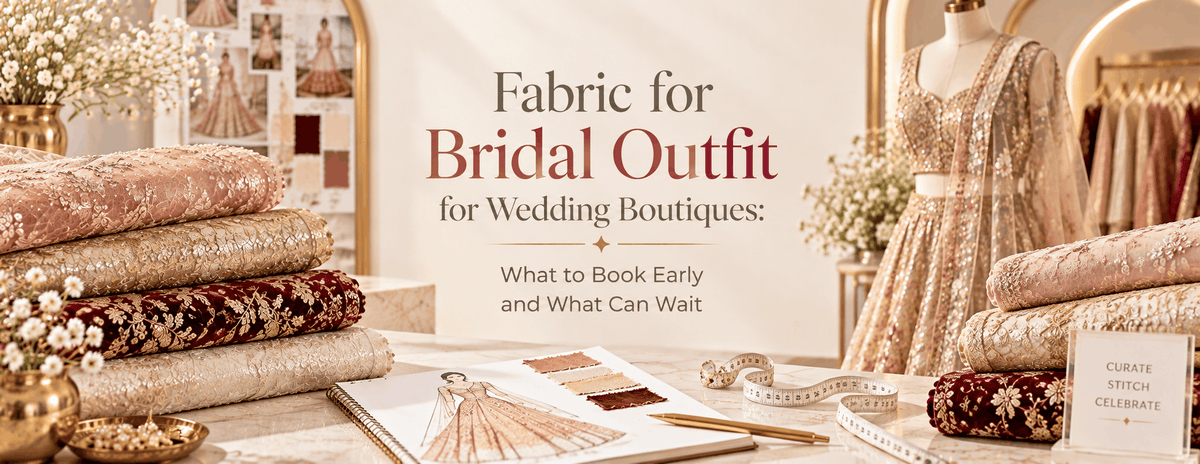
Fabric for Bridal Outfit for Wedding Boutiques: What to Book Early and What Can Wait
Wholesale Reference Guides · 11 minute read · Updated 15 October 2026
At our counter we see the same pattern every wedding season. A boutique takes a bridal order, picks the main cloth in a hurry, then spends the next three weeks chasing everything that has to match it.
The boutiques that stay calm do it the other way round. They treat a bridal job as a short list of things to book in a fixed order.
Some of it must be locked early. Some of it can wait without any harm. Knowing which is which is most of the skill.
Book the heavy main cloth first and book the full need from one lot. Everything after that is a matching exercise rather than a search.
Four things to settle on every bridal job
- Ask for the fitting date, not the wedding date. The fitting is the deadline that actually bites.
- Take the whole set from one lot. Main cloth, dupatta cloth, blouse cloth, in one booking.
- Check the shade under two lights. Daylight tells you one thing. A warm bulb tells you another.
- Get the lot reference on the bill. Without it a reorder is a fresh shade approval.
Lock the cloth that cannot be replaced. Leave the cloth that can.
Quick answer: Bridal fabric wholesale is easiest when you book in order rather than all at once. Start with the heavy embellished main cloth, since it fixes the shade plus the weight for everything else and it is the one piece that cannot be matched once the design sells through. Book the dupatta cloth and the blouse cloth with it, from the same lot. Plain support cloth and trims come last, because they can be sourced again. Count back from the bride's first fitting date rather than the wedding date. Boutique buyers who want to see the classical bridal shades together can match against live running stock in the Bridal Bliss collection at Paras Gallery Fabrics, which gathers reds and maroons across net and velvet and brocade.
Why bridal cloth is booked earlier than anything else
Bridal work is heavy. It takes longer to cut and longer to stitch than anything else that passes through your workroom.
A bride also has fittings. Each fitting has a date that cannot move. If the cloth arrives late the fittings slip. If a fitting slips the whole job is under pressure, because every date behind it was set against that one.
There is a second reason, the one buyers underestimate. A design you like today may not be on the shelf when you ask again. Heavily worked cloth is not produced in endless supply, so the roll in front of you is a real roll rather than a catalogue entry.
If you are sure of a piece for a bride, book it while it is there. The cost of holding cloth you decided on is small. The cost of going back for cloth that has gone is the whole job.
The booking order, plus what each step is protecting
This is the sequence I write on the back of an enquiry slip at the counter. Read the last column, because that is the part most buyers skip.
| Order | What you are booking | Usual bases | When to book it | What booking it protects |
|---|---|---|---|---|
| First | Heavy main cloth, lehenga or saree | Net, velvet, brocade | The day the bride confirms | The design itself. This is the piece that cannot be replaced |
| Second | Dupatta cloth and blouse cloth | Matched to the main base | Same booking, same lot | Shade agreement across the worn outfit |
| Third | Plain support cloth and lining | Satin, cotton, soft net | Once the main cloth is safe | The fall of the finished garment |
| Fourth | Trims, borders, laces | Any | Last, with the cloth in hand | Nothing urgent. These are the easiest to find again |
Buyers reverse this more often than you would think. They see a dupatta cloth they like, hold the decision open on the main piece, then end up choosing a main cloth that suits the dupatta they happened to find. That is how a bridal outfit ends up looking assembled rather than designed.
Count back from the fitting, never from the wedding
Most bridal panic is arithmetic that nobody did. The wedding date feels like the deadline, so the booking feels early. It is not.
The deadline that bites is the first fitting, because that is the first date a bride turns up expecting to see something on her body. Do the subtraction once, in this order, then write the answer on the job card.
- Start at the first fitting date. Ask the bride for it before you quote rather than after.
- Subtract your cutting and stitch-up time. Heavy embellished cloth is slower on the table, so use your tailor's real number for bridal work rather than the number you use for a suit.
- Subtract a buffer for the shade check. You want the bulk in hand with enough room to raise a problem while it is still a problem you can solve.
- Subtract your supplier's stated lead time for that design. Ask for it in writing on the enquiry. A design sitting in stock and a design that needs a fresh frame run are very different waits.
What is left is your booking date. If that date has already passed you have learned something useful immediately. This is not a job for that design, so show the bride what is on the shelf instead of promising what is not.
Telling a bride no in week one costs you a conversation. Telling her no in week five costs you the order plus whatever she says about you afterwards.
One lot for the whole outfit
Bridal reds are not one red. A red from one lot can lean slightly warmer than a red from the next, so on the roll you may never notice.
Once the lehenga and the dupatta are worn together, a trained eye will. So will every camera in the room, which is the comparison that actually matters to the family.
Ask for the full need at the first booking. Main cloth, dupatta cloth and blouse cloth from the same lot. If your fitting plan means you will cut in stages, say so before you confirm rather than after, because it is much easier to hold a lot than to match one later.
The three bridal buys and how to treat each
The table above tells you what each piece is. These three cards tell you how to treat it when the bride is sitting across the table from you.
The piece added after the booking is what breaks a bridal lot
Here is the failure we see more than any other. It has nothing to do with the bride.
You book the bridal set correctly, from one lot, on day one. Three weeks later the bride's mother decides she wants a dupatta in the same shade. Or a sister wants a blouse that sits with the lehenga in the photographs. Nobody thinks of this as a new job. Everybody thinks of it as a small addition.
It is not a small addition. It is a fresh shade approval on a lot that may already be finished, so what you get is the next lot under the same shade name, which is the exact thing the one-lot rule exists to avoid. The addition then sits next to the main outfit in every photograph that matters.
Two habits remove most of this. Ask at the first booking who else in the family is dressing for the day, then accept a vague answer, because even a vague answer tells you whether to hold a little extra length while the lot is open. Then keep the lot reference on the file rather than only on the bill, so when the call comes three weeks later your first move is to ask whether that lot is still running instead of ordering blind against a shade name.
Bridal colours need two kinds of light
The classical bridal palette is red and maroon with wine and rani pink alongside. These shades change more than most when the light changes, so a deep red can read almost brown under a warm bulb and bright under a window.
Check each shade in daylight, then under the kind of lighting your customer will be photographed in. Pin a small piece to your shade card with the date written on it. When the bulk arrives, compare it against the card before anything is cut.
Also remember that the classical bridal shades come pre-dyed. If a customer wants a colour outside that range, plan it as a separate job from the start rather than expecting to shift a finished bridal cloth to a new shade.
Know what each base asks of you
Net is light and sheer. It needs support cloth under it plus a careful hand on the needle.
Velvet is heavy and holds its shape. It needs the right side kept clear of the iron, which is a workroom habit rather than a buying decision, but it is worth saying out loud before the cloth reaches the table.
Brocade is firm and carries its own structure. It may need very little support, though it can be stiff at the seams and that changes how a panel sits.
If you know which base each job will use, you can plan the support cloth at the same time. That is what removes the late rush that spoils bridal schedules.
What to write on the bill before you leave
A bridal order is the one order most likely to come back to you in pieces, so the bill is a record you will actually use. Three things belong on it beyond the design number plus the rate.
The lot reference, because without it a reorder is a new shade approval. The usable width in inches after the selvedge, because two rolls at the same rate can differ by several inches of cuttable cloth and bridal panels are where that difference shows up as a shortfall. The date you took your shade cutting, so when you compare the bulk against the card you know how old the card is.
None of this takes a minute at the counter. All of it saves an argument later. On a bridal job the argument always lands in the week you have least room for it.
Common mistakes on bridal bookings
- Counting from the wedding date. The fitting is the real deadline. Counting from the wedding hides weeks of slack that do not exist.
- Splitting the set across bookings. Main cloth now, dupatta later, blouse later still. Three lots, three shades, one unhappy family.
- Judging a bridal red under one light. Counter light flatters almost every deep shade. The photographs will not.
- Taking no lot reference. The commonest reason a reorder cannot be matched is that nobody wrote down what to match it against.
- Treating a family addition as a top-up. It is a fresh approval. Handle it as one, early, while the lot may still be open.
What to do at the counter
- Before you go: write the first fitting date for each bridal job, then work the four subtractions backward from it.
- Step 1: pick the main cloth and ask for the full need from one lot.
- Step 2: look at the shade in daylight plus warm light, then pin a dated cutting to your shade card.
- Step 3: book the matching dupatta cloth and blouse cloth in the same transaction.
- Step 4: ask who else in the family is dressing, then decide whether to hold a spare length while the lot is open.
- Then confirm: settle support cloth plus trims, with the lot reference, the usable width and the shade-card date on the bill.
Questions boutique buyers ask me at the counter
What should I book first for a bridal order?
Book the heavy embellished main cloth first. It fixes the shade plus the weight that everything else is matched to, plus it is the only piece in the set that cannot be sourced again if the design sells through. Once it is confirmed the rest of the job becomes a matching exercise rather than a search. Boutiques that reverse this order end up choosing a main cloth to suit a dupatta they happened to find, which is how a bridal outfit ends up looking assembled.
Why should bridal pieces come from the same lot?
Reds and maroons carry small differences between lots even under the same shade name. On the roll the difference is invisible, because you are looking at one cloth on its own. Worn together, the lehenga and the dupatta are compared directly by everyone in the room plus every camera. Asking for the full need from one lot at the first booking costs nothing. Matching a shade across two lots afterwards is sometimes not possible at all.
How early should a boutique book bridal fabric?
Count back from the first fitting rather than the wedding. Take the fitting date, subtract your tailor's real cutting and stitch-up time for heavy work, subtract a buffer to check the bulk against your shade card, then subtract the lead time your supplier states for that specific design. The result is your booking date. Ask for the lead time in writing on the enquiry, since a design sitting in stock and a design that needs a fresh frame run are very different waits.
What if the family adds a piece after I have booked?
Treat it as a new shade approval rather than a top-up. Call with the lot reference and ask whether that lot is still running before you order anything. If it is, add to it immediately. If it is not, show the family the new cloth against the original before you commit, so the decision about a visible difference is theirs and is made early. The cheapest protection is to ask at the first booking who else is dressing for the day, then hold a little extra length while the lot is open.
What should I compare when the bulk arrives?
Compare the bulk against your dated shade cutting in daylight before anything is cut, then check the usable width after the selvedge against what you were quoted. Look at the pieces together rather than one at a time, since the whole point of the one-lot rule is how they read side by side. Raise anything you find before the cloth goes on the table, because a shade question is a conversation while the cloth is whole and a loss once it is cut.