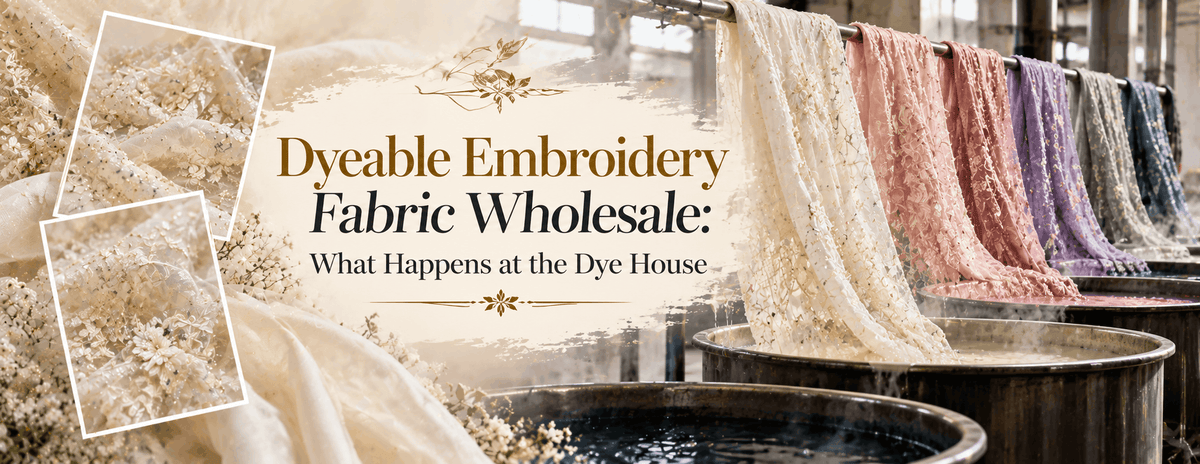
Dyeable Embroidery Fabric Wholesale: What Happens at the Dye House
Wholesale Reference Guides · 8 minute read · Updated 21 October 2026
The cloth on the counter is cream, stiff plus faintly smells of starch. Nothing about it looks like what you are going to sell.
That is the point of buying dyeable. It is also the trap.
Every other category in your buying list is graded on what it is. This one is graded on what it will become, somewhere else, in someone else's bath, three weeks after you sign the bill. So the sample in your hand answers almost none of the questions that matter.
Quick answer: Ask what fibre the thread is before you discuss shade. Polyester thread stays cream while the ground colours. Cotton or viscose thread colours with it.
Budget 3 to 6 percent shrinkage on cotton, 4 to 8 on viscose. Trial half a metre at your own dyer first, then write the result into a dye brief so the reorder matches. The undyed ranges sit in the dyeable embroidery collection.
Dyeable means unfinished, it does not mean white
The first complaint most sellers hear is that the cloth arrived cream instead of white. It was always going to.
Dyeable stock is greige, or ready for dye, so it came off the frame plus went no further. No bleaching, no brightener, no finishing pass. Expect ecru, oatmeal or pale straw, varying between lots, because the base yarn is showing through.
This matters commercially in exactly one place: pastels. A pale pink over a warm ecru ground reads muddier than the same recipe over bleached cloth. If your range leans soft, ask whether the goods were bleached before embroidery or budget a bleaching pass.
The second surprise is the hand. Greige cloth carries sizing, a starch dressing that helps it run through the machine, which makes a soft muslin feel like paper. So wet a corner, let it dry plus feel it then. That is the cloth your customer will handle.
The one question that decides the whole order: what fibre is the thread?
Everything else in this guide is housekeeping. This is the decision.
A dye bath does not colour cloth. It colours fibres, plus different fibres need different dyes. Reactive dyes bond to cotton and viscose. Disperse dyes colour polyester.
A commercial dye house runs one bath at a time. So whichever fibre does not match that bath comes out the colour it went in.
That gives two very different products from cloth that looks identical on the counter.
Cotton or viscose thread on a cotton ground colours together, so the cloth reads tone on tone with the work a shade deeper. Polyester thread resists the bath, so the ground takes colour plus the work stays cream.
That contrast is the look a lot of buyers want plus almost none of them specify. Ask for the thread fibre and write the answer on the bill, because the same design number is sold both ways.
Two smaller cases. Sequins, beads plus film based work are unaffected by a reactive bath, so a gold sequin on a dyeable base is reliable. Metallic zari is the opposite, because hot baths attack plating. Keep zari out of a dyeable programme unless the work is film based.
Shrinkage happens after the embroidery, which is the problem
Every greige cloth shrinks in its first wet process, because it has never been finished or compacted. On plain goods that is an arithmetic nuisance. On embroidered goods it is a quality risk.
Expect roughly 3 to 6 percent on cotton grounds plus 4 to 8 percent on viscose, more if the weave is loose.
The trouble is that the embroidery does not shrink with it. Thread lines are anchored at thousands of points, so as the ground draws in, the cloth has nowhere to go except upward.
You get a fine ripple along dense motifs that no pressing removes. Light buti work barely shows it. Dense jaal work shows it badly.
Two things reduce the risk. Ask whether the base was pre-shrunk before the embroidery was worked, since a pre-shrunk base has already done most of its moving.
Where the answer is no, order your allowance in metres rather than percent. Six percent sounds manageable until a twenty metre thaan is eighteen and a half.
The half metre trial that settles every argument
Before any dyeable booking above a single thaan, send half a metre to the dye house you actually use, at the shade you actually plan to run. It costs very little. It answers four questions no counter inspection can.
Look at shade take on the ground against the thread. That confirms the fibre answer you were given.
Measure length plus width before and after. That gives you a real shrinkage number for this quality instead of a rule of thumb.
Check dense motif areas for ripple. That tells you whether the base was pre-shrunk.
Rub the dried piece against a white cloth. That shows whether the dyer washed off properly plus whether the ground will crock onto a customer's blouse.
Run it at your dyer, not the seller's. The recipe, the bath ratio plus the machine all change the result. Then record the dyer's recipe number beside the design number, because that pair is your reorder key.
Write the dye brief before you release the order
A recipe number on its own will not reproduce a shade. I have watched two runs off the same number come back visibly apart, because the second went in with a different base lot, a different bath load plus a different person reading the swatch.
A recipe is a chemistry note. What you need is a brief. Put five things on one sheet.
The ground fibre plus the thread fibre, stated separately, so nobody substitutes a quality on you. The target shade as a physical cutting stapled to the sheet, never a colour name, because cream, ivory plus off white are the same word to three different people.
Then the finish you want after dyeing, the shrinkage allowance written in metres, plus the bath notes from your trial. File it dated, with the swatch. Six months later that sheet is worth more than any memory of the shade.
Check the thaan the day it lands, not the day it goes to the bath
Most buyers open a dyeable lot properly for the first time when it is already on its way to the dyer. By then a short lot is your problem rather than the seller's.
So unroll it the day it lands. Measure the width yourself across three places rather than taking the number off the roll end, because width is the figure that quietly breaks a cutting plan.
Check the roll against the billed quantity, since a thaan is a convention rather than a guarantee. Look along the selvedge for frame marks, which tell you how the panel was held plus where it will ripple.
Then hold a length against daylight for yellowed bands, thin patches or a repeat that drifts off line.
Photograph anything doubtful beside a tape measure, then raise it the same day. A fault reported on day one is a conversation about a replacement. The same fault on day twenty, after dyeing, is a conversation about who ruined the cloth.
Dyeable embroidery qualities plus how they behave in the bath
| Quality | Ground | Thread type | Result after one reactive bath | Where it sits on the counter rate |
|---|---|---|---|---|
| Light buti work | Cotton, muslin | Cotton | Solid tone on tone | Entry of the range |
| Thread jaal | Viscose georgette | Viscose | Work reads one shade deeper | A step above light buti |
| Contrast resist work | Cotton, chanderi | Polyester | Work stays cream on coloured ground | Around the middle of the range |
| Cutwork plus scallop | Cotton, organza | Mixed | Edges need checking for fray after bath | Upper half of the range |
| Heavy allover with sequins | Viscose, georgette | Viscose plus film sequin | Sequin holds its own colour | Top of the range |
Those are undyed rates, which is where buyers misread the category. Add the dye house charge, which moves with shade depth plus lot size, then add your shrinkage allowance in metres. Only then compare against a ready dyed quotation.
Done honestly, dyeable often lands close to ready dyed on cost. What it buys you is not a saving but control: your shade, your timing plus one base serving eight colourways. Ask for the current rate on the day, since undyed goods move with the base cloth market.
Order tiers plus who pays for the minimum bath
| Order tier | Typical quantity | How the rate moves | Who it suits |
|---|---|---|---|
| Trial cut | 0.5 to 1 metre | Counter rate, no concession | Designers running a dye trial before booking |
| Small bulk | 1 thaan (about 18 to 22 m) | First trade band opens here | Boutiques testing one shade |
| Trade bulk | Several thaans of one quality | Sharper band than small bulk | Labels running a colourway range off one base |
| Base reservation | A season's requirement on one base | Base-linked rate on request | Exporters, resellers holding a season plan |
Tiers and bands differ counter to counter plus they move with the season, so ask for the current ones on the day rather than planning against a figure from a blog.
The economics that catch small buyers sit at the dye house rather than the fabric counter. Most baths carry a minimum charge, so twenty metres and fifty metres frequently cost the same to run. Two shades of twenty metres each is two minimums.
So if you are testing a new base, test it in one colour. Spread into a colourway range only once the base has earned it.
Timing is the other cost nobody quotes. A dye house takes four days to three weeks depending on season, plus the queue is longest exactly when you need it.
So book dyeable stock a full cycle earlier than ready dyed. Boutiques that discover dyeable goods in October learn this the expensive way.
Storing greige goods before they go to the bath
Undyed cloth is more fragile in storage than finished cloth, which surprises people, since it looks like plain fabric plus gets treated like plain fabric.
Cotton greige holds moisture readily. A thaan stored damp through monsoon can develop mildew spotting that will not dye out, because the stain sits in the fibre rather than on it. So keep it off the floor, away from outer walls plus wrapped in cloth rather than sealed polythene.
Sunlight is the second problem. An undyed roll near a window yellows unevenly along the exposed edge, plus that band takes colour differently to the rest.
Treat it as perishable stock. Rotate it, oldest thaan at the front, plus run any dyeable base within one season of purchase.
Five checks before you release a dyeable embroidery booking
- Get the thread fibre in writing. Polyester resists a reactive bath and stays cream. Cotton or viscose colours with the ground.
- Ask whether the base was pre-shrunk before embroidery. If not, dense motifs will ripple once the ground draws in.
- Run a half metre at your own dyer. Measure before and after, then keep the recipe number with the design number.
- Order your shrinkage allowance in metres. Six percent on a twenty metre thaan is more cloth than it sounds.
- Add dye cost plus queue time before comparing with ready dyed. Dyeable buys control, not a saving.
Dyeable questions that come up at the counter
Does dyeable embroidery fabric come in white?
Usually not. Greige goods skip bleaching plus finishing, so they arrive ecru, oatmeal or pale straw, varying slightly between lots. On mid and deep colours that is irrelevant. On pastels it is not, so either source goods bleached before embroidery or budget a separate bleaching pass.
Will the embroidery take the same colour as the ground?
Only if the thread shares the ground's fibre. Cotton or viscose thread on a cotton ground comes out tone on tone. Polyester thread will not take a reactive bath at all, so it stays cream against a coloured ground.
Both results sell, yet only one is what you had in mind. Name it at the quotation stage.
How much does dyeable embroidery fabric shrink?
About 3 to 6 percent on cotton grounds plus 4 to 8 percent on viscose, with loose weaves at the top of those ranges.
It shows up as ripple through dense motifs rather than a uniformly smaller piece, because the embroidery holds its size while the ground contracts. Measure your own trial piece, then keep that figure against the design number.
Is dyeable embroidery cheaper than ready dyed fabric?
The counter rate is lower plus the landed cost often is not, once you add the dye charge, the shrinkage allowance, the minimum bath on small lots plus freight to and from the dyer.
Buy dyeable for control rather than price. One base serves eight colourways, plus you commit to colour only when the order is real.
What do I do if a lot comes back off-shade?
Stop before you cut, because a cut panel ends the conversation. Lay the lot beside your dye brief's stapled cutting, in daylight at a window, since a tube light will talk you into accepting something you reject a week later.
If it reads close plus the lot is consistent, build one product around that shade. If it is off, or shades vary within the lot, that is a correction conversation with the dyer, which the brief is there to settle.
Lock dyeable embroidery fabric at trade rates
If you run a boutique, a label or a reselling line, the fastest way to secure trade pricing on dyeable goods is to join the wholesale programme.
You get thaan rates, thread fibre stated on the quotation rather than left vague, confirmation of whether the base was pre-shrunk, trial cuts released ahead of the bulk booking, shrinkage allowance quoted in metres, plus base reservation so one quality carries your whole colourway range.