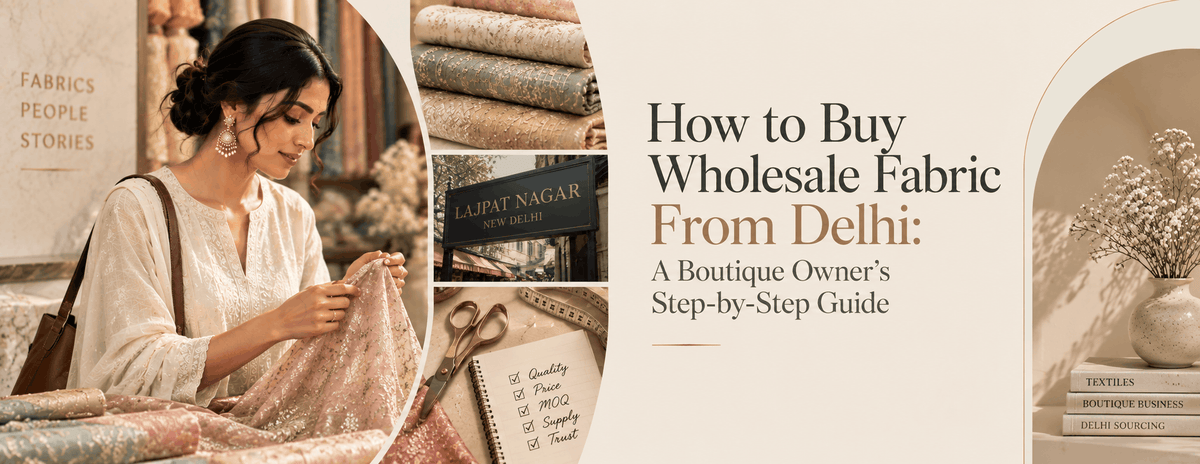
How to Buy Wholesale Fabric From Delhi: A Boutique Owner's Step-by-Step Guide
Wholesale Reference Guides · 12 minute read · Published 14 October 2026
Most first bulk orders do not fail at the counter. They fail three weeks earlier, in the part nobody writes down.
A boutique owner arrives in Delhi with a phone full of saved pictures and a rough idea of a budget. She sees forty beautiful things in two hours. She buys eleven of them. Back home, four of those eleven have no customer waiting and no second piece available in the same shade.
At our counter in Lajpat Nagar the buyers who come back year after year are not the ones with the best eye. They are the ones who turned buying into a repeatable order of steps.
Settle what you need on paper before you settle what you like in person. Every other step is built on that one habit.
Four things to fix before your first Delhi order
- Write the requirement as garments. Not as fabric names. How many pieces, for which customer, by which date.
- Decide in person or from your desk. The two routes need different preparation. Pick one before you start.
- Ask for a cutting from the lot that will travel. Not a reference piece that lives on the shelf.
- Agree the commercial side out loud. Quantity, shade window, packing, transport plus who carries a short cut.
A good buyer is not the one who negotiates hardest. It is the one who asks the right question before anything is cut.
Quick answer: Buying wholesale fabric from Delhi works as a sequence rather than a shopping trip. Write your requirement as finished garments first. Shortlist suppliers who answer questions in writing. Ask for a cutting from the dispatch lot. Settle quantity, shade window, packing plus transport in plain words before anything is cut. Record the lot reference so a reorder is possible. Boutique buyers who want the Delhi sourcing background in one place can read the Delhi wholesale fabric guide from Paras Gallery Fabrics.
Why a Delhi order goes wrong before the money moves
Nobody asks how to buy wholesale fabric from Delhi because the cloth is hard to find. Delhi is not short of cloth. That is the problem.
Walk through Lajpat Nagar on a working morning and the range is wider than any one boutique can use in a year. Choice without a brief turns into drift. You pick what catches the eye at ten in the morning, then compare it at four in the afternoon against something else that caught the eye. By evening the list has no shape to it.
The second failure is quieter. A buyer asks for a rate before she asks for anything else. The rate becomes the whole conversation. Nobody discusses how long the shade will stay matchable, how the lot will be packed, what happens if a roll is short. Those are the things that actually decide whether the order was good.
So the sequence below puts the rate conversation late on purpose. Not because price does not matter. Because a rate means nothing until you know exactly what you are rating.
Step one: write the requirement as garments, not as fabric
Before you book a train, open a notebook and list what you are actually making this season. Each line should read like a garment, with a count plus a date against it.
Twenty anarkalis for the festive rail by the second week of November. Six bridal lehengas against confirmed bookings. A dupatta run to sell alongside both. That is a requirement.
Now convert each garment line into what the cloth has to do. A bridal lehenga needs weight and structure. A festive anarkali needs fall. A dupatta needs to carry colour without adding bulk. You are describing behaviour, not naming a fabric yet.
This is the part most buyers skip. It is also the part that protects every later step. Once the requirement is written as behaviour plus counts plus dates, you can walk past forty beautiful rolls without flinching, because none of them answer anything on your list.
One more line belongs on that page. Mark which items are already sold and which are speculative. Confirmed bookings deserve the heavy cloth with the long lead time. Speculative stock deserves whatever you can reorder easily.
The three ways boutiques actually buy
Before you plan the trip, work out which of these three you are. They need different preparation. Mixing them is what wastes a journey.
Step two: send a requirement that gets a usable answer
A message that says "send rate list for georgette" gets you nothing you can use. The reply will be a wall of options.
A message that works has five parts. What the cloth is for. Roughly how much you need. The colour family. When you need it. Whether this is a one off or something you expect to repeat.
So: "Need a fall cloth for twenty festive anarkalis, deep shades, want dispatch by first week of November, likely to repeat in spring." Any decent counter can answer that in one reply with three or four real options.
Ask for pictures taken in daylight against a plain background. Ask whether the piece shown is running stock or a sample. Ask whether the same shade is available in quantity today, not whether it can be arranged. Those two answers are different. The gap between them is where most delays live.
Step three: what a cutting has to prove
Never scale an order from a photograph. Ask for a cutting. Be specific about which cutting you want.
The piece you want is from the lot that would actually be dispatched to you. A reference swatch kept on a shelf tells you what the design looks like. It does not tell you what this week's roll looks like.
When the cutting reaches you, give it ten minutes of real attention rather than a glance.
- Two lights. Look at it in daylight near a window, then under the warm bulb your shop actually uses. Deep shades move the most between the two.
- Fold and release. Squeeze a corner, hold it, open your hand. Watch whether it springs open or keeps a sharp line. That tells you how it will arrive after transport.
- Hold it the way the garment will hang. Drape it over your forearm rather than laying it flat. Flat cloth lies to you about fall.
- Rub test for colour. A damp white cloth over the darkest part. If colour transfers, you want to know now.
- Show it to your tailor. He will tell you in one minute whether it behaves on a machine, which is a question you cannot answer by looking.
If a cutting passes all five, you have a real basis for a bulk order. If it fails one, ask for an alternative rather than talking yourself into it.
Step four: read the open roll, not the corner
If you are standing in the market, you get to check the roll itself. Use that properly.
Ask for the roll to be opened at a length rather than a corner. A corner is always the best part. Look down the open length for shade variation from one end to the other, for weaving faults, for any patch where the pattern repeat breaks.
Check the width yourself with the tape. Width decides how many pieces come out of a metre, so a small difference changes your whole costing without anyone mentioning it.
If the design has a repeat, measure one full repeat. Long repeats waste cloth on panel work. That waste is yours, not the supplier's.
Then ask the one question most buyers forget. Ask how much of this exact lot is left. A design you love is useless to you if there are nine metres of it in the building.
Step five: settle the commercial side in plain words
Now the rate conversation makes sense, because both sides know exactly what is being discussed.
Settle these in the same sitting. Get them into the message thread afterwards so there is a record. Quantity in the unit the supplier actually sells in. The shade window, meaning how long this shade can be matched. Who packs it and how. Which transporter carries it and who books them. What happens if a roll runs short of the stated length. What happens if you need to add to the order next week.
Each of those has caught a buyer I know at least once. None of them are awkward questions. A counter that minds being asked is telling you something useful about itself.
Step six: write down what makes the reorder possible
Almost every reorder problem traces back to a missing note.
Before the lot leaves, record the design reference, the lot or batch reference, the shade name the supplier uses rather than the one you use, the width plus the date. Keep a small cutting of the actual dispatched cloth stapled to that note.
Six weeks later, when a customer wants a second piece, that cutting is the only thing that settles whether the new roll matches. Memory does not do it. A phone picture does not do it either, because screens shift colour.
Dye lots drift. That is normal and it is not anybody cheating you. The buyers who handle it well are simply the ones who can prove what the first lot looked like.
Step seven: open the bale the day it lands
Open it the day it arrives, even if you are busy. A discrepancy raised the same week is a conversation. The same discrepancy raised next month is an argument.
Count the pieces against the invoice. Measure one roll end to end rather than trusting the label. Compare the cloth against your stapled cutting under your own bulb. Look at the outer layers for transit marks, because the outside of a bale takes the beating.
If something is off, photograph it where it sits, before cutting anything. Send it into the same thread you have been using. Nothing settles a short measure faster than a picture of the roll with a tape across it.
What changes when you never visit Delhi
More boutique owners now buy from Delhi without visiting it. The process holds. Three parts of it need more weight.
Cuttings matter more, because they are your only physical contact with the cloth. Ask for them every time, even on a repeat, when the shade has to match something.
The written thread matters more, because you have no counter conversation to fall back on. Confirm each agreed point back in your own words and let the supplier correct you.
Transport matters more, because a bale crossing the country is handled by people neither of you has met. Agree who books it, who pays, how it is marked plus what the expected transit looks like, before dispatch rather than after.
A video call while the roll is open solves more than any amount of messaging. Ask for one. Most counters will do it without blinking.
The mistakes that cost first time buyers the most
- Buying the whole season in one visit. Split it. Confirmed bookings first, speculative stock once you can see what is moving.
- Shopping without the written requirement. The list is what lets you say no to beautiful things you cannot sell.
- Approving a shelf swatch instead of a dispatch cutting. They are different pieces of cloth.
- Leading with the rate. It turns a sourcing conversation into a haggle before anyone has described the cloth.
- Keeping no lot record. This is the single most common reason a reorder cannot be matched.
- Opening the bale a fortnight late. Every remedy gets harder with time.
What to do at the counter
- Before you go: requirement written as garments with counts plus dates, confirmed bookings marked separately, tape plus torch packed.
- Step 1: send the five part requirement message and ask what is running in quantity today.
- Step 2: get a cutting from the dispatch lot and run the five checks on it.
- Step 3: open the roll at a length, check width plus repeat, ask how much of the lot remains.
- Then confirm: settle the commercial points in writing, staple the dispatch cutting to the lot note, then open the bale the day it arrives.
Questions buyers ask at the counter
How do I buy wholesale fabric from Delhi if I have never done it before?
Learning how to buy wholesale fabric from Delhi is less about the market than about the order you do things in. Start by writing your requirement as finished garments with counts plus dates rather than as fabric names. Shortlist counters that answer questions in writing. Ask for a cutting from the lot that would be dispatched to you. Check it in daylight plus your shop light, settle the commercial points in plain words, then keep your first order deliberately small.
Do I have to visit Delhi in person to place a bulk fabric order?
No. Plenty of boutique buyers now order from another city entirely. Remote buying asks for more written confirmation plus a cutting every time, because the message thread becomes the only shared record. A video call with the roll open fills most of the gap a visit would have filled.
What should I check on a fabric cutting before placing a bulk order?
Look at it in two lights, fold it in your fist to see how it recovers, drape it the way the garment will hang rather than laying it flat, rub a damp white cloth over the darkest shade, then show it to your tailor. A cutting that passes all five is a reasonable basis for scaling up.
Why does my reorder never match the first lot exactly?
Dye lots drift between batches and deep shades drift most. It is normal rather than a sign of anything wrong. The fix is a record: keep the lot reference plus a stapled cutting of the cloth that was actually dispatched, then ask at the time of the first order how long that shade stays matchable.
What should I do the day a wholesale fabric lot reaches my shop?
Open it that day. Count pieces against the invoice, measure one roll end to end, compare the cloth with your stapled cutting under your own light, then check the outer layers for transit marks. If anything looks off, photograph it before cutting anything plus raise it in the same thread the same week.