Allover Embroidery Fabric Wholesale: What Coverage Density Really Costs You
Two thaans on the counter. Both sold to you as allover embroidery, both on the same georgette base, both in the same shade family. One is quoted at Rs 600 a metre. The other is Rs 1,900. Neither seller is lying to you.
Allover describes where the work sits, not how much of it there is. It means the embroidery runs across the full width and full length with no fixed placement, which is why you can cut a panel from anywhere on the roll. The word says nothing about coverage. So the entire buying decision on allover goods comes down to grading a number that almost nobody states on a quotation.
Quick answer: On allover embroidery fabric you are buying coverage density, not design. Hold the cloth to daylight and judge how much ground still shows, then weigh a metre, since weight tracks density and weight is what decides drape. Match density to ground weight rather than to taste. Check the frame join across the width, where spacing and shade shift. Delhi trade rates run roughly Rs 420 to Rs 2,600 per metre.
What you are actually buying is the freedom to cut anywhere
Start with why this category exists at all. On placed goods the work has to land somewhere specific, so every cut is planned around it. Allover goods remove that constraint. A blouse, a kurta yoke, a sleeve, a lehenga panel can all come out of the same length in whatever order the marker plan prefers.
For a boutique running mixed orders that is worth real money. Your cutting wastage falls to whatever the pattern shapes leave behind, with no dead length added for placement. A single thaan can serve four different garments in a week. Nothing else in the embroidered shelf behaves that way.
Which is exactly why the category gets abused. Because there is no placement to check, buyers tend to grade allover goods the way they grade a plain fabric, by look and hand feel, then negotiate on rate. The one variable that moves the price by three times over never gets measured.
Grade coverage by how much ground you can still see
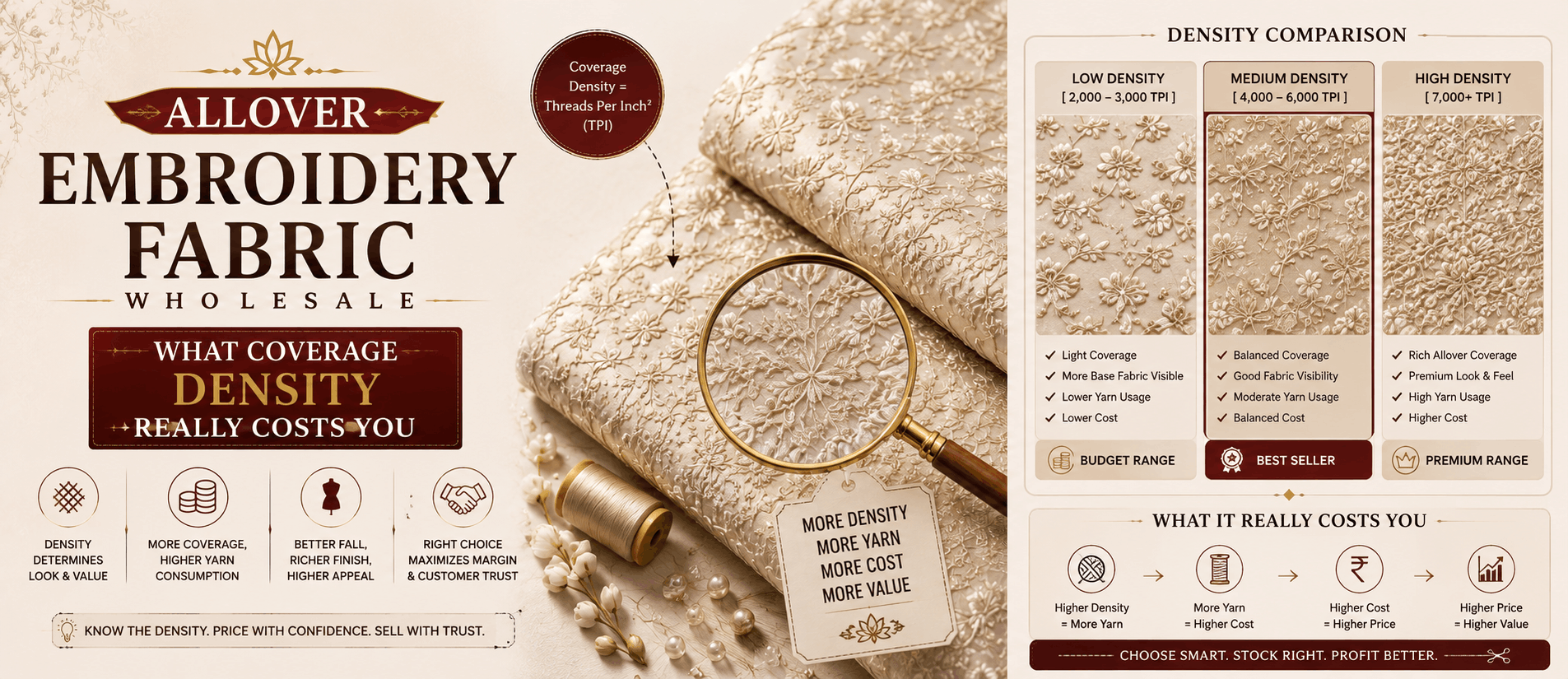
There is no industry number for this, so use your eyes in a repeatable way. Hold a single layer up against a window in daylight, at arm's length, then judge what reads first, the ground or the work. Four bands cover almost everything on a Delhi counter.
Open coverage. Motifs sit clearly apart. The ground colour is what the eye reads from across a room, with the work giving texture. Light, cheap to produce, forgiving on drape. Medium coverage. Ground and work read about equally, with motifs close enough to touch or nearly touch. This is the workhorse band for festive suits plus daywear sarees. Close coverage. The work dominates, ground shows only as gaps between motifs. Heavier, considerably dearer, mostly used where the garment has to carry a room. Blind coverage. Almost no ground visible at all. Usually bead, sequin or heavy thread built up until the base is a carrier rather than a surface.
Write the band on your enquiry before you ask for a rate. It changes the conversation completely, because a seller who knows you have graded the cloth will not offer you an open coverage against a close coverage quotation. You can see how the four bands read against each other across running designs in our allover embroidered fabric collection.
Density decides drape long before it decides price
Here is the failure boutiques repeat every season. A close coverage is chosen on a soft base because the sample square looked rich on the counter. The suit is stitched and it hangs like board. Nobody can point to a defect, yet the garment is wrong.
Embroidery adds weight and it also adds stiffness, because every stitch pins the ground yarns and stops them sliding. A fabric that drapes by yarn movement loses that movement as coverage climbs. Fine georgette, chinon plus soft net all drape by movement. Put a blind coverage on them and you have removed the property you paid for the base to have.
So match the two. Open to medium coverage belongs on the fluid grounds where fall matters, which is most saree, dupatta plus flared kurta work. Close to blind coverage belongs on grounds that were structured to begin with, meaning net, organza, silk, tissue or a firmer georgette, where the design intends the cloth to hold a shape. Weigh a metre if you can, because weight per metre is the honest version of a coverage grade, plus it is the number your tailor will care about when the garment is lined.
What allover work costs in the Delhi market, by density band
| Coverage band | Typical components | Usual grounds | Best garment use | Delhi trade price (per metre) |
|---|---|---|---|---|
| Open thread work | Machine thread, small buti | Georgette, chinon, cotton | Daywear suits, office kurtas | Rs 420 to Rs 640 |
| Medium thread with zari accents | Thread plus fine zari | Georgette, organza, chanderi | Festive suit sets, dupattas | Rs 700 to Rs 1,050 |
| Medium sequin allover | Sequin with thread fill | Net, organza, satin | Sangeet wear, party kurtis | Rs 950 to Rs 1,450 |
| Close bead and sequin | Bead, sequin, katdana mix | Net, silk, firm georgette | Lehenga panels, gowns | Rs 1,500 to Rs 2,100 |
| Blind coverage bridal | Built-up mixed handwork | Net, silk, velvet base | Bridal lehengas, heirloom orders | Rs 2,000 to Rs 2,600 |
Read the table down the ground column rather than across the price column. Most costing mistakes on allover goods are not about paying too much, they are about buying the right density on the wrong base. The broader shelf, sorted by base and by work type, sits in our embroidered fabric range if you want to compare the same coverage band across three different grounds before committing.
The frame join is the seam nobody tells you about
Embroidery frames are narrower than most fabric widths, so a full panna of allover work is produced in runs that meet somewhere across the width. Where two runs meet you get a join line. On good goods it is invisible. On rushed goods it announces itself.
Two things shift at the join. Spacing first, because the operator sets the start of the second run by eye and a few millimetres of error reads as a visible channel or an overlap down the length. Shade second, since a fresh cone of thread from a different lot will not match perfectly, plus on a large flat panel the eye picks up a shade step it would never notice on scattered motifs.
Open the thaan to full width at the counter and walk your eye across it. Then decide where the join will fall on your garment. A join running down a lehenga panel front is a rejection. The same join sitting inside a side seam or under a pleat costs you nothing. This is one of the few faults you can design around instead of returning, provided you know it is there before the cloth is cut.
Where the rate breaks: quantity tiers on allover goods
| Tier | Typical quantity | Rate movement | Who it suits |
|---|---|---|---|
| Cut piece trial | 1 to 2 m, full width | Retail rate | Testing density against a ground before bulk |
| Single thaan | About 18 to 22 m | 7 to 11 percent off retail | Boutiques cutting mixed garments from one design |
| Trade bulk | 5 to 20 thaans | 13 to 20 percent off retail | Resellers running a season line |
| Frame-run booking | 25 thaans and above, one lot | Lot-linked rate on request | Labels needing shade continuity across a run |
The top tier buys something the others cannot. When a whole run is worked in one booking, the thread comes off one lot plus the frames stay set, so shade continuity holds from the first thaan to the last. Anyone stitching a garment that uses three or four cut lengths together will feel the difference immediately. Anyone reordering the same design six weeks later will feel its absence.
Whatever the tier, put three things on the bill instead of a design number: coverage band as you graded it, usable width in inches after the selvedge, plus the lot or batch reference. The lot reference is the only thing that gives a reorder any chance of matching.
Three faults that only surface after the cloth is cut
Needle damage comes first. Dense work on a fine ground means thousands of penetrations per square inch, plus a blunt or oversized needle leaves permanent pinholes. Hold a suspect area to light and look at the ground between motifs. Scattered bright points mean the ground has been perforated, so the panel will run or tear along the stitch line under stress. It is invisible against a counter light and obvious against a window.
Backing residue comes second. Heavier allover work is stabilised with a backing paper or film that is torn away afterward. On close coverage the fragments trapped under stitches never come out, which is what makes some allover goods feel papery rather than soft. Crush a corner in your fist and release it. Cloth that crackles has backing still in it, plus that will not improve after stitching.
Shade banding comes third and it is different from the join line. Long runs on one design get worked in sittings, so a band of slightly deeper colour can appear across the width where a session changed. Roll out four or five metres rather than judging a folded sample, because banding is only visible over length.
What to settle before the allover booking leaves your hands
- Grade the coverage against daylight and name the band. Open, medium, close or blind, written on the enquiry before any rate is discussed.
- Match density to ground weight, not to the sample square. Fluid grounds take open to medium, structured grounds take close to blind.
- Open the full width and find the frame join. Then decide where it lands on your pattern before the cloth is cut.
- Hold the ground to a window and look for pinholes. Needle damage on a fine base is permanent plus it fails in wear.
- Record the lot reference on the bill. Without it a reorder six weeks out is a fresh shade approval.
What buyers ask before booking allover goods
Is allover embroidery always more expensive than placed embroidery?
Per metre, usually yes, since more of the surface carries work. Per finished garment, often no. Placed goods force you to cut around a fixed motif position, so a share of every length is dead cloth that you paid for and cannot use. Allover goods let the marker plan sit wherever it likes, which pulls cutting wastage down to the pattern shapes alone. For a boutique cutting several garment types from one design the total frequently lands lower on allover even at a higher rate per metre. Run the comparison on cost per garment rather than on the quotation, plus include the offcut you would have carried on the placed alternative.
How do I compare two allover quotations that look identical?
Put both samples against daylight side by side and grade the coverage band first, because that single difference accounts for most price gaps in this category. Then compare usable width after the selvedge, since two rolls quoted at the same rate can differ by four or five inches of cuttable cloth, which changes your yield per metre. Third, weigh equal squares from each. Weight is the closest thing to an objective density reading you can take at a counter. Only after those three should you look at component quality, meaning bead finish, thread lustre plus stitch tension. Sellers expect the last conversation and rarely expect the first three.
Why does the same allover design look different on two grounds?
Because the ground contributes at least half of what the eye reads. A net base lets light through between motifs, so the work appears to float plus the design reads open even at medium coverage. The same design on satin sits against a solid reflective surface, so it reads heavier and the shade of the thread shifts against the sheen. Organza sits in between, holding shape while still passing light. This is why a design number alone is never a reorder instruction. Specify design plus ground plus coverage band together, or you will approve a sample that looks nothing like the goods you remember.
Does allover fabric need lining on every garment?
It depends on component type rather than on density. Thread work on an opaque ground usually needs no lining beyond what the silhouette calls for. Anything with bead, sequin, katdana or cutdana needs a lining because the reverse of the work sits against skin and the knots abrade. Sheer grounds need lining regardless of coverage, since gaps between motifs are see-through by design. Budget the lining as part of the fabric decision rather than as a stitching afterthought, because on close coverage goods the lining choice also affects how the finished garment hangs.
Booking allover embroidered fabric at trade rates
If you run a boutique, a label or a reselling line, the practical route to trade pricing on allover goods is the wholesale programme. You get thaan rates, coverage band stated on the quotation rather than left to the sample, usable width declared after the selvedge, frame join position noted before dispatch, ground pinhole check on fine bases, lot reference printed on every bill for reorder matching plus frame-run bookings where one lot carries a whole season line. See the tiers and register on our wholesale fabric page to open your first bulk allover order.