
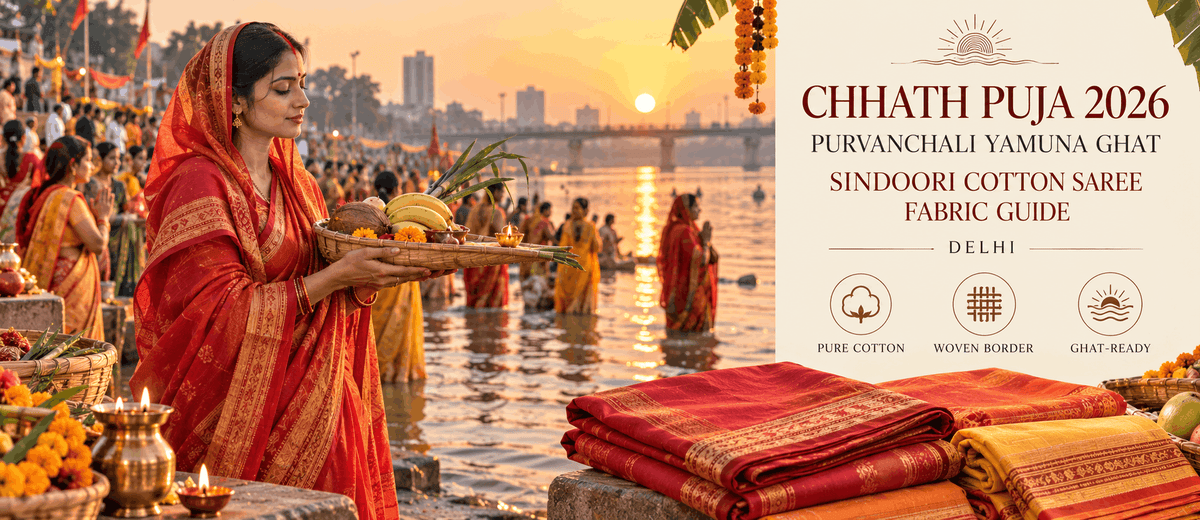
Chhath Puja 2026: Purvanchali Yamuna Ghat Sindoori Cotton Saree Fabric Guide (Delhi)
Quick Answer (Chhath Puja Sindoori Cotton Saree Fabric, In 90 Seconds)
Chhath Puja falls across 13 to 17 November 2026. Nahay-Khay is Friday 13 November, Kharna Saturday 14 November, Sandhya Arghya Monday 16 November evening, and Usha Arghya Tuesday 17 November before sunrise. The Purvanchali women's fabric register is a 6-metre pure cotton saree cut in sindoori (deep orange-red), turmeric-yellow, or parrot-green, always with a red or gold woven border, and always new and unwashed for the vrat. Budget sits at Rs.700 to Rs.1,600 per saree cut at Paras Gallery, blouse piece Rs.180 to Rs.260. Order Delhi by Wednesday 11 November for a Monday-Tuesday cluster.
Who This Guide Is For
Purvanchali (Bihari, Bhojpuri, Eastern-UP-origin) women in Delhi who observe Chhath Puja and travel to Yamuna ghat (ITO ghat, Kalindi Kunj ghat, Wazirabad ghat, Nigam Bodh ghat, and the CWG Village ghat) for the Sandhya Arghya and Usha Arghya rituals. Also for family members buying the saree fabric for a Chhath-vrati mother, wife, sasu-maa, or elder sister.
From The Counter Desk
At our Paras Gallery Fabrics counter in Central Market, Lajpat Nagar, the ten days before Chhath bring in a specific stream of Purvanchali households. "Bhaiya, sindoori chahiye. Naya chahiye. Kori bhi chahiye. Chhath ke vrat ke liye." Deep orange-red, brand new, unwashed. For the Chhath fast.
The Chhath fabric register is one of the strictest in the Hindu festival year. The saree must be new. It must be unwashed. It must be cotton (never a mixed synthetic). The colour holds to a narrow band of sindoori, turmeric-yellow, or parrot-green. The border must be red or gold woven, never printed. And the vrati wears the same set across both Sandhya and Usha Arghya, drying it overnight on the ghat rope or at home.
Why The Chhath Register Is Different
- The saree stands in river water. Cotton is the only working choice. Silk stains, chanderi absorbs river silt, synthetic clings uncomfortably in the November evening chill.
- New and unwashed. Chhath prohibits any wear before the vrat. Order the saree with the mill fold still intact. Do not pre-wash.
- The saree wears twice in twelve hours. Sandhya Arghya at sunset Monday, Usha Arghya at dawn Tuesday. The vrati either dries it on a rope at the ghat overnight or brings a second identical set. Cotton dries in three to five hours of the November breeze.
- The colour is tied to Chhathi Maiya and Surya. Sindoori for the sunset offering, turmeric-yellow for the dawn, parrot-green for the middle-day family Kharna. Never white (departed-soul register), never black (never a Chhath colour), never deep blue.
The Four Chhath Vrat Cotton Sarees That Work
Each option is a 6.3-metre running pure-cotton cut, stocked in the Chhath week at our counter.
1. Sindoori (deep orange-red) plain cotton with a woven gold border, Rs.900 to Rs.1,400 per piece
The Sandhya Arghya default. Deep orange-red body, one and a half inch woven gold border. Photographs well at sunset in the water. Blouse piece in matching sindoori cotton, Rs.220.
2. Turmeric-yellow plain cotton with red woven border, Rs.850 to Rs.1,300 per piece
The Usha Arghya morning choice. Warm yellow body, red border. Reads dawn well. Some vratis wear this set for Kharna evening too, then change to sindoori for Sandhya Arghya.
3. Parrot-green cotton with red or maroon border, Rs.700 to Rs.1,100 per piece
For Kharna day (Saturday) and the puja-cooking hours. Also the correct choice for the vrati's daughter or bahu who helps at the ghat but does not fast herself.
4. Handloom cotton with woven zari border in Chhath-red, Rs.1,300 to Rs.1,600 per piece
For the household matron or older bahu who has kept the Chhath fast for twenty years and wants a step above the standard mill-cotton register. Reads senior, and the zari border catches the diya-light on the ghat.
The Chhath Colour Register (What The Vrati Wears When)
| Day | Ceremony | Colour Register |
|---|---|---|
| Fri 13 Nov | Nahay-Khay (bathe and eat) | White or off-white cotton (yes, white is allowed only for Nahay-Khay) |
| Sat 14 Nov | Kharna (evening kheer prasad) | Parrot-green or turmeric-yellow cotton |
| Sun 15 Nov | Fast day, home rest | No specific rule, cotton in any Chhath-friendly colour |
| Mon 16 Nov | Sandhya Arghya at ghat | Sindoori (deep orange-red) with gold or red border |
| Tue 17 Nov | Usha Arghya at dawn | Turmeric-yellow with red border, or repeat sindoori |
Some vratis wear the same sindoori set for both Sandhya and Usha, drying it overnight. Others carry two sets. Both are correct.
What A Real Chhath Family Order Looks Like
A Purvanchali household in Vikaspuri walked in ten days ago. Vrati is the mother (48), fasting for 22 years. Below is the register we built.
- Sandhya Arghya set: sindoori cotton with woven gold border, Rs.1,200, blouse Rs.220
- Usha Arghya set: turmeric-yellow cotton with red woven border, Rs.950, blouse Rs.200
- Kharna set: parrot-green cotton with maroon border, Rs.800, blouse Rs.200
- Nahay-Khay set: off-white cotton with narrow red border, Rs.750, blouse Rs.180 (used from her existing stock; only fabric bought for the blouse)
Total three new saree cuts plus one blouse, around Rs.3,570. Delivered by Wednesday evening. Vrati keeps all pieces folded in a fresh cotton cloth, mill fold intact, until Nahay-Khay morning.
Delivery Timeline For A Chhath Cluster
- Nahay-Khay saree (if buying new): order by Tuesday 10 November evening for Friday morning wear.
- Kharna set: order by Wednesday 11 November evening.
- Sandhya Arghya sindoori and Usha Arghya yellow sets: order together by Wednesday 11 November evening for a safe Monday-Tuesday cluster.
- Blouse stitching: three-day turnaround at Lajpat Nagar tailor. Book by Thursday 12 November morning.
Do not delay the order. Chhath cotton in sindoori and turmeric-yellow with woven borders sells out at every Delhi wholesale hub in the last three days before the Sandhya Arghya. Our counter holds stock until Saturday 14 November, then only mixed lots remain.
Practical Rules For The Ghat Wear
- Do not stitch the saree with lining or an inner petticoat frill. Simple petticoat, plain cotton, no lace. The vrati stands in water; frills tangle.
- Blouse should be high-neck, elbow-length or three-quarter sleeve, cotton. Sleeveless is not the Chhath register.
- Fall attachment is standard. The saree's edge takes a wet-and-dry cycle. A cotton fall protects the border.
- No jewellery except the vrati's suhaag set. Chhath is a Surya vrat, not a display occasion.
- Chunari-style pallu over the head is required at the ghat. The pallu length matters: 1.2 metres of pallu, not less.
What The Vrati Skips From The Standard Festival Playlist
- Sequin work, katdana, zari heavy embellishment. Snag on the water plants, catch mud, unsafe.
- Georgette, chiffon, crepe. Cling to the body wet, do not dry overnight, cold in November evening.
- Deep maroon or black. Neither is a Chhath colour. Sindoori sits close to red but is a different shade with a specific ritual meaning.
Collections Referenced In This Guide
This guide references Paras Gallery's cotton fabric collection for the pure-cotton sindoori, turmeric, and parrot-green base, the printed cotton collection for small-motif Kharna alternatives, the hand-print collection if the family wants a Kharna green with a woodblock motif, and the chanderi collection for the household matron's handloom step-up. For a family group appointment, book a counter appointment. For fabric quantity confirmation, use the fabric estimator. For a Bihari Association or Purvanchali Samaj bulk buy, register on the wholesale page.
FAQs
Q1. Can the Chhath saree be washed before the vrat, even a light rinse?
No. Chhath tradition is strict about the saree being new and unwashed at the time of Sandhya Arghya. Buy the saree with the mill fold intact and open it only on Nahay-Khay morning.
Q2. My vrati mother has kept Chhath for thirty years and wears her old sindoori saree every year. Is that acceptable?
That is a household practice question. The strict register asks for a new saree each vrat. Many long-fasting vratis carry the same saree year on year as a personal Chhathi Maiya connection. Neither is wrong. If she asks for a new one this year, our counter can match the same sindoori shade she has been wearing.
Q3. Can I wear a silk-cotton blend for the Sandhya Arghya?
Not recommended. The register asks for pure cotton because the saree gets wet standing in river water. Silk-cotton blends absorb river silt and stain during the offering.
Q4. What is the tailor cost for a Chhath blouse in Lajpat Nagar?
Rs.400 to Rs.500 for a high-neck, three-quarter or elbow-length cotton blouse with a small V at the back. Add Rs.100 for the fall attachment on the saree.
Q5. My family goes to Kalindi Kunj ghat. Do I need a different fabric weight than for a Yamuna Bank ITO ghat visit?
No. The same 100 to 120 GSM pure cotton works at every Yamuna ghat. What varies is the walk distance from the parking to the water edge. Kalindi Kunj is a longer walk on sand and grass, so wear closed sandals or slippers you can carry easily.
Q6. Can you deliver to Vikaspuri, Uttam Nagar, or Dwarka in time for the Chhath cluster?
Yes. Any order placed by Wednesday 11 November 1 PM at the counter reaches Vikaspuri, Uttam Nagar, or Dwarka by Thursday evening through our regular bike-courier at Rs.120 to Rs.250 per delivery.
Book a counter appointment: parasgalleryfabrics.com/pages/book-an-appointment
Fabric estimator: parasgalleryfabrics.com/pages/fabric-estimator
Wholesale enquiries: parasgalleryfabrics.com/pages/wholesale
WhatsApp: +91 96544 40244
Store: Central Market, Lajpat Nagar, New Delhi


%0AChhath%20Puja%20falls%20across%2013%20to%2017%20November%202026.%20Nahay-Khay%20is%20Friday%2013%20November,%20Kharna%20Saturday%2014%20November,%20Sandhya%20Arghya...)