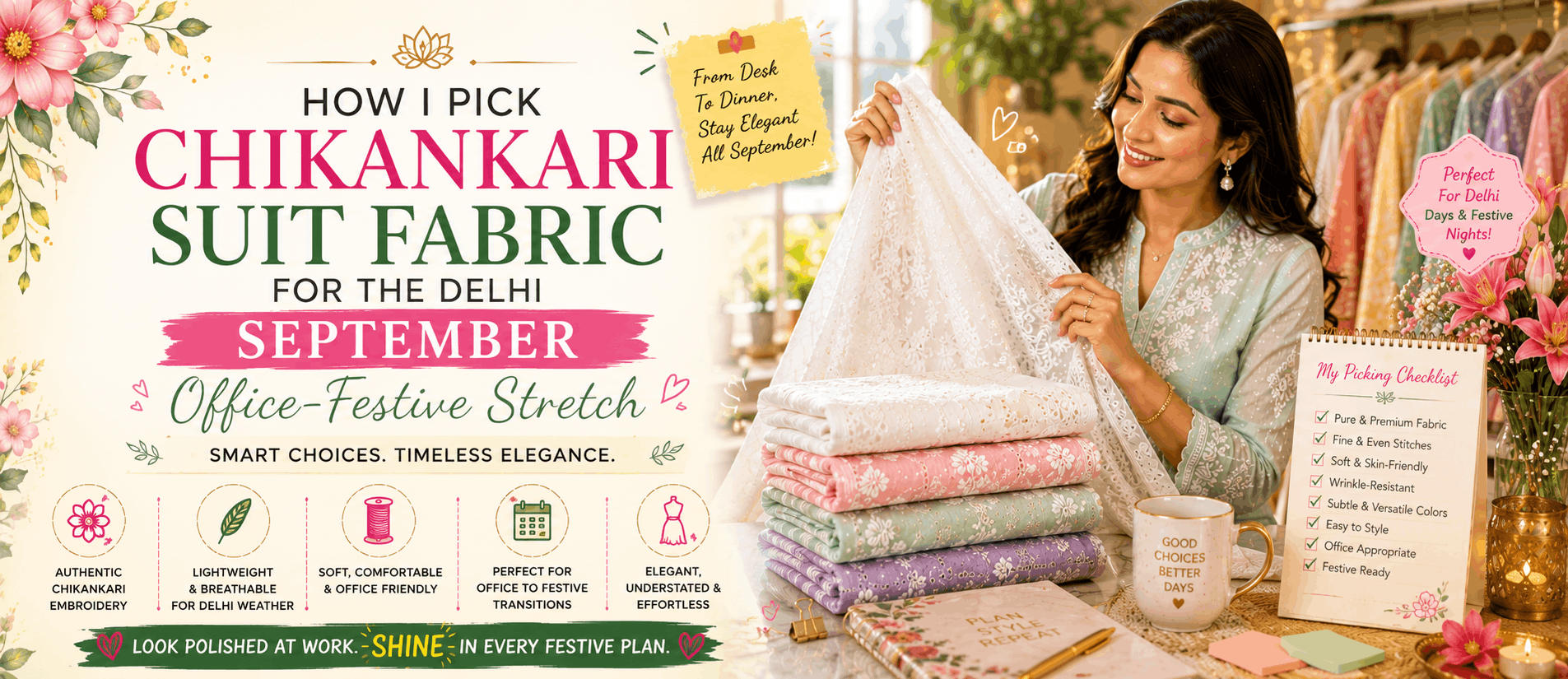
How I Pick Chikankari Suit Fabric for the Delhi September Office-Festive Stretch
September is a heavy month at every Delhi office. Onam lunch on Sept 5. Ganpati puja on Sept 14. Navratri kicks in on Sept 22.
Three office-festive days in three weeks, and no HR budget for three new sarees.
Chikankari suit fabric solves this cleanly. Pastel base, subtle embroidery, cotton comfort. Reads as festive without shouting.
Here is what I sell every September to women asking for one fabric that can carry three occasions.
Quick Answer: For September 2026 office-festive wear, buy 2.5 metres of Chikankari suit fabric for the kurta, 2 metres of matching plain cotton for the bottom, and 2.25 metres of Chikankari or plain chiffon for the dupatta. Total 6.75 metres. One cut, three outfits with dupatta swaps.
Why Chikankari, not printed fabric, for office
Machine-printed Chikan-look cotton wears out. The print sits on the surface. After 3 to 5 washes, the pattern loses depth and the base cotton pills at the collar.
Real hand Chikankari embroidery is stitched by Lucknow artisans onto the base fabric. The threadwork lifts slightly off the cotton. It survives 40 to 60 washes with basic care. The cost per wear is lower over a year.
For an office wardrobe where the same piece cycles every second week, this matters.
The metre plan for a Chikankari suit
Paras Gallery Fabrics sells suit fabric by the metre. That means you buy three separate cuts and stitch locally.
- Top / kurta: 2.5 metres of Chikankari-embroidered cotton, mul, or chanderi
- Bottom / salwar or pants: 2 metres of matching plain cotton, same tone as base
- Dupatta: 2.25 metres, either Chikankari on chiffon or plain chiffon in a contrast pastel
- Total: 6.75 metres
The dupatta and salwar bottom are not bundled. You choose each cut separately.
Base fabric options for Delhi September
- Mul cotton — softest, best for humid September afternoons, drapes soft
- Cotton 60s — mid-weight, holds embroidery well, office-crisp with light starch
- Chanderi silk-cotton — slightly formal, subtle shine, good for post-work festive events
- Georgette — flowier, best for evening office parties, less breathable than cotton
For an office wardrobe, mul or cotton 60s does 80 percent of the September calendar comfortably.
Chikankari stitches that read as real
Real hand Chikankari uses 32 named stitches. You do not need to remember all of them, but three tell you fast whether it is real:
- Bakhiya (shadow work): stitched from behind, shows a faint outline on the front. Machine cannot replicate.
- Murri (rice-grain knot): a small raised knot. Feels textured to touch.
- Phanda (round knot): tiny beaded knot that sits proud of the fabric.
Rub your palm across the embroidery. Hand Chikankari has depth. Printed Chikankari feels flat, like painted paper.
Four Chikankari suit fabric picks for September
1. White-on-white Chikankari on mul cotton
Best for Onam office lunch or Ganpati puja day. Reads as elegant and neutral. Pairs with any pastel bottom. Lightweight, sits well in humid afternoons.
2. Pastel pink with white Chikankari
Best for casual office day plus early Navratri. Pink base with white shadow work. Contrast dupatta in mint green or lemon yellow. Reads gentle festive, not loud.
3. Mint green Chikankari with silver sequins
Best for evening office puja or post-work Ganpati aarti. Subtle silver mukaish scattered inside the embroidery. Catches puja diya light. Not for daytime full sun, silver reads harsh in direct September glare.
4. Off-white chanderi with multi-colour Chikankari
Best for Navratri office days when colour rotation matters. Cream base with red, green, and yellow stitching. Reads Navratri-appropriate across the nine days. Slightly heavier drape, best for cooler September evenings.
Common mistakes at the Chikankari counter
Buying stitched Chikankari suits. Ready-made suits assume standard measurements. A working woman needs proper armhole and kurta length. Buy fabric, stitch locally.
Skipping the dupatta cut. Ask for the dupatta cut same day. Matching Chikankari base fabric later is nearly impossible.
Ignoring the wrong side. Real Chikankari looks nearly as clean on the reverse. Machine prints show a rough back with visible ink bleed.
Choosing bright colours. September Delhi light is harsh. Pastels photograph better than jewel tones for office selfies.
Storing on hangers. Hand-embroidered kurta pulls at shoulder seams on hangers. Fold flat with tissue paper between folds.
What Chikankari suit fabric costs in Delhi (August 2026)
Wholesale rates at Lajpat Nagar for cut-piece orders. Retail runs 30 to 50 percent higher for hand pieces.
| Chikankari type | Per metre | Full suit (6.75 m) |
|---|---|---|
| Machine-print Chikan-look on cotton | ₹180–₹280 | ₹1,215–₹1,890 |
| Light hand Chikankari on mul cotton | ₹420–₹680 | ₹2,835–₹4,590 |
| Medium hand Chikankari on cotton 60s | ₹680–₹1,100 | ₹4,590–₹7,425 |
| Heavy hand Chikankari on chanderi | ₹1,150–₹1,850 | ₹7,760–₹12,485 |
| Chikankari with mukaish on georgette | ₹1,400–₹2,400 | ₹9,450–₹16,200 |
Rates hold for 5-metre orders and above. Single-piece cuts add ₹50 to ₹90 per metre. Handwork prices vary by stitch density (per booti count).
Styling for three office-festive days
- Onam lunch (Sept 5): white-on-white Chikankari, off-white palazzo, temple gold jhumkas, tan kolhapuris
- Ganpati puja (Sept 14): pastel pink Chikankari, contrast mint dupatta, small pearl studs, gold flats
- Navratri day 1 (Sept 22): off-white chanderi with red-green-yellow Chikankari, matching salwar, silver jhumkas
Same three cuts, three dupattas, three occasions covered.
Ready to cut for September?
If you want a Chikankari swatch delivered to a Delhi NCR address before you commit, WhatsApp +91 96544 40244 or browse our hand Chikankari suit fabric online.
For plain bottom fabric in matching tones (2 metres per suit), see our plain cotton bottom fabric range. Boutique owner sourcing hand Chikankari for a September office-festive drop? Our wholesale Chikankari suit fabric desk handles 20-metre-plus rolls with fixed rate cards.
FAQ
How many metres of Chikankari suit fabric do I need?
A full suit needs 2.5 metres of embroidered top, 2 metres of matching plain bottom, and 2.25 metres for the dupatta. Total 6.75 metres. Paras Gallery Fabrics sells all three cuts separately by the metre — dupatta and salwar bottom are not bundled with the top.
Can I wear Chikankari to a Delhi office in September?
Yes. Pastel Chikankari on mul cotton reads as elegant office wear year-round. For festive days like Onam or Ganpati puja, add a subtle contrast dupatta and simple gold jewellery. Skip mukaish (silver sequin) versions for direct-sun daytime shoots.
How do I tell real hand Chikankari from machine-printed Chikan-look?
Look at the reverse side. Hand Chikankari shows near-clean stitching on the back. Printed versions show ink bleed and no thread texture. Rub the embroidery — hand work has depth and slight raised texture; prints feel flat.
How do I wash a Chikankari kurta at home?
Cold-water hand wash with mild soap. Do not use detergents with brighteners. Dry flat in shade. Iron on reverse or through a muslin cloth. Store folded flat with tissue paper between folds, not on hangers.
What is the cost per wear for Chikankari suit fabric?
Hand Chikankari on cotton 60s costs around ₹4,590 to ₹7,425 for a full suit cut. It survives 40 to 60 washes with basic care. Worn 20 times in the first year across office-festive days, the cost per wear works out to ₹230 to ₹370, lower than most fast-fashion office kurtas over the same period.
Paras Gallery Fabrics · Shop No. 06, Pushpa Central Market, Lajpat Nagar II, New Delhi 110024 · WhatsApp +91 96544 40244 · Support@parasgalleryfabrics.com