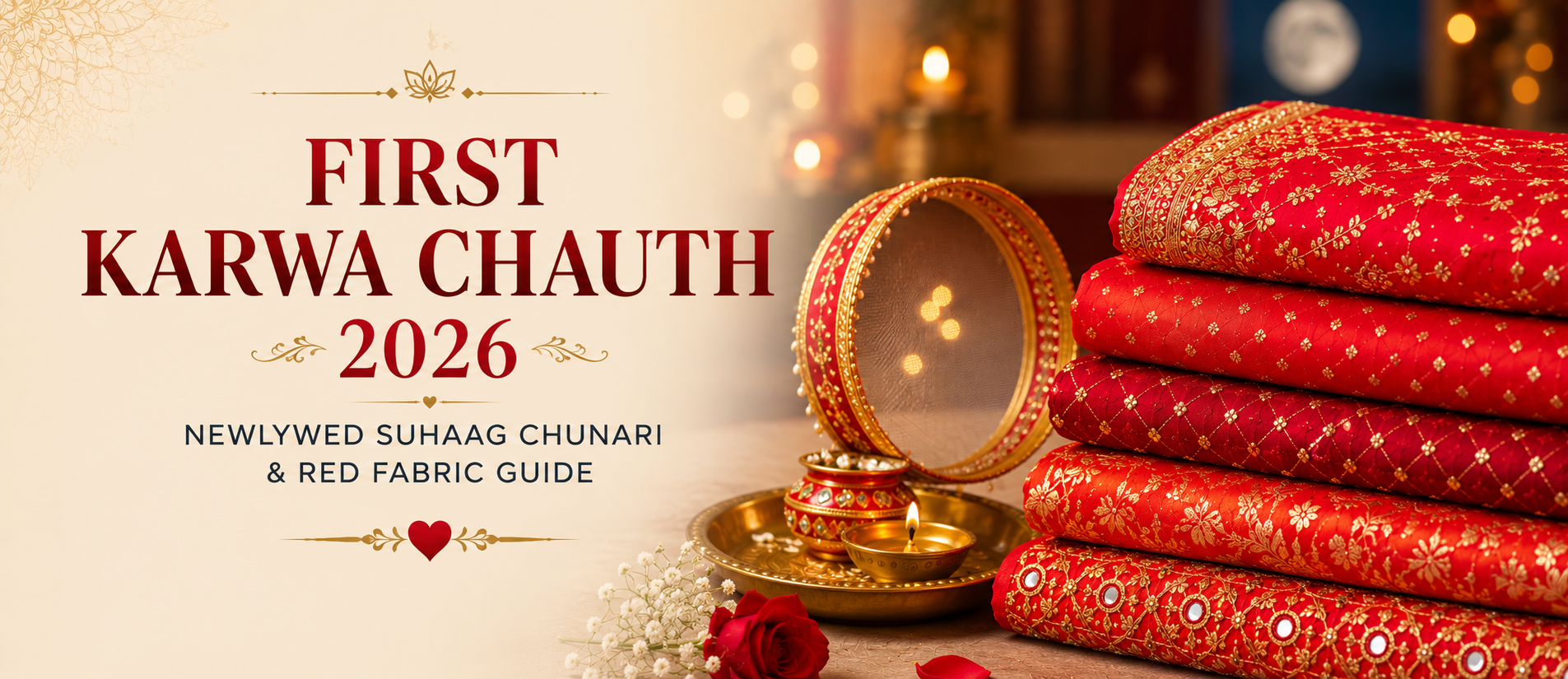
First Karwa Chauth 2026: Newlywed Suhaag Chunari & Red Fabric Guide
Quick answer: For your first Karwa Chauth on Friday 30 October 2026, most sasural families expect a red or maroon saree or heavy suit with a red or gold chunari-style dupatta. Book fabric by 22 September so your karigar can stitch by 25 October, leaving 5 days for jewellery and mehendi trials.
Written by Sneha at Paras Gallery Fabrics. Every year we help newlyweds pick their pehla Karwa Chauth outfit. This guide is what I tell them across the counter.
Key takeaways
- Karwa Chauth 2026: Friday 30 October.
- First Karwa Chauth (pehla) usually calls for a red or maroon outfit, often bridal-echo.
- Suhaag ki pehli chunari is traditionally red with gold work (from sasural).
- Book fabric by 22 September, stitching by 25 October.
- Budget Rs 8,000 to Rs 40,000 for the outfit, depending on fabric grade.
Why pehla Karwa Chauth needs its own plan
Karwa Chauth is not a fashion day. It is a suhaag vrat, and the first time you observe it after marriage carries weight in both your maayka and sasural. Photos travel across the family WhatsApp. Older women notice the chunari, the mangal sutra length, the bindi shape, everything.
Most sasural families expect the newlywed to wear:
- Red or maroon primary colour (auspicious for suhaag)
- Traditional silhouette (saree or heavy suit, not indo-western)
- Gold jewellery with chuda still visible if within 40 days of wedding
- Suhaag ki pehli chunari if the sasural has gifted one
If the sasural has not gifted a chunari, the maayka often sends one. Ask both sides before buying.
Understanding the suhaag chunari
The pehli suhaag chunari is a heavy red or maroon dupatta, usually with gold gota-patti, zardozi or heavy embroidery. Some families use bandhani-print pure silk. Others go with net or georgette with gold work.
Traditionally the chunari:
- Is 2.5 to 2.75 metres long (longer than a regular dupatta)
- Has heavy gold border on all four sides
- Is worn over the head during puja and moon-viewing
If nobody has gifted you one, buy one that pairs with your outfit. Do not skip it for the first Karwa Chauth. Explore net and gota picks in our all dupattas collection (350 pieces live).
Outfit choice: saree or suit
Both are traditional. Choice depends on:
- Your comfort during the day-long fast (11 to 12 hours without water)
- What your sasural family typically wears
- Your body type and confidence in a saree
Choose a saree if:
- Your sasural mother-in-law and dadi wear sarees on festival days
- You are confident carrying pallu for 12 hours
- You want the bridal-echo look (many brides re-do a lighter version of the wedding saree)
Fabric picks for the saree: heavy georgette, silk-based georgette, embroidered chinon, silk with rich border.
Browse our georgette collection for saree fabric. 647 live pieces.
Choose a heavy suit if:
- Your sasural is more comfortable with suits than sarees
- You want the katori-choli or anarkali silhouette
- You are managing a busy karwa puja preparation and a saree feels too much
Fabric picks for the suit: velvet with zardozi, embroidered net anarkali, silk suit with heavy dupatta.
Explore rich-work picks in our dyeable embroidery collection (958 pieces).
Colour picks beyond just "red"
Red is the default. But there are honest variations that older women accept as auspicious:
| Shade | Sasural acceptance | Notes |
|---|---|---|
| Sindoori red | Universal, safest choice | Classic pehla Karwa Chauth colour |
| Maroon | Universal | Photographs richer than red in indoor puja lighting |
| Rani pink | Widely accepted | Newer, but common in modern Punjabi households |
| Wine and burgundy | Accepted in urban families | Good for evening moon-viewing photos |
| Peach and gold | Only if sasural specifies "not full red" | Rare for first Karwa Chauth |
| Deep orange | Not typical | Usually associated with other festivals |
Ask your saas or a family elder before choosing anything other than red or maroon.
The pehla Karwa Chauth outfit fabric requirement
Saree option (heavy georgette with border)
| Piece | Fabric metres |
|---|---|
| Saree | 5.5 m |
| Blouse | 1 m (heavy embroidered) |
| Petticoat | 2 m (colour-matched satin) |
| Chunari or extra dupatta | 2.5 m |
Suit option (heavy anarkali)
| Piece | Fabric metres |
|---|---|
| Anarkali kurti | 6 m |
| Salwar or churidar | 2.5 m (contrast) |
| Dupatta or chunari | 2.5 m |
| Lining | 4 m (soft cotton) |
The 8-week timeline that works
| Week ending | What to do |
|---|---|
| 6 September (this Sat) | Finalise saree or suit choice, browse fabric |
| 13 September | Pause during Pitru Paksha week 1 |
| 20 September | Pause during Pitru Paksha week 2 |
| 27 September | Confirm and buy fabric, measurements taken |
| 4 October | Give to karigar, first trial |
| 11 October | Second trial |
| 18 October | Third trial, fit locked |
| 25 October | Final pickup, jewellery matched |
| 30 October | Karwa Chauth |
This gives 5 clean days for mehendi, jewellery pickup, and the pooja thali arrangement.
What sasural families notice (based on customer feedback over 12 years)
- Chunari length and coverage. The pallu of the chunari should reach the middle of your back when worn over the head.
- Border weight matching. Blouse border should echo the saree border, not compete with it.
- Mangal sutra visibility. The neckline should not hide the mangal sutra fully.
- Chuda coverage. If you are still wearing wedding chuda, half sleeves let it show properly.
- Comfort while fasting. Very heavy velvet in October Delhi can be difficult after 11 hours. Test-wear for one hour before finalising.
Pricing you should expect (Delhi retail, Oct 2026)
| Grade | Saree with blouse fabric + chunari | Suit with dupatta |
|---|---|---|
| Simple | Rs 8,000 to 15,000 | Rs 10,000 to 18,000 |
| Mid | Rs 15,000 to 28,000 | Rs 18,000 to 32,000 |
| Heavy bridal-echo | Rs 28,000 to 55,000 | Rs 32,000 to 60,000 |
Stitching adds Rs 3,000 to Rs 8,000 depending on work.
What the sasural traditionally gifts (varies by family)
- Suhaag ki pehli chunari (heavy red gota dupatta)
- A gold set (mangal sutra, jhumki, or bangles)
- The karwa (clay or silver pot for the puja)
- A saree or suit (sometimes, sometimes only chunari)
If the sasural is not sending fabric, buy the outfit yourself but leave the chunari question to the family. It avoids a small awkward moment on the day.
FAQ
Is red compulsory for first Karwa Chauth?
Not compulsory in religious terms. Culturally, most North Indian and Punjabi families expect red or maroon for the newlywed. If your sasural specifies otherwise, follow that.
Can I wear my wedding lehenga for first Karwa Chauth?
You can, but many families prefer a fresh outfit. If reusing, pair with a fresh chunari to give it a Karwa Chauth-specific feel. Also, sitting in a heavy wedding lehenga for a 12-hour fast is difficult.
What if I am not fasting for medical reasons but still doing the puja?
Wear the same outfit. Nobody at the moon-viewing will know or care. The outfit signals suhaag, not the fast.
Can I book everything online without a shop visit?
For pehla Karwa Chauth, we recommend one appointment. Colour matching for chunari and border weight is easier in person. WhatsApp video calls work as second best.
Do I need to buy from the sasural's city?
No, but if the sasural is in a different city, courier the outfit for a trial photo a week early. Older ladies often prefer to see it before the day.
In short
For first Karwa Chauth (pehla) on 30 October 2026, newlyweds traditionally wear a red or maroon saree or heavy suit with a red-gold suhaag chunari. Book fabric by 22 September for stitching by 25 October. Fabric options are heavy georgette or silk saree, or velvet or embroidered net anarkali. Budget Rs 8,000 to Rs 55,000 for the outfit depending on grade. The chunari is often gifted by the sasural.
Featured snippet
How to plan first Karwa Chauth outfit fabric:
- Confirm saree or suit preference with sasural family.
- Pick red, maroon, or sasural-approved shade.
- Buy 5.5 m saree fabric with 1 m blouse and 2.5 m chunari; or 6 m anarkali with dupatta.
- Book fabric by 22 September, karigar by 27 September.
- Keep last 5 days free for mehendi, jewellery matching, and pooja thali.
Ready to plan your pehla Karwa Chauth?
Come this week for a proper newlywed consultation. Our team walks you through saree vs suit, chunari matching, and stitching timeline in one 90-minute session. Book an appointment.
WhatsApp for fabric photos and same-day Delhi courier: +91 96544 40244.
Suhaagan bani rahe, chuda barkat de.