


Shopping Sangeet Fabric Online: Checks Before You Buy
Buying Online Guides · Draft 23 October 2026 Buying sangeet fabric online starts with a dance plan, not a colour swatch alone....

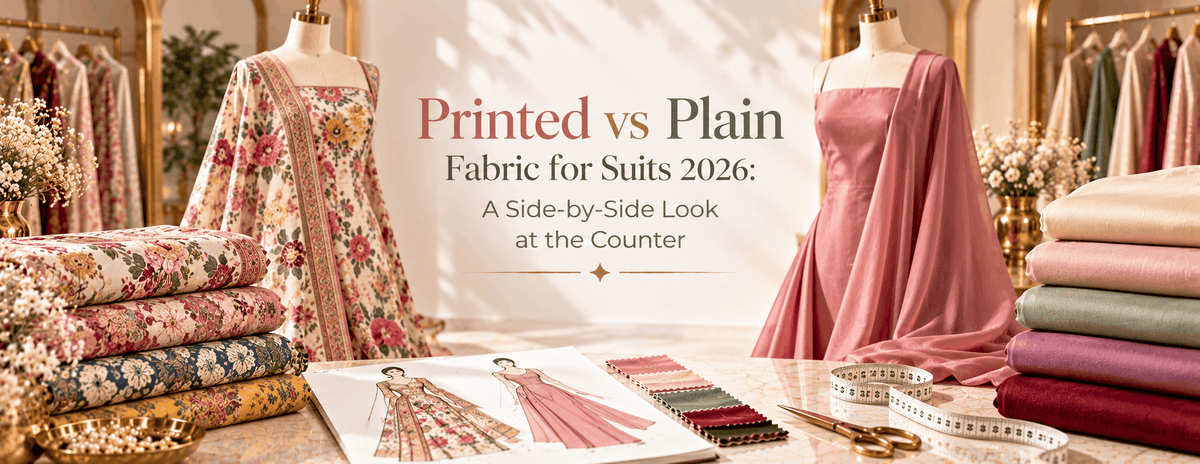
Fabric Comparison Guides · 9 minute read · Published 16 October 2026
Printed suit or plain suit. Honestly, this is the question we hear more than any other on a weekday morning. Working women on a half-day leave, Monday morning rush, mom-in-law buying for her bahu, boutique owners restocking before Diwali. The answer is not what the magazines say. It depends on where you wear it, how often, and how much time you have in the morning.
The suit wardrobe is the hardest-working thing in an Indian woman's closet. It goes to office, to pujas, to the chemist, to kitty party, to a cousin's engagement. One suit does five jobs. Which is why picking the base matters more than the colour or the embroidery - the base decides how many times you can wear it before it starts looking tired.
Printed means the pattern lives on the surface. Block print, digital print, screen print, hand print - all count. Plain means a single colour or an undyed base with the surface open for stitching, zari border or embroidery. Both come in cotton, muslin, chanderi, crepe, georgette-satin. The call is not about which fibre is better. It is about pattern yes or pattern no.
Here is the counter version of the comparison.
THE WINNING MOVE: PRINTED FOR THE EVERYDAY AND FESTIVE MORNING SUIT. PLAIN FOR THE OCCASION OR HEAVY-EMBROIDERY SUIT.
Quick answer: Printed for office and festive morning. Plain for occasion and heavy embroidery. The printed fabric collection has the running mixed-base prints. For a side-by-side counter trial with dupatta pairings, book a counter slot.
Printed does the design work for you. That is the honest short answer. A printed cotton suit with a plain contrast dupatta, a pair of jhumkis, and you are out of the house in ten minutes. The pattern hides the small creases a workday adds. It hides a tiny food spot too, if you are being honest. The colour variation stays visually interesting for repeat wears, which is why printed cotton outsells plain cotton two to one in our shop. Across the running range we have 213 cuts in printed cotton alone, 70 in printed muslin, 108 in printed crepe. Blocks, digital prints, traditional motifs, florals, abstracts, quirky, geometric - there is a lot.
Plain is the serious canvas. The embroiderer can place work anywhere. The border, the yoke, the neckline, the sleeve - all choices stay yours. A plain crepe with a heavy zardozi yoke reads like you spent twice the money you did. A plain chanderi with a thread-plus-mukesh pattern reads traditional in the best way. Plain is where you spend if the suit is for an engagement, a karva chauth puja, a brother's wedding sangeet. One rule - a plain base demands a visual anchor somewhere. Embroidery, zari border, printed dupatta, something. Totally bare plain with nothing added reads cheap even if the fibre is pure.
Printed carries interest baked in. Plain is a canvas, open. Group photos love a printed suit because it photographs rich across the frame. A solo close-up portrait loves a plain base because the embroidery can shine.
Printed suit, pair with a plain dupatta picking up one colour from the print. Plain suit, pair with a lightly printed dupatta or an embroidered border dupatta. One thing you should never do - printed suit with a printed dupatta from a different print family. That look is called trying-too-hard and the aunties will mention it.
Printed handles light embroidery, small panels, mukesh at the neckline. Heavy embroidery on a printed base fights the pattern. Plain is the correct canvas for zardozi, katdana, dori. The embroidery house will tell you the same.
Printed cotton and printed muslin breathe. Delhi summer, Delhi monsoon, both forgive. Plain cotton breathes equally but shows underarm sweat and back damp cleaner than a print does. For an outdoor afternoon in July, printed is the kinder choice simply because the pattern hides what you would rather not show on camera.
Browse the printed cotton edit for the everyday office pick
213 cuts across block print, digital print and traditional cotton prints. Covers the full office-to-festive morning range for the Delhi working wardrobe.
Browse Printed Cotton →You will see this on Instagram. Looks great in a close-up. Looks like a loud fight on a group photograph. The pattern and the stitch argue for your eye. Save your zardozi for a plain base, use the printed cotton for its everyday job.
Printed suit, printed dupatta, from different print families. The eye bounces. The outfit reads busy. Only exception - if both prints belong to the same story (same designer, same block tradition, same hand), then it reads cohesive. Otherwise just use a plain dupatta that picks one colour out of the print.
Plain crepe suit, no embroidery, plain crepe dupatta, no border, no earrings loud enough to carry the look. Reads like a hospital gown. The whole point of plain is to make space for something to anchor the eye. Place that anchor - a neckline mukesh, a sleeve border, printed dupatta, something.
If you can come in, come in. Our team will walk a bolt of each category, pin a mock neckline on a form, and show you three dupatta pairings for each so you see the whole look before buying. Book the slot or walk in. Our chanderi vs cotton for suit, office festive 2026 breaks down the plain-base fibre side in more detail.
A good block print or a quality digital print holds colour for many washes if the base was dyed before the print and the finishing was done right. A cheap transfer print fades in six to eight washes. Ask us which print family your cut is from, we will tell you honestly. For a repeat-wear workday suit, pick the quality side.
Yes, but keep it to a small panel. Neckline, sleeve, hem border. Not a yoke, not a full back. The pattern plus the stitch creates visual noise if the embroidery is heavy.
A medium-density print, usually. The pattern breaks up the body line. Which also makes photos easier for many wearers. A plain base with a placed embroidery panel can also flatter if the panel is placed right, but that is a stitcher decision not a fabric decision.
Printed cotton suit, machine wash cold, gentle cycle, shade dry. Plain cotton suit, same. Printed georgette-satin or a plain crepe, dry clean to keep the hand right. Steam press on reverse side on low heat, works for both.
Shop related fabric collections
Printed cotton, cotton and chanderi for the suit wardrobe
Monday to Thursday, 11 am to 2 pm, the shop is quieter. Our team can walk 15 bolts with you in 30 minutes. Pin a mock neckline, drape sample dupattas, show you both options next to each other. Faster than scrolling for an hour.
Or chat directly: +91 96544 40254
Buying Online Guides · Draft 23 October 2026 Buying sangeet fabric online starts with a dance plan, not a colour swatch alone....
Occasion Guides · Draft 23 October 2026 The short version: Choose anniversary dinner outfit fabric by testing how it feels while seated,...
Fabric education · Draft prepared 23 October 2026 A beautiful fabric name can still leave basic questions unanswered. To read fabric label...


