
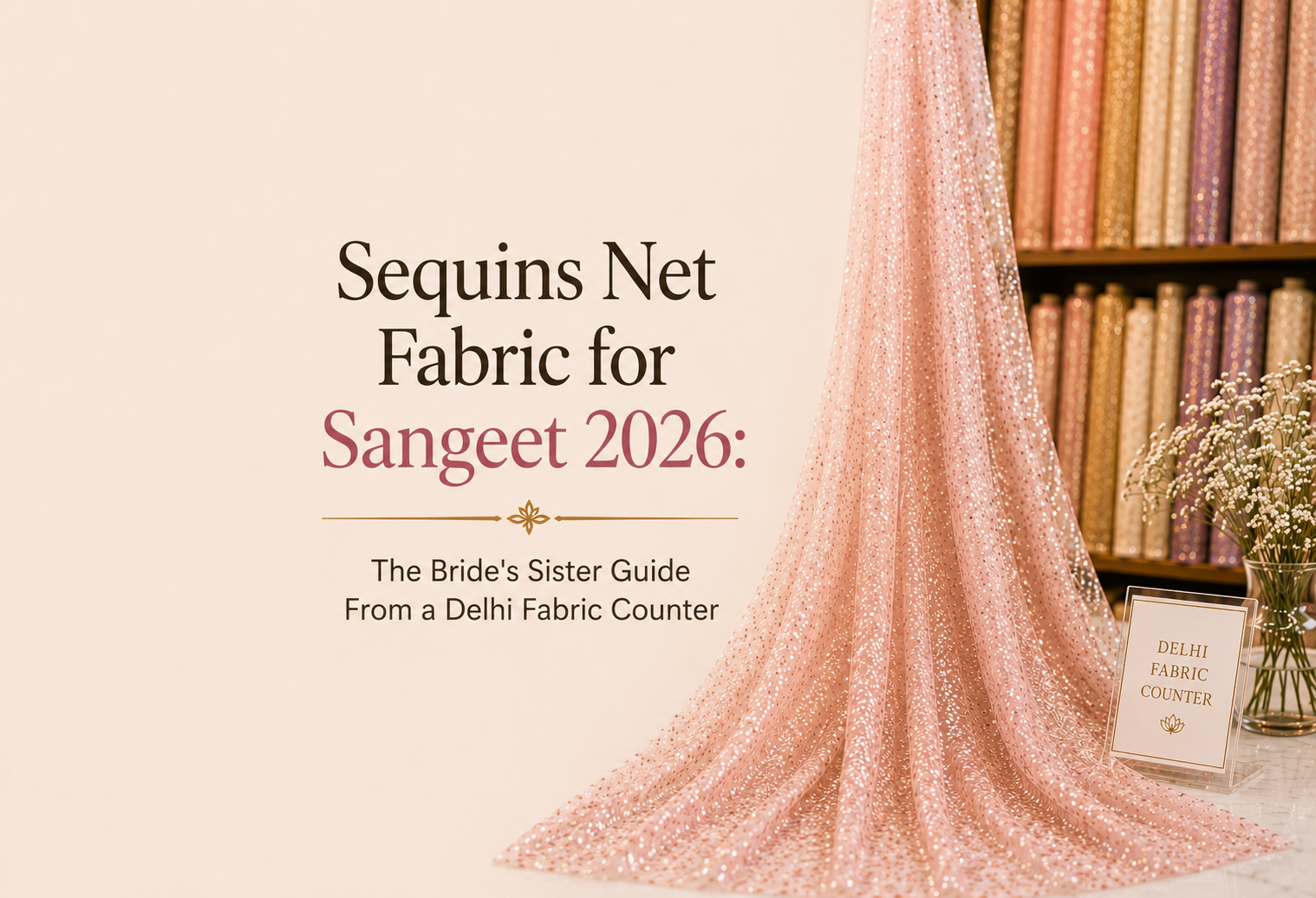
Sequins Net Fabric for Sangeet 2026: The Bride's Sister Guide From a Delhi Fabric Counter
Every August my counter turns into a sister-of-the-bride clinic.
She walks in with the bride's lehenga pictures on her phone. She wants to look beautiful. She wants to dance. What she does not want is to steal the frame in her sister's sangeet reels.
That is the actual brief. Every single time.
Sequins net is the sangeet default for a reason. It moves on the dance floor, catches DJ lights, photographs shiny without going bridal when picked right. Pick it wrong though. You look like a walking disco ball. Or worse, like you forgot the sangeet was tonight.
Here is the guide I would send my own cousin.
The safest sequins net picks for the bride's sister at a 2026 sangeet: pastel peach for daylight, midnight blue for evening, champagne for versatility, mauve for photo-heavy functions. Order 5.5 metres for skirt, 1.5 for choli, 2.5 for dupatta. Always add a cotton or satin lining.
When sequins net works, plus when to skip it
Net has body without weight. It swirls when you spin. It behaves under DJ strobe. Sequins hold light beautifully across warm plus cool lighting.
Which is why sangeet lehengas have shifted from heavy velvet-tissue to sequins net across almost every Delhi wedding I have supplied fabric for over the last four seasons.
But sequins net is not right for every function. Skip it for mehendi where it looks too shiny in daylight. Skip it for haldi where colour bleeds under yellow paste. Skip it for the mandap itself, reads too party.
Save the shine for the sangeet, the DJ reception, or the cocktail. Slots into the Sangeet Serenade plus Party Glamour end of the wedding spectrum, not the daytime end.
The 7 sequins net options I recommend for the bride's sister
1. Pastel peach with tone-on-tone sequins
My daylight sangeet default. Peach with peach sequins reads soft and photograph-ready without competing with the bride.
If she is in classic red or pink, peach next to her looks beautiful in group photos. Almost every bride's sister who tried this last year texted me post-wedding to say the drone shots looked cinematic.
2. Midnight blue with silver sequins
Photographs like a designer piece on Instagram reels. Silver sequins on midnight blue catch camera flash beautifully and read cinematic under DJ lights.
Do not confuse midnight blue with royal blue here. Royal reads too costume. Midnight sits closer to indigo, gives you that expensive-looking, understated shine.
3. Champagne with fine gold sequins
This is the "I want to look pulled together without matching the bride" answer.
Champagne photographs neutral, works across skin tones, does not clash with red or pink or gold or maroon on the bride. Light gold sequins on champagne net is what I quietly send to sisters who tell me "kuch simple par nice chahiye." That phrase always ends with champagne on my counter.
4. Mauve with rose gold sequins
My number one pick for photo-heavy functions. Mauve is having a big moment in Delhi weddings right now.
Not lilac. Mauve specifically. That pinkish-grey shade sits beautifully in warm indoor lighting plus cool outdoor light. Rose gold sequins on mauve net is the current bride's-sister flex.
5. Emerald green with antique-tone sequins
For a sister who has already worn peach, blue, champagne to previous cousins' weddings and wants something different. Emerald with antique sequins reads rich without being loud.
Not for every sangeet. But for a late-evening one, it photographs beautifully. Slides toward the Reception Royale mood board if the same outfit needs to double as a reception piece.
6. Powder pink with silver sequins
For a traditional family setup. Reads sweet, feminine, understated. Silver sequins keep it from turning too girly.
Best if the bride is in red or maroon and you want to complement without echoing the exact shade.
7. Wine with light gold sequins
For the older sister or the married bhabhi. Reads mature without going matronly.
Not the shade for a 22 year old cousin. Perfect for a 32 year old married didi who wants to look put-together on the dance floor without competing with the younger crowd. Pair with a simpler gold-border dupatta from the net range so top and bottom balance.
4 mistakes that ruin a sequins net lehenga
I have watched customers spend fifteen thousand rupees on a sequins net lehenga then come back frustrated on wedding day. Four things go wrong.
- Sequins falling off in patches. Happens when they are glued rather than stitched. Tug two or three gently at the counter. If they come off, walk away.
- Net turning scratchy against skin. Buy an inner lining. Cotton or satin. Non-negotiable even in August humidity.
- Colour looking different at the venue. Sequins net shifts dramatically under yellow versus white light. Check the swatch under warm bulb plus natural window light before committing.
- Dupatta feeling heavy after two hours of dancing. Order a lighter net dupatta rather than the same heavy fabric as the lehenga. Your shoulders will thank you at hour four.
Delhi wholesale prices this week
Real numbers from our Lajpat Nagar Central Market counter for 2026.
- Plain sequins net, light scatter: Rs 380 to Rs 620 per metre
- Medium density, all-over work: Rs 780 to Rs 1,400 per metre
- Heavy work with thread embroidery: Rs 1,600 to Rs 3,200 per metre
- Designer, hand-work with pearl accents: Rs 3,400 to Rs 6,500 per metre
A full sangeet lehenga in the medium range costs a bride's sister roughly Rs 4,500 to Rs 12,000 in fabric alone. Add another Rs 3,500 to Rs 8,000 for stitching, depending on choli detail.
Run your yardage through the Fabric Estimator before you commit. Boutique buyers picking up ten metres or more per shade should use the Wholesale page for thaan-level pricing.
Colour cheat sheet for the bride's sister: pastel peach for daytime sangeet, midnight blue or champagne for evening, mauve or rose gold for photo-heavy functions, wine or emerald for the older sister. Avoid matching the bride's exact colour on the invite.
Questions sisters ask me at the counter
What sequins net colour should the bride's sister wear?
Pastel peach for daytime. Midnight blue or champagne for evening. Mauve or rose gold for photo-heavy functions. Wine or emerald for the older sister. Whatever you pick, avoid matching the bride's exact colour on the invite.
How much sequins net fabric do I need for a lehenga?
5.5 metres for the skirt, 1.5 for the choli, 2.5 for the dupatta. That covers most standard sizes with a small buffer for hem finishing.
Is sequins net comfortable to dance in?
Yes, if you buy a proper inner lining. Without lining it scratches by hour two. With soft cotton or satin underneath, it moves well and stays comfortable across a four-hour sangeet.
Can I wear sequins net to daytime functions like haldi or mehendi?
No. Sequins net is a sangeet plus cocktail plus reception fabric. For haldi look at Haldi Fun with organza or georgette. For mehendi look at Mehendi Magic in chinon or cotton silk.
Where can I buy sequins net fabric online with pan-India delivery?
Parasgalleryfabrics.com ships pan-India in three to six working days from our Lajpat Nagar hub. Same-day swatch courier if you want to see the shine under your own home lighting before committing.
Ready to buy?
Shopping for your sister's sangeet outfit, or picking up sequins net pieces for cousins together? WhatsApp me at the shop for same-day swatch courier across Delhi NCR, Mumbai, Bengaluru, Hyderabad, Chennai, Kolkata, Ahmedabad.
Browse the live ranges on Sequins Fabric plus Net Fabric. If the outfit needs to double for a pre-sangeet engagement, look at the Engagement Enchantment palette.
Run your fabric numbers through the Fabric Estimator before placing your order. The Wholesale page carries the bulk-order form for boutique-level thaan pricing.