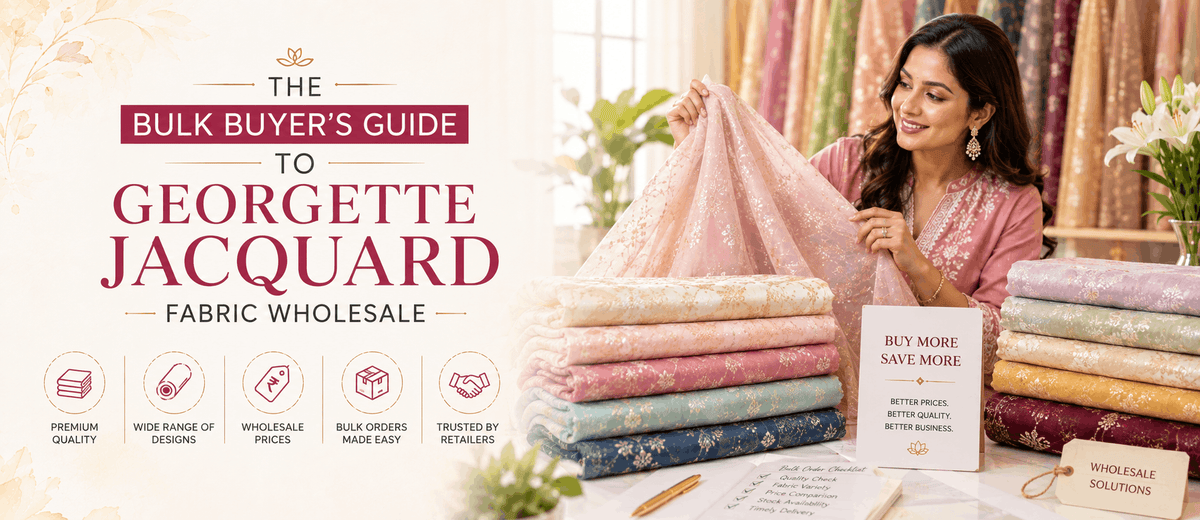
The Bulk Buyer's Guide to Georgette Jacquard Fabric Wholesale
A buyer came back to the counter last season with a returned kurti and a customer complaint written on a slip. A thread had pulled out of the motif on the sleeve and left a loop the size of a fingernail. She wanted to know what was wrong with the fabric. Nothing was wrong with it. She had sold a long-float jacquard to a customer who wears rings, which is a stocking decision rather than a manufacturing fault. Once you understand how the design got into the cloth, that whole conversation changes.
Georgette jacquard sells hard right now because it gives a boutique a design without a print bill or an embroidery job card. The pattern arrives already in the cloth. That is also exactly why it needs a different set of checks at the counter than any plain georgette.
Quick answer: Georgette jacquard fabric wholesale means buying loom-patterned georgette by the thaan at trade rates instead of by the metre. The design is built into the weave by a jacquard head, so it adds roughly 20 to 60 GSM over plain georgette, leaves floats on the reverse that can snag, runs one-way on most motifs plus it cannot be corrected after weaving. Delhi trade rates run roughly Rs 110 per metre for poly self-design jacquard up to Rs 700 for silk-blend qualities.
The design is built by the loom, not laid on the cloth
On a jacquard loom every warp yarn can be lifted on its own. That is the whole trick. Instead of a repeating mechanical pattern, the loom follows a design file and raises a different set of yarns on every pick, which lets a motif of any shape appear in the cloth as it is being made.
Because the pattern comes from yarn position rather than colour, most georgette jacquard reads as a self design. You see the motif through the difference in light reflection, surface height plus density, not through a second shade. Hold the cloth flat under a tube light and the design almost disappears. Tilt it and the motif jumps out. Buyers used to prints often reject a jacquard on a flat table then reorder the same design after they see it hanging on a stand.
The practical consequence is one most bulk buyers learn expensively. A print can be corrected between runs. An embroidery can be redone on fresh ground. A woven design cannot be touched once it is off the loom, so any fault in the design file or the lifting runs through the entire thaan at identical spacing. Check the first metre carefully, because the last metre will be the same.
Turn the thaan over before you judge anything
The reverse of a georgette jacquard is where the real information sits. Every yarn that is not part of the motif on the face has to travel somewhere, so it floats across the back until it is needed again. Those floats are the negative image of your design.
Measure them roughly with your eye. Floats under about five millimetres behave. Floats running a centimetre or more are a liability on anything a customer wears close to hands, bags or jewellery, because a ring catches the loop then drags the motif out of true on the face. On sarees the risk sits in the pallu that gets handled all evening. On kurtis it sits on the sleeve and the side seam.
Do the nail test at the counter. Run a fingernail lightly across the reverse in the direction of the floats. If yarns lift and stay lifted, that cloth will snag in wear. If they settle back flat, the float length is safe for general stitching. This one check takes ten seconds and prevents most of the returns that come back on woven-design goods.
Georgette jacquard qualities on a Delhi counter
Fibre under the jacquard moves the rate far more than the complexity of the motif does.
| Quality | Typical GSM | Character at the counter | Best garment use | Delhi trade price (per metre) |
|---|---|---|---|---|
| Poly self-design jacquard | 80 to 110 | Crisp, springy, holds shape | Volume kurtis, daily dupattas | Rs 110 to Rs 160 |
| Viscose georgette jacquard | 100 to 135 | Softer fall, deeper shade take | Sarees, flowy gown panels | Rs 190 to Rs 280 |
| Lurex jacquard georgette | 110 to 150 | Metallic yarn inside the motif | Festive dupattas, party wear | Rs 240 to Rs 360 |
| Imported jacquard georgette | 120 to 170 | Tighter motif edges, cleaner back | Designer sarees, label collections | Rs 320 to Rs 480 |
| Silk-blend jacquard georgette | 130 to 190 | Warm handle, natural dry rustle | Bridal blouses, occasion sarees | Rs 450 to Rs 700 |
Note the GSM column, because that is the number buyers skip. Plain georgette usually sits between 60 and 90 GSM. Put a jacquard motif into the same cloth and you are carrying another 20 to 60 GSM, which changes how a garment hangs. A style cut for plain georgette will sit heavier and swing less in jacquard, so a ruffle that fluttered in the sample may just hang in production. Buyers can compare motif scale, weight plus reverse-side float across live running designs in our georgette jacquard collection before blocking a season quantity.
Repeat size, one-way motifs plus the cloth you will lose
Woven designs come with a fixed repeat, meaning the distance after which the motif starts again. Small scattered butis of two to five centimetres cut almost like a plain cloth. Once the repeat crosses fifteen or twenty centimetres you are cutting around a design, not just cutting cloth.
Two things then cost you metres. Matching across seams on joined panels, sleeves or a saree border typically eats five to eight percent extra. Direction costs more. Most jacquard motifs face one way, so a panel cannot be flipped end to end to nest better in the marker, which pushes wastage into the eight to twelve percent range on larger repeats.
Ask two questions before you book. What is the repeat in centimetres. Is the motif directional. A supplier who cannot answer either has not looked at the cloth properly. Buyers building drape-led products where the motif has to run correctly down a pallu can study repeat behaviour across live stock in our saree fabric range.
Trade bands, thaan sizes plus why reorders are harder on a woven design
Most Delhi suppliers work close to the structure below, ours included. The point worth negotiating on jacquard is not the rate. It is repeat availability, because a woven design needs the loom set up again while a print only needs a screen or a file.
| Order tier | Typical quantity | Rate movement | Who it suits |
|---|---|---|---|
| Sample cut | 1 to 5 metres | Retail rate | Designers testing motif scale on a stand |
| Small bulk | 1 thaan (about 18 to 22 m) | 6 to 10 percent off retail | Boutiques trialling one design |
| Trade bulk | 5 to 20 thaans | 12 to 20 percent off retail | Resellers, repeat festive labels |
| Loom booking | 50 thaans and above, one design | Mill-linked rate on request | Exporters, labels wanting a design locked |
Buy your full season requirement of a jacquard design in one go wherever cash allows. A print reorder takes days. A woven reorder waits for loom time. When it does come, the new lot carries a fresh dye lot on a cloth where the motif already catches light differently from the ground. Two dye lots of the same jacquard hung side by side in a showroom look further apart than two lots of a plain cloth. Ask for the design number plus the dye-lot number on the bill every single time.
Getting georgette jacquard through cutting and stitching
Two structures are fighting inside this cloth. The georgette ground wants to move because of its high-twist crepe yarn. The jacquard motif is denser and moves less. That difference is behind almost every stitching complaint on this fabric.
Wash a half-metre before you cut a bulk lot, because the ground can relax more than the motif area and pull the design slightly out of shape. Expect around three to five percent shrinkage on viscose-rich qualities plus very little on poly. Lay up in single or double layers only, since the springy ground shifts under a heavy stack. Use a fine sharp needle in size 65 or 70 with a slightly longer stitch, plus keep the presser foot pressure light so the motif does not flatten under the foot. Finish seams with a narrow overlock or a French seam rather than pinking, because a cut edge on georgette frays quickly. Press from the reverse with a cloth between the iron and the fabric, since direct heat crushes the raised motif and the shine will not come back.
Where georgette jacquard orders go wrong
- Judging the design flat on a table. A self-design motif reads through light and shadow. Hang it or drape it on a stand before you accept or reject it.
- Skipping the float check on the reverse. Long floats snag on rings, bags plus nails. Run a nail across the back and watch whether the yarns lift.
- Costing it like plain georgette. Large repeats plus one-way motifs waste eight to twelve percent extra cloth. Build that into the garment price.
- Cutting bulk without a shrinkage test. Ground and motif relax at different rates, so wash a half-metre first, especially on viscose qualities.
- Ordering short and planning to repeat. A woven design needs loom time plus a fresh dye lot. Buy the season in one lot where you can.
Questions I get across the table on georgette jacquard
What is the difference between georgette jacquard and embroidered georgette?
The design in a jacquard is woven into the cloth on the loom, so it is part of the structure and cannot peel, pull out or fall off. Embroidery is stitched onto a finished cloth afterwards, which means the ground carries thread and often backing paper marks. Jacquard costs less per metre for the same visual density, stays flatter for stitching plus survives washing better. Embroidery gives you scale, colour contrast plus surface work that no loom can produce.
Does georgette jacquard snag easily?
It depends entirely on float length on the reverse face. Floats under about five millimetres are safe for normal wear. Floats of a centimetre or more catch on rings, watch straps plus bag hardware, then pull the motif out of shape on the face. Test at the counter by running a fingernail across the back. If the yarns lift and stay lifted, keep that design for dupattas rather than sleeves.
What is the minimum order for georgette jacquard fabric wholesale?
Trade rates usually begin at one full thaan of about 18 to 22 metres. Below that you pay close to retail. The sharper 12 to 20 percent band typically opens at five thaans. A loom booking, where the design is woven only for you, generally starts around 50 thaans with a longer lead time because the loom has to be set up for that design file.
Is georgette jacquard heavier than plain georgette?
Yes, usually by 20 to 60 GSM. Plain georgette normally runs 60 to 90 GSM while jacquard qualities run 80 to 190 GSM depending on fibre plus motif density. That extra weight is why a style sampled in plain georgette falls differently once it is cut in jacquard. Check the GSM before you carry a pattern across from one to the other.
Lock georgette jacquard at trade rates
If you run a boutique, a label or a reselling line, the quickest way to secure trade pricing is to join the wholesale programme. You get thaan rates, design plus dye-lot numbers recorded against every booking, float length noted on request, design blocking for your festive calendar plus loom bookings where you want a motif locked to your label. See the tiers and register on our wholesale fabric page to start your first bulk georgette jacquard order.