Jacket Set Fabric Wholesale: Buy the Pair, Not the Piece
Wholesale Reference Guides · 6 minute read · Updated 30 September 2026
A boutique owner we supply once told us about a rail she could not shift. The jackets were a deep teal and the inner tops were a teal from a later lot. Under her shop lights they looked like a pair. Near the door in daylight the top was a shade warmer. Every customer who held the two together put the set back.
Nothing was wrong with either piece. The trouble was that they had been bought as two items and sold as one. A customer looking at a set does not look at each piece. She looks at how they sit next to each other.
A single piece is judged on its own. A jacket set is judged as a pair. The weaker half sets the price the customer will pay.
Four things a jacket set has to do for you
- Match as a pair. The jacket and the inner are held together at the counter, so shade and finish have to agree in daylight.
- Look finished when worn open. A jacket is rarely buttoned. The front edge and the inside face are seen all day.
- Hold structure without stiffness. The jacket should keep its line but still move when the wearer walks or lifts an arm.
- Reorder cleanly. Sets sell in repeat colours, so you need the same jacket cloth and the same inner cloth to be there next month.
Customers do not buy a jacket and a top. They buy the picture the two make together. They check it twice.
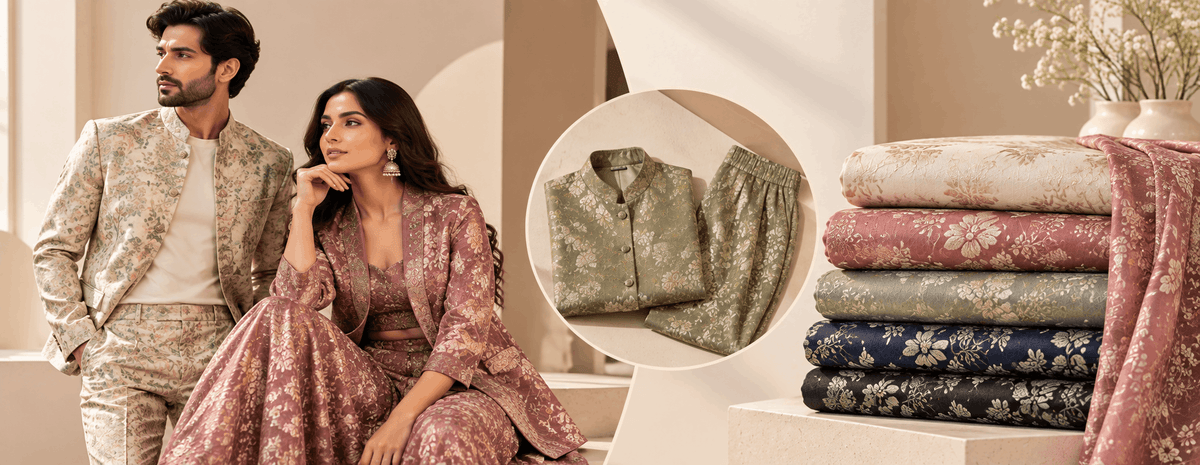
Quick answer: Jacket set fabric wholesale means buying in bulk the cloth used to make a jacket and its matching inner as one coordinated set. It covers a jacket fabric with enough body to hold its line, an inner fabric that is lighter and comfortable against the skin and a shade match between the two that survives daylight. A set sells as a pair, so the range that earns its place is matched by lot and can be reordered in the same colour. Paras Gallery Fabrics keeps this range together as Jacket Set, sourced with pairing in mind.
Why a set is judged differently from a single piece
When a customer picks up a kurti fabric or a blouse piece she asks one question. Do I like this? With a jacket set she asks two more. Do these two belong together? Will the jacket still look good when I am not wearing the inner I am trying today?
That second question is the one buyers forget. A jacket is often worn over other outfits, so it has to look right on its own. The inner is worn under the jacket and on its own on a warm evening. Each has to hold up alone and both have to agree when paired.
So the buying question changes. You are no longer asking whether one fabric is good. You are asking whether two fabrics make a set that still looks intentional after a wash, a season and a reorder.
Three pieces, one set, three different jobs
A jacket set is really a small team of fabrics. Each member has its own way of letting the set down.
How much structure should a jacket have?
This is where most jacket sets go wrong. Buyers see a beautifully stiff sample and assume it will look sharp. Then a tailor cuts it and the jacket stands like a board.
A good jacket cloth holds its line at the shoulder and the front edge while still bending at the elbow. Hold a corner of the fabric and let it hang. If it folds in soft, clean curves it will move well. If it juts out in hard planes it will fight the wearer.
Turn the piece over as well. The inside face of an open jacket is on show, so rough backing or loose thread ends will be noticed. Check that the reverse looks tidy enough to be seen.
What to do at the counter
- Before you go: decide which colour stories you sell in pairs and note the ones customers ask for again, so you buy against repeat demand.
- Step 1: lay the jacket cloth and the inner cloth together near a window and judge the shade in daylight before you judge either piece alone.
- Step 2: ask for the jacket and the inner from the same lot wherever a set is sold as a set.
- Step 3: hold the jacket fabric by a corner and let it hang, then turn it over and check the reverse.
- Then fix quantity: go deeper on the pairs your regular customers return for and lighter on one-off statement colours.
Questions buyers ask at the counter
Why should a boutique buy jacket set fabric as a pair rather than piece by piece?
Because customers judge the jacket and the inner together. Buying each piece separately at different times risks shade drift that only shows once the two are held side by side. Buying them as a pair from the same lot removes that risk before it reaches the rail.
How do I check that a jacket fabric has the right structure?
Hold a corner and let the fabric hang. Good jacket cloth folds in soft, clean curves and keeps its line at the edge. If it stands out stiffly or collapses completely, it is likely to disappoint once cut.
Does the inner fabric matter as much as the jacket?
Yes for comfort. The inner is worn against the skin for the longest hours. A light, smooth fabric that drapes under the jacket usually earns more repeat customers than a showier one that feels heavy.
Can the same jacket cloth be sold with more than one inner colour?
Often yes. A neutral or tonal inner lets one jacket cloth serve several customers. Confirm the shade pairing in daylight first and keep the pairing consistent across reorders.
What should I look at on the reverse of a jacket fabric?
An open jacket shows its inside face. Look for rough backing or loose thread ends and check that the reverse is tidy enough to be seen. It is a small check that prevents complaints later.