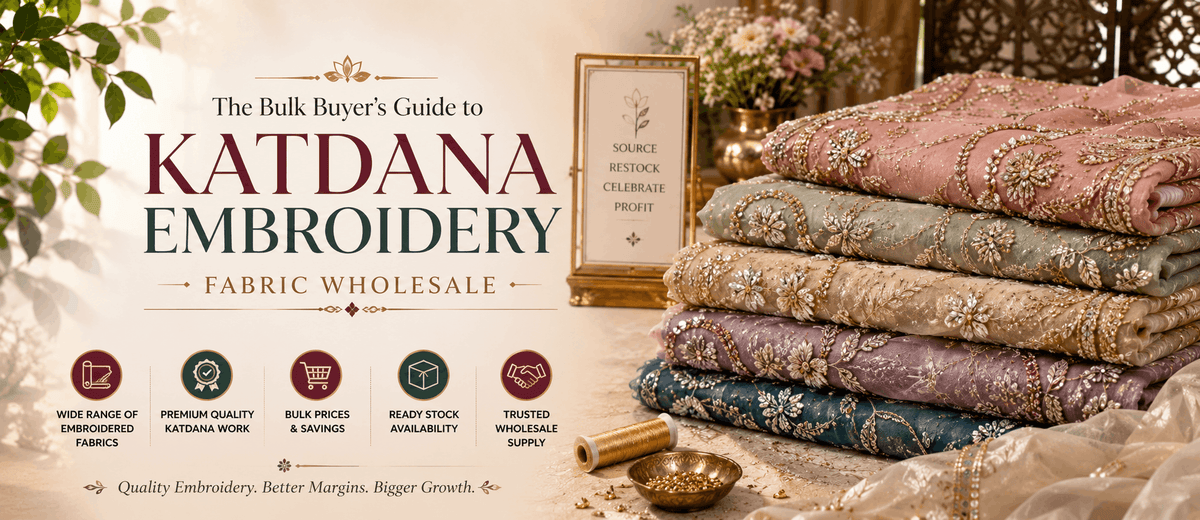
The Bulk Buyer's Guide to Katdana Embroidery Fabric Wholesale
A label sent back forty gowns last winter. The complaint on the docket said the beadwork was falling off. It was not falling off. One thread had snapped near a side seam during trial, then the whole row of beads had walked off the cloth like a zip opening. The work was fine. The attachment method was wrong for a garment that gets pulled over the head. Nobody at the buying stage had asked how the beads were held on, because everybody was looking at the front.
Katdana sells well because it gives a boutique surface value at a fraction of a stone or zardozi bill. It also carries three risks that plain cloth never brings to the counter. Weight, attachment plus plating. Get those three right at the buying stage plus this fabric behaves for years.
Quick answer: Katdana fabric wholesale means buying cloth already carrying small cut metallic bead work by the thaan at trade rates. The bead sets the price, not the ground. Katdana adds roughly 40 to 220 grams per metre, so plan lining plus support before you cost the garment. Run a shed test on the reverse, ask whether beads sit on an aari chain or are lock stitched, then confirm the plating grade. Delhi trade rates run roughly Rs 260 per metre for light work on net up to Rs 1,900 for dense work on silk.
Katdana is a bead, not a stitch
Buyers often use katdana loosely to mean any shiny surface work. Being precise matters at a counter because it changes what you inspect. Katdana is a small cut metallic bead, usually a short tube or a faceted grain of one to three millimetres, threaded onto the cloth rather than stitched with thread alone.
Compare it to the two things it usually sits beside. A sequin is a flat pierced disc that lies against the cloth, so it flashes in wide sheets of light. A katdana stands slightly proud of the surface, so it catches light in small hard points and reads as texture from close range yet as a shimmer from across a room. That standing profile is also why katdana snags on lining, on other garments in a rail plus on jewellery in a way a flat sequin does not.
Practically, this means a katdana piece needs a smoother lining than a sequin piece, needs more hanging room in your rail plus needs a garment bag at dispatch. Boutiques that treat the two identically get more counter returns on katdana.
Weigh the thaan before you cost the garment
This is the single number the trade skips. Bead work is added mass sitting on a cloth that was never engineered to carry it.
Light scattered katdana adds around 40 to 70 grams a metre. Row work along borders adds 80 to 130. All-over dense fills push 150 to 220. Put that on a net ground of about 30 to 45 GSM plus you have more than tripled the weight of the cloth. The garment consequence is immediate. Sleeves drop. Yokes sag away from the shoulder. A flared panel that swung in the sample hangs straight in production.
Do this at the counter. Ask for the finished GSM of the beaded cloth rather than the GSM of the base. If the supplier only knows the base figure, weigh a cut half-metre on a kitchen scale, double it, then compare against the plain cloth. Any gain over about 100 grams a metre means you should be budgeting for a firmer lining, a canvas or fusing at the shoulder plus possibly a stay tape at the yoke seam. Build that into the garment cost sheet before you quote a retail price, not after your tailor complains. Buyers can compare bead density against ground weight across live running designs in our katdana collection.
How the bead is held on plus why one broken thread runs
Two attachment systems dominate, with very different failure behaviour.
Aari chain stitch. A hooked needle pulls a continuous thread through the cloth in a chain, catching beads as it goes. It is fast, it is economical plus it is what most volume katdana uses. The weakness is structural. Because it is one continuous chain, a break anywhere in the row lets the chain pull back like a knitted stitch dropping, so beads shed in a line rather than singly.
Lock stitch or hand knotting. Each bead is secured with its own stitch or the thread is knotted at intervals. It costs more per metre plus takes longer. The payoff is that damage stays local. One bead comes off, the rest hold.
Check this on the reverse face. An aari chain shows a clear continuous chain line running behind each bead row. Lock stitching shows separated stitch marks with no chain. If you are buying for pull-on styles, kidswear, rental wear or anything with a heavy trial cycle, pay the extra for lock stitching on the stress areas at minimum. If you are buying aari chain for volume, ask the karigar to tie off at intervals rather than running a whole panel on one thread, then tell your tailor to backstitch the row ends before cutting so the chain cannot open at a raw edge.
Katdana qualities on a Delhi counter
| Quality | Ground | Added weight per metre | Best garment use | Delhi trade price (per metre) |
|---|---|---|---|---|
| Scattered katdana on net | Soft net | 40 to 70 g | Dupattas, overlay panels | Rs 260 to Rs 380 |
| Border row work | Georgette | 80 to 130 g | Sarees, kurta hems | Rs 420 to Rs 640 |
| Katdana with faux mirror | Organza or net | 110 to 160 g | Festive lehenga panels | Rs 700 to Rs 1,050 |
| All-over dense fill | Net or georgette | 150 to 220 g | Bridal cholis, gown bodices | Rs 1,100 to Rs 1,500 |
| Katdana on silk ground | Silk or silk blend | 140 to 200 g | Bridal sets, label collections | Rs 1,400 to Rs 1,900 |
Net carries the majority of katdana production because it is light enough to absorb the added mass without becoming a board. If you are matching ground weight to bead density for the first time, work through live net qualities in our net fabric range before you settle on a base.
Plating, steam plus perspiration: where the shine goes
Katdana colour is a surface coating on glass or plastic. It is not dyed through. That means it can be lost, plus the ways it gets lost are all inside your control.
Test the lot before you book. Rub twenty beads firmly with a white cloth dampened with plain water. Any colour transfer means the coating is soft plus the goods will dull in a season. Hold a steam iron ten centimetres above a sample for fifteen seconds then look at the beads under strong light. Cheap plating goes cloudy or takes a milky film. Finally, leave a swatch in a sealed bag with a damp tissue overnight, because trapped humidity mimics what perspiration does at the underarm on a wedding evening.
Two practical rules follow. Never let a katdana garment take direct iron contact, since heat plus pressure kills plating faster than anything else. Press from the reverse with a cloth barrier or steam it hanging. Second, tell your retail staff to advise dry clean only plus storage in a breathable cover rather than plastic, because sealed plastic holds moisture against the coating.
Order tiers, cutting wastage plus reorder matching
| Order tier | Typical quantity | Rate movement | Who it suits |
|---|---|---|---|
| Sample cut | 1 to 3 metres | Retail rate | Designers testing drape under added weight |
| Small bulk | 1 thaan (about 18 to 22 m) | 5 to 9 percent off retail | Boutiques trialling one design |
| Trade bulk | 5 to 20 thaans | 12 to 18 percent off retail | Resellers, festive labels |
| Design booking | 40 thaans and above, one design | Karigar-linked rate on request | Exporters, labels locking a motif |
Cutting wastage on katdana is higher than buyers expect because a marker cannot be laid straight through a bead line. Every cut has to fall in a gap or the beads must be picked out first, which is slow hand work. On scattered designs expect five to seven percent extra. On row or border work expect ten to fourteen percent, since panels must be placed against the border rather than nested efficiently. Cost that into your metre requirement rather than discovering it at the cutting table.
Reorders bring a second issue. Beads arrive in lots too, so the metallic tone of a gold katdana can shift slightly between lots even when the ground shade matches perfectly. Under showroom lighting a bead lot mismatch is more visible than a fabric dye lot mismatch, because metallic surfaces reflect rather than absorb. Ask for the bead lot number alongside the design number plus dye lot on every bill, then buy your full season quantity of a design in one release wherever cash allows.
Getting katdana through cutting and stitching
Run the shed test first. Lay a half-metre face down on a dark cloth, rub the reverse firmly with your palm for ten seconds, then count what fell. More than three or four beads means the tie-off is weak plus the lot will shed in wear. Send it back before it becomes a garment.
At the table, cut single ply only. A stacked lay slides on beadwork plus the beads under the shears will crack. Use a fresh size 90 or 100 needle then change it every two to three garments, because a bead strike blunts a needle instantly and a blunt needle drags the ground. Move the presser foot pressure down so the machine does not ride over a bead line. Where a seam must cross beadwork, pick the beads out of the seam allowance by hand first, then stitch clean cloth to clean cloth and put those beads back by hand afterwards if the design needs continuity. Finish edges with a bias binding rather than an overlock, since an overlock knife will hit beads. Press hanging with steam only.
Where katdana orders go wrong
- Costing it like the base cloth. Added weight of 40 to 220 grams a metre changes lining, support plus wastage. Price the finished cloth, not the ground.
- Buying aari chain work for pull-on styles. One broken thread opens a whole row. Ask for lock stitching or interval tie-offs on stress areas.
- Skipping the shed test. Ten seconds of rubbing on a dark cloth tells you what six months of wear will do.
- Ignoring plating grade. Damp rub, steam plus overnight humidity tests take a day and prevent a season of dull returns.
- Ordering short on a bead design. Bead lots shift tone between runs and metallic mismatch shows harder than a dye lot. Buy the season in one release.
Questions I get across the table on katdana
What is the difference between katdana and sequin work?
A sequin is a flat pierced disc that lies against the cloth and flashes in wide sheets of light. Katdana is a small cut metallic bead of roughly one to three millimetres that stands slightly proud of the surface, so it reads as texture close up plus as a fine shimmer from a distance. That standing profile makes katdana heavier for the same coverage area, more prone to snagging on lining or jewellery plus more dependent on how it is anchored. It also means a katdana garment needs a smoother lining and more hanging room than a sequin garment.
Does katdana beadwork fall off in wear?
It depends on how the beads are held. Aari chain stitch runs one continuous thread through a row, so a single break lets the chain pull back and beads shed in a line. Lock stitching secures each bead individually, so damage stays local. Check the reverse face for a continuous chain line versus separated stitch marks. Then run a shed test by rubbing a half-metre face down on a dark cloth for ten seconds. More than three or four loose beads means the tie-off is weak.
What is the minimum order for katdana fabric wholesale?
Trade rates usually begin at one full thaan of about 18 to 22 metres. Below that you pay close to retail. The sharper 12 to 18 percent band typically opens at five thaans. A design booking, where a motif is worked only for your label, generally starts around 40 thaans with a longer lead time because bead work is hand applied and the constraint is karigar capacity rather than machine time.
Can katdana fabric be ironed or washed at home?
No on both counts for anything you sell as occasion wear. Direct iron contact crushes the beads plus destroys the plating, so press from the reverse over a cloth barrier or steam the garment hanging. Home washing loosens tie-offs and lets water sit under the coating, which dulls the metallic finish. Advise dry clean only, storage in a breathable cover rather than a sealed plastic bag plus a garment bag at dispatch so beads do not catch on other pieces in transit.
Lock katdana at trade rates
If you run a boutique, a label or a reselling line, the quickest way to secure trade pricing on bead work is to join the wholesale programme. You get thaan rates, finished GSM stated rather than base GSM, bead lot plus dye lot recorded against every booking, attachment method noted on request, design blocking for your festive calendar plus karigar bookings where you want a motif held for your label. See the tiers and register on our wholesale fabric page to start your first bulk katdana order.