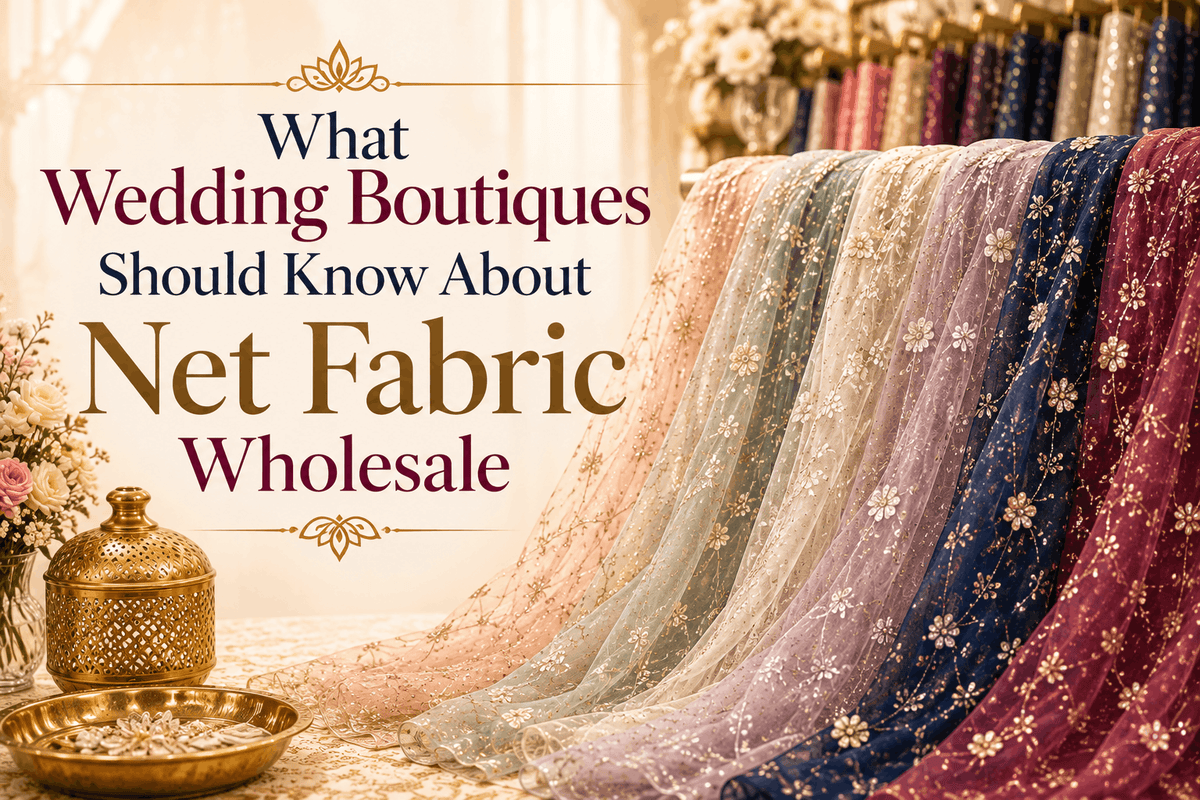
What Wedding Boutiques Should Know About Net Fabric Wholesale
Every wedding season the same scene plays out at the counter. A boutique owner points at a gorgeous embroidered net on a mannequin photo and asks for forty metres of "the same net." Nine times out of ten the net in that photo is a different weight, a different weave, sometimes a different family entirely from what they think they are buying.
Net is the backbone of wedding fabric. It is also the most misread fabric in the trade. This guide breaks down net fabric wholesale the way a working buyer needs it, so your next bulk order matches the design in your head.
Quick answer: Net fabric wholesale means buying net by the thaan at trade rates. Soft net runs 30 to 50 GSM for drape. Hard net runs 50 to 80 GSM for structure. Delhi trade prices sit around Rs 70 to Rs 150 per metre for plain net. Embroidered net runs Rs 250 to Rs 800 per metre. Larger orders unlock lower rates.
The net family, explained for buyers
Net is a mesh fabric made by knotting or fusing yarn into an open grid. The size of that grid, the yarn thickness and the finish decide everything about how it behaves. Once you can name the type, you stop ordering the wrong one.
- Soft net. Light with a flowing fall. The go-to for lehenga dupattas, flared kalis and gowns that need movement.
- Hard net. Stiff and springy. Used under lehengas for volume and in cancan linings. Not for anything worn against skin without a lining.
- Mono net. Very fine, almost invisible mesh. Preferred for delicate embroidery bases where the thread should look like it floats.
- Butterfly net. A lightweight net with a soft sheen, popular for lighter festive dupattas.
- Embroidered net. Any of the above with sequin, thread or zari work already done. This is where most bridal budgets go.
Net types matched to wedding garments
Here is the table I keep for wedding-line buyers. It maps the net type to the job so your karigar is not fighting the fabric.
| Net type | Typical GSM | Behaviour | Best wedding use | Delhi trade price (per metre) |
|---|---|---|---|---|
| Soft net | 30 to 50 | Flowing drape | Lehenga dupattas, gowns, kalis | Rs 80 to Rs 150 |
| Hard net | 50 to 80 | Stiff, holds shape | Cancan, lehenga volume lining | Rs 70 to Rs 120 |
| Mono net | 25 to 40 | Fine, near sheer | Delicate embroidery base, veils | Rs 90 to Rs 170 |
| Butterfly net | 30 to 45 | Soft sheen, light | Festive dupattas, overlays | Rs 110 to Rs 190 |
| Embroidered net | 80 to 200 (with work) | Weighted by work density | Bridal lehengas, heavy dupattas | Rs 250 to Rs 800 |
These reflect Delhi wholesale rates this week for standard 44 to 58 inch widths. Embroidered net swings widest because the sequin and zari work drives the cost more than the base. You can match live shades and work densities against our running net fabric collection before locking an order.
Soft net or hard net: the decision that trips buyers
This is the mix-up I correct most. Soft net and hard net are not grades of the same thing. They do opposite jobs. Soft net gives you fall. Hard net gives you form. A flared bridal lehenga usually needs both. Soft net for the visible outer kalis so it moves when she walks. Hard net or cancan underneath so the shape stands up through a long function. Order only soft net and the lehenga droops. Order only hard net and it looks like a stiff cone. Buyers who understand this split place cleaner orders and get fewer returns from their own customers.
Minimum order quantity and pricing bands
Net moves in high volume during wedding season, so the rate structure rewards planning ahead. This is the working model most Delhi suppliers use.
| Order tier | Typical quantity | Rate movement | Who it suits |
|---|---|---|---|
| Sample cut | 1 to 5 metres | Retail rate | Testing a shade or work sample |
| Small bulk | 1 thaan (about 18 to 22 m) | 5 to 10 percent off retail | Boutiques stitching one lehenga design |
| Trade bulk | 5 to 20 thaans | 12 to 22 percent off retail | Wedding-line boutiques, resellers |
| Manufacturer lot | 50 thaans and above | Mill-linked rate on request | Exporters, large wedding labels |
Plain soft net and hard net are your safe volume buys because they never go out of rotation. Embroidered net is where you should hold back. Work styles date within a season or two, so order embroidered net to confirmed demand rather than stocking it deep.
Quality checks before you take a thaan of net
- Mesh consistency. Hold it to light. The grid should be even across the full width. Uneven holes mean weak weaving that tears at the seam.
- Snag test. Drag a fingernail lightly across the surface. Quality net resists snagging. Cheap net pulls a thread instantly.
- Stretch recovery. Pull gently on the bias then release. Good net returns close to shape. Net that stays stretched will sag on a finished lehenga.
- Work adhesion on embroidered net. Tug a sequin line gently. Loose sequins on the thaan mean shedding on the shop floor and unhappy customers.
- Colour fastness. Rub a damp white cloth on deep shades. Transfer signals a rushed dye job.
Building a wedding line around net
A smart wedding boutique treats net as a system, not a single fabric. Soft net for the outer drama. Hard net for the hidden structure. Mono net for the fine embroidery pieces. One embroidered net design as the season hero that pulls customers in. Pair these with a matched base and lining to build a full lehenga offer from one fabric family. Our wedding fabric range shows the coordinated shades that boutiques order alongside net to keep a set matched.
Storing and handling net stock
Net snags on rough surfaces, so keep rolls off raw wooden edges and away from metal shelving burrs. Store embroidered net rolled with a cloth layer between wraps so sequins do not catch the next layer. Keep it out of long direct sun to protect deep dyes. Hard net can be stored upright since it holds shape, but soft net should lie flat or roll loose so no crease sets in.
Questions wedding buyers ask me at the counter
What is the minimum order for net fabric wholesale?
Trade pricing usually starts at one full thaan of roughly 18 to 22 metres. The deeper 12 to 22 percent discount opens at around five thaans. Buyers who pool shades together reach that tier faster.
Which net is best for a bridal lehenga?
Use soft net for the visible flared kalis so the lehenga moves, with hard net or cancan underneath for volume. If the fabric itself is the highlight, choose an embroidered net on a mono or soft net base.
Why do two net rolls at the same price feel so different?
GSM and yarn quality. A lower GSM net costs less to make but tears sooner and sags on the body. Always ask for the GSM and run the snag test before comparing two rates.
Can I reorder the same embroidered net later in the season?
Only if the design is still in production. Embroidered net runs in limited lots. If you expect repeat demand, book the quantity upfront or record the design code and confirm availability before you promise a customer.
Ready to stock net for the wedding season?
Wedding-line boutiques get the sharpest net rates through the wholesale programme, with thaan pricing, shade booking and colour pooling across buyers. Review the tiers and register on our wholesale fabric page to place your first bulk net order this season.