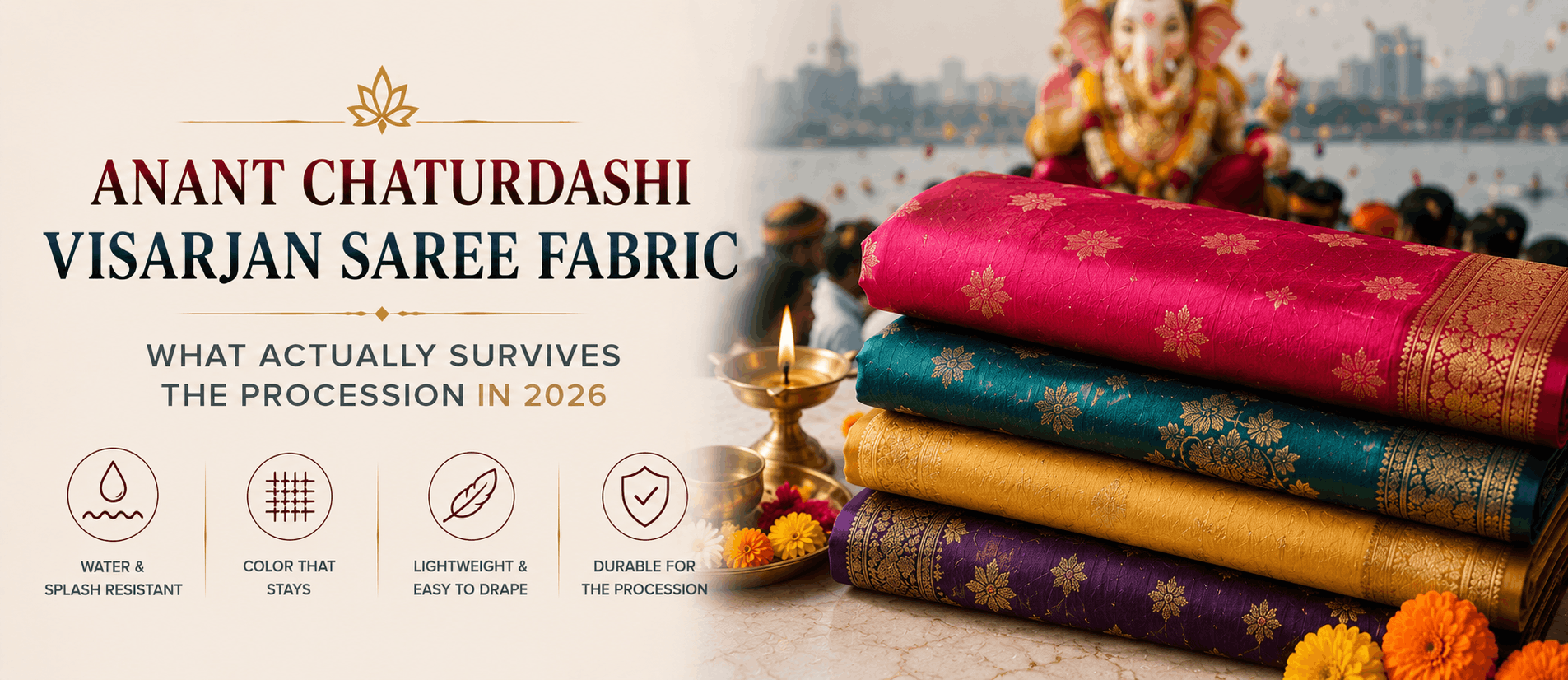
Anant Chaturdashi Visarjan Saree Fabric, What Actually Survives the Procession in 2026
Quick Answer
For Anant Chaturdashi visarjan on Friday, 25 September 2026, wear a cotton or cotton-blend saree in indigo, deep blue, aqua or teal. These shades match Bappa's water-immersion moment and hide the sprinkle marks from the procession. Skip pure silk and heavy zari, they stain and pull heavy when they get wet. Buy 6.3 metres of a light cotton or a cotton-Chanderi blend with a matching 0.8-metre blouse piece. Keep the drape shorter than a normal saree so the pleats do not sweep the ground.
Why the visarjan saree is nothing like the sthapana saree
The saree you wore for the aarti on sthapana day is not the saree you wear to visarjan.
Sthapana is indoor, calm, red-cream palette, kalash centred, silk-heavy. Visarjan is outdoor, moving, water-close, blue-white palette, sometimes a two-kilometre procession with dhol and dance before Bappa reaches the water.
If you wear a heavy silk banarasi on visarjan you will regret it by the second lane. Sweat, dust from the sindoor thrown in the air, splashes from the visarjan pot, sometimes actual rainwater in Mumbai and Pune. All of that hits the fabric.
Cotton is the answer. Not any cotton though, and not any blue.
The three fabrics that actually work for visarjan
1. Pure cotton, the safest visarjan pick
A soft mercerised cotton in indigo or deep blue is the most reliable saree for visarjan day. Weight around 90 to 110 grams per metre. Breathes in the September afternoon heat. Handles a splash without leaving a permanent water ring. Air-dries within an hour.
Best for a walking visarjan, especially in Mumbai or Pune where the procession can go for two to three hours.
Our cotton fabric collection holds 384 pieces sorted by weight and finish. Ask for the mercerised finish if you want a slight sheen without the pure silk weight.
2. Cotton-Chanderi blend, when you want the visarjan photo to look elegant
Chanderi silk-cotton blends give you a soft sheen without the full weight of silk. Body sits at 100 to 120 grams per metre. Not fully waterproof but recovers faster than pure silk after a splash.
Best if your visarjan is a short one, say fifteen to twenty minutes from home to the water body, and you want the family photo before immersion to look softer than a plain cotton.
Our dyeable Chanderi collection has 249 pieces you can send to the dyer for a specific indigo or peacock blue.
3. Georgette in a matte weave, for city-society visarjans
For a housing-society visarjan where the procession is only a walk to the building's water tank or a nearby park pond, a matte georgette in navy or teal works. Very light body, 60 to 80 grams per metre. Dries fast. Does not cling if it gets wet.
Avoid the shiny satin-finish georgettes. Only the matte weave. Shiny georgette reads as a party saree, not a puja saree.
Our georgette range has 663 pieces including several matte weaves suitable for visarjan.
Colours that suit Ganpati visarjan
The tradition is water-linked. So the colour palette leans blue, white, aqua, and light silver. Not the reds and yellows of sthapana.
- Indigo blue, the deepest and most traditional visarjan shade, hides sprinkle stains
- Peacock blue, slightly brighter, photographs well against the water
- Aqua or turquoise, for a younger woman or a first-time visarjan attendee
- Off-white with a blue border, a lovely middle-ground for grandmothers
- Silver-grey, for the family who wants a subtle look
Avoid pure red on visarjan day. It reads as a sthapana colour and clashes with the water-immersion mood.
Avoid heavy zari borders. The zari darkens if it gets a splash and you cannot restore it at home.
How many metres for a visarjan saree
A saree is 5.5 metres in some cuts, 6.3 in others, and up to 9 for a traditional nauvari. For visarjan, keep it manageable.
| Style | Saree metres | Blouse metres | Notes |
|---|---|---|---|
| Standard drape, urban visarjan | 5.5 metres | 0.8 metres | Easiest to manage in a walking procession |
| Full nivi drape with pleats | 6.3 metres | 0.8 metres | Slightly longer but pleats sit better |
| Nauvari (Maharashtrian) | 8 to 9 metres | 0.8 metres | Only if you are used to draping it and the visarjan is nearby |
| Half-saree for a young girl | 3.5 metres saree plus 2 metres dupatta | 0.75 metres | For teenagers in the family |
Whatever the length, tie the pallu with a light pin so it does not slip off during the immersion prayer.
The colour and safety choices most families miss
Two things get overlooked every year at the shop.
First, the blouse fabric. If your saree is cotton, keep the blouse cotton too. A silk blouse under a cotton saree looks mismatched and sweats badly.
Second, the footwear. Cotton saree, flat sandal or a simple juti. Not heels. The procession has uneven ground and immersion points near ponds and rivers can be slippery.
For a matching dupatta or a small stole to cover the head during aarti at the water, look at our all dupattas collection which has 350 pieces in matching cotton and Chanderi shades.
Booking timeline for visarjan sarees, 2026
Anant Chaturdashi is Friday, 25 September 2026. The visarjan procession in most cities starts by mid-afternoon and finishes by evening aarti at the water body.
- By 15 September: fabric bought, sent to the dyer if needed
- By 20 September: blouse stitched, first fitting done
- By 23 September: saree pre-drape practised at home, blouse finalised
- 25 September morning: saree pressed, blouse pinned, footwear kept ready
If you are attending a housing-society visarjan and there is no procession, you have until 22 September to book fabric. If you are joining a public visarjan (Lalbaugcha Raja, Andheri Cha Raja, or a Delhi-Mumbai colony procession), give the tailor a full week.
Small practical notes I share at the counter
- Do not carry the saree pallu loose during immersion. Tuck it once at the waist.
- Keep a spare cotton dupatta in your bag. Useful if the saree gets a heavy splash and you need to cover a wet patch on the walk back.
- Do not wear a full mangalsutra with delicate stone work if you are close to the water. Sindoor and water make gold darken.
- Skip fresh flower gajra in the hair on visarjan day. It wilts by the second kilometre. Wear a fabric-flower brooch instead.
FAQs
What colour saree should I wear for Anant Chaturdashi visarjan in 2026?
Indigo, deep blue, peacock blue, aqua or off-white with a blue border. These water-linked shades match the visarjan mood and hide splash stains from the procession.
Which fabric is best for a Ganpati visarjan saree?
Pure mercerised cotton for a long walking procession. A cotton-Chanderi blend for a short procession where the family photo matters. Matte georgette for a small housing-society visarjan.
Can I wear silk for visarjan on 25 September 2026?
Not recommended. Silk stains permanently when it hits water and darkens where the zari sits. Save the silk for the sthapana or the aarti-at-home visarjan.
How many metres of fabric for a visarjan saree?
5.5 to 6.3 metres for a standard drape plus 0.8 metres for the blouse. Nauvari drape needs 8 to 9 metres if you are used to it.
When should I buy the fabric for a visarjan saree?
By 15 September if you need dyeing, and by 22 September for a straightforward pre-dyed saree with a stitched blouse.
Book a fabric consultation
Come to the shop and I will show you the exact indigo and peacock-blue cottons I keep aside for visarjan sarees. Saree, blouse, matching dupatta, all sorted in one visit.
Book an appointment: parasgalleryfabrics.com/pages/book-an-appointment
Boutique or bulk order: parasgalleryfabrics.com/pages/wholesale
Fabric estimator: parasgalleryfabrics.com/pages/fabric-estimator
WhatsApp: +91 96544 40244