
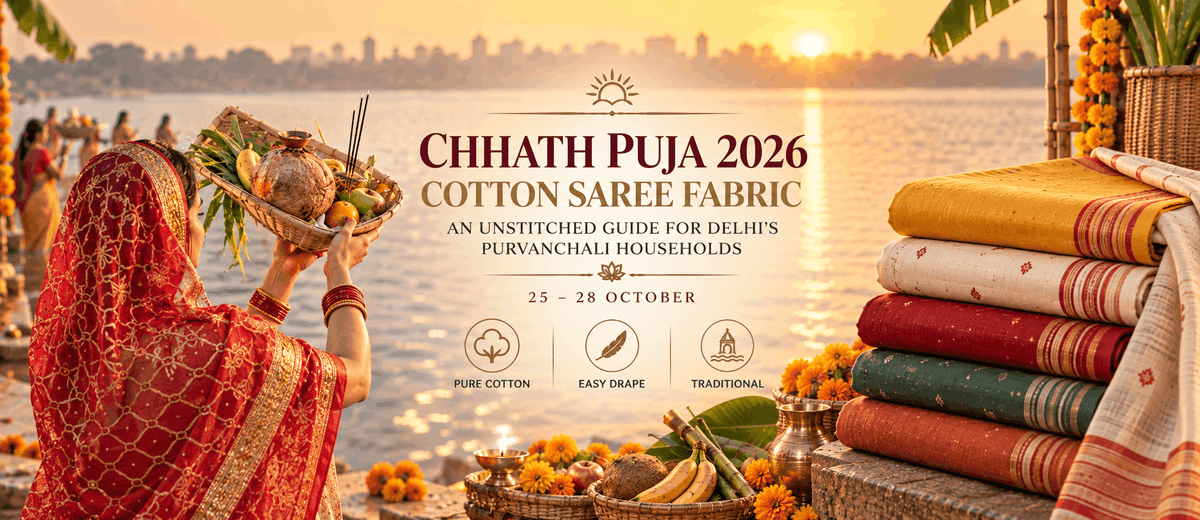
Chhath Puja 2026 Cotton Saree Fabric: An Unstitched Guide for Delhi's Purvanchali Households (25-28 October)
Quick Answer
Chhath Puja 2026 runs across four days, 25 to 28 October, with the two main arghya (offering) days on 27 October (Sandhya Arghya) and 28 October (Usha Arghya). For Purvanchali (Bihari, Purbi UP, Jharkhandi) households in Delhi, the fabric ask is very specific. The vrati (fasting woman) needs an unstitched pure cotton saree, no stitched border, no zari overlay, in yellow, red, orange or green with a plain woven border. The men need a cotton or handloom dhoti or gamcha, unstitched. The rest of the family wears cotton or cotton-silk suits. Skip synthetic, skip georgette, skip anything with sequins for the vrati saree. Cut 6.3 metre of running cotton for the saree and 2.5 metre of cotton for the dhoti. Buy the fabric by 20 October so the household is ready before Nahay-Khay begins.
Why Chhath Puja fabric has to be unstitched cotton
Chhath is the strictest fast in the North Indian calendar. Two arghya days, one at sunset, one at sunrise, both from the waist deep in a river or a pond. In Delhi that is the Yamuna ghats, the Kondli ghat, the Sanjay Lake or a temporary neighbourhood water-tank set up by the RWA.
The vrati stands in cold October water for 30 to 45 minutes. She has fasted without water for 36 hours. The saree she wears has to be:
- Unstitched, because purity for this vrat means no needle marks in the cloth. A stitched border or a stitched fall is not permitted by the strict reading.
- Pure cotton, because the saree gets wet, gets dried, and gets worn again the next morning. Synthetic does not wick water out. Cotton does.
- Woven border, not stuck-on border, for the same purity rule.
That is why the standard shop-front georgette or embroidered saree is not the Chhath saree. Chhath has its own fabric-code.
The saree fabric for the vrati
Yellow, red, orange or green cotton
The four traditional Chhath colours for the vrati saree are yellow, red, orange, and green. Each carries its own meaning in the vrat. Almost every Purvanchali customer in Central Market pulls yellow or red for the main arghya days.
- Yellow for the Surya-Devta rise.
- Red for shakti and vermillion.
- Orange for saffron and sindoor.
- Green for the harvest offering (prasad basket).
Browse the cotton running-length collection. This handle holds around 384 fabrics right now. Look for a plain-weave body cotton with a narrow woven border in a matching or contrast colour. That woven border is important, it must not be a separate stitched-on lace.
If the household wants a light block-print
A soft block-print on cotton is accepted by most Purvanchali households as long as the print is small and traditional (bel-buti, floral). Skip a screen-print or digital print, and skip anything with metallic ink.
Browse the printed cotton collection, 213 fabrics, for the small-bel-buti options.
The fabric-metrage plan
| Household member | Item | Fabric | Cut |
|---|---|---|---|
| Vrati (fasting woman) | Saree | Pure cotton, woven border | 5.5 m |
| Vrati | Blouse | Same cotton | 0.8 m |
| Vrati | No petticoat lining (traditional) | -- | 0 |
| Second woman (helper/daughter) | Saree | Cotton | 5.5 m |
| Second woman | Blouse | Cotton | 0.8 m |
| Man (vrati's husband or head) | Dhoti | Cotton or handloom | 2.5 m |
| Man | Kurta | Cotton | 2.5 m |
| Man | Gamcha (shoulder cloth) | Handloom cotton | 1.2 m |
| Child | Kurta-pyjama | Cotton | 1.8 m |
A four-person household plans around 20 to 22 metres of unstitched cotton for the full Chhath wardrobe. That is a full boutique-restocking cut, and this is why many Central Market boutiques do a Chhath-week bulk order.
Colour, per day of the 4-day fast
| Day | Date 2026 | Ritual | Colour on the vrati |
|---|---|---|---|
| Nahay-Khay | Sun, 25 Oct | Cleaning, one-time meal | Yellow or cream |
| Kharna | Mon, 26 Oct | Fast begins after kheer | Red or orange |
| Sandhya Arghya | Tue, 27 Oct evening | Sunset offering at ghat | Red |
| Usha Arghya | Wed, 28 Oct dawn | Sunrise offering, parana | Yellow or green |
So the vrati typically needs two sarees across the four days. Some strict households prefer to keep the same red saree from Kharna evening to Sandhya Arghya, and change to a yellow at dawn for Usha Arghya.
What to strictly avoid on the vrati saree
- Synthetic net, hard net, plastic net. Traps ghat water, chafes waist in wet drape.
- Sequins, stone work, mirror work. Fall off in water, and disqualified by strict reading.
- Zari border with metallic threads. Sinks against wet skin, disqualified by strict reading.
- Stitched fall or stitched border. Purity rule requires an unstitched saree.
- Georgette, chinon, chiffon. They cling and do not dry between arghya sittings.
Delhi ghat-day weather note
Late October Delhi is 14 to 18 degrees Celsius at dawn. The vrati stands in Yamuna or ghat water at that temperature. A thick handloom cotton or a medium-weight cotton with a khesh weave insulates better than a fine muslin cotton. Muslin cotton is beautiful for a summer saree but wrong for a 5:30 AM sunrise arghya in October.
Dhoti and gamcha for the men
The vrati's husband holds the daura-supli (bamboo basket of prasad) and walks with the family to the ghat. He wears an unstitched cotton or handloom dhoti in white or off-white, sometimes with a thin red or yellow border. A cotton or handloom gamcha (shoulder cloth) in yellow, red or plain white goes over the shoulder for the puja.
Browse cotton dhoti and gamcha length in the cotton collection.
When to buy the fabric
Chhath Puja 2026 starts on Sunday, 25 October (Nahay-Khay). The four-day fast concludes on Wednesday, 28 October dawn.
- Fabric buy: 12 to 20 October.
- Woven-border check with your tailor: 20 to 22 October. No stitching needed for the saree, but the border finish and the pallu edge is confirmed.
- Blouse stitching: 20 to 24 October.
- Vrati keeps the saree ready, folded, unworn, from 24 October evening.
Do not delay the buy past 20 October. Central Market runs out of yellow and red pure cotton in the Chhath week, every single year.
For boutique owners restocking
If you run a boutique in Uttam Nagar, Dwarka Sector-3, Vikaspuri, Karol Bagh, Ghaziabad, Noida-63 or Faridabad Old, where Purvanchali households cluster, the Chhath cotton stack for October has to be:
- Yellow pure cotton with narrow woven red border, at least 12 pieces on the floor by 10 October.
- Red pure cotton with narrow woven yellow border, at least 12 pieces.
- Orange and green cotton, 4 to 6 pieces each.
- White and off-white cotton dhoti-length, 20 pieces.
- Yellow and red cotton gamcha, 30 pieces.
Wholesale packs available through the wholesale desk, specify "Chhath October stack" when you enquire.
The Pitru Paksha rule, and Chhath
Pitru Paksha 2026 closes on Saturday, 10 October. Sharadiya Navratri starts on Monday, 12 October and ends with Dussehra on Tuesday, 20 October. Chhath Puja begins Sunday, 25 October.
So the Chhath buy window (12 to 20 October) is completely outside Pitru Paksha. No shopping-pause conflict for this festival. Families that observed Pitru Paksha can resume from 11 October and have the full Chhath window ahead of them.
FAQ
Q1. What is the correct chhath puja cotton saree fabric for the vrati?
An unstitched pure cotton saree with a woven border, no sequins, no zari, no stitched fall, in yellow, red, orange or green. The vrati wears it during the sunset arghya (27 October) and sometimes for the sunrise arghya (28 October) as well.
Q2. Why does the Chhath saree have to be unstitched?
The strict reading of the vrat requires purity in the fabric. A stitched fall or a stitched-on border is not permitted. A woven-in border on plain-weave cotton is acceptable and is what most households use.
Q3. How many metres of cotton fabric does a Chhath household need in total?
A four-person household plans 20 to 22 metres of unstitched cotton. That covers a vrati saree, a second helper saree, a men's dhoti and kurta, a gamcha, and a child's kurta-pyjama.
Q4. Which colour is worn on the Usha Arghya morning of Chhath?
Yellow or green is the traditional Usha Arghya morning colour. Some households prefer yellow for the sunrise moment and switch to green for the parana meal after.
Q5. Can synthetic or georgette fabric be used for the Chhath vrati saree?
No. The vrati stands in ghat water for 30 to 45 minutes and the saree gets wet. Synthetic and georgette cling and do not dry between the two arghya sittings. Pure cotton is the accepted fabric.
Q6. When should Purvanchali households in Delhi buy the Chhath cotton fabric?
Buy between 12 and 20 October 2026. Central Market and Karol Bagh cotton stocks in yellow and red run low in the Chhath week every year. Blouse stitching can be done between 20 and 24 October so the household is ready by Nahay-Khay evening on 25 October.
Ready to plan the Chhath cotton wardrobe?
Walk into Central Market, Lajpat Nagar, or WhatsApp the shop on +91 96544 40244 with the four-person family cut, and we will pull yellow, red and orange plain-weave cotton with woven borders side-by-side. Book a slot on the appointment page. Boutique owners restocking for the Purvanchali cluster, the wholesale desk has the Chhath October stack ready in yellow, red, orange and green. Not sure how much cotton your family cut needs? Use the fabric estimator.
Written by Sneha at Paras Gallery Fabrics, Central Market, Lajpat Nagar. Chhath saree and dhoti advice shaped by Bihari, Purbi UP and Jharkhandi households in Uttam Nagar, Dwarka Sector-3, Vikaspuri and Noida-63 who observe the four-day vrat every year.


%20days%20on%2027%20October%20(Sandhya%20Arghya)%20and%2028%20October%20(Usha%20Arghya).%20For%20Purvanchali%20(Bihari,...)