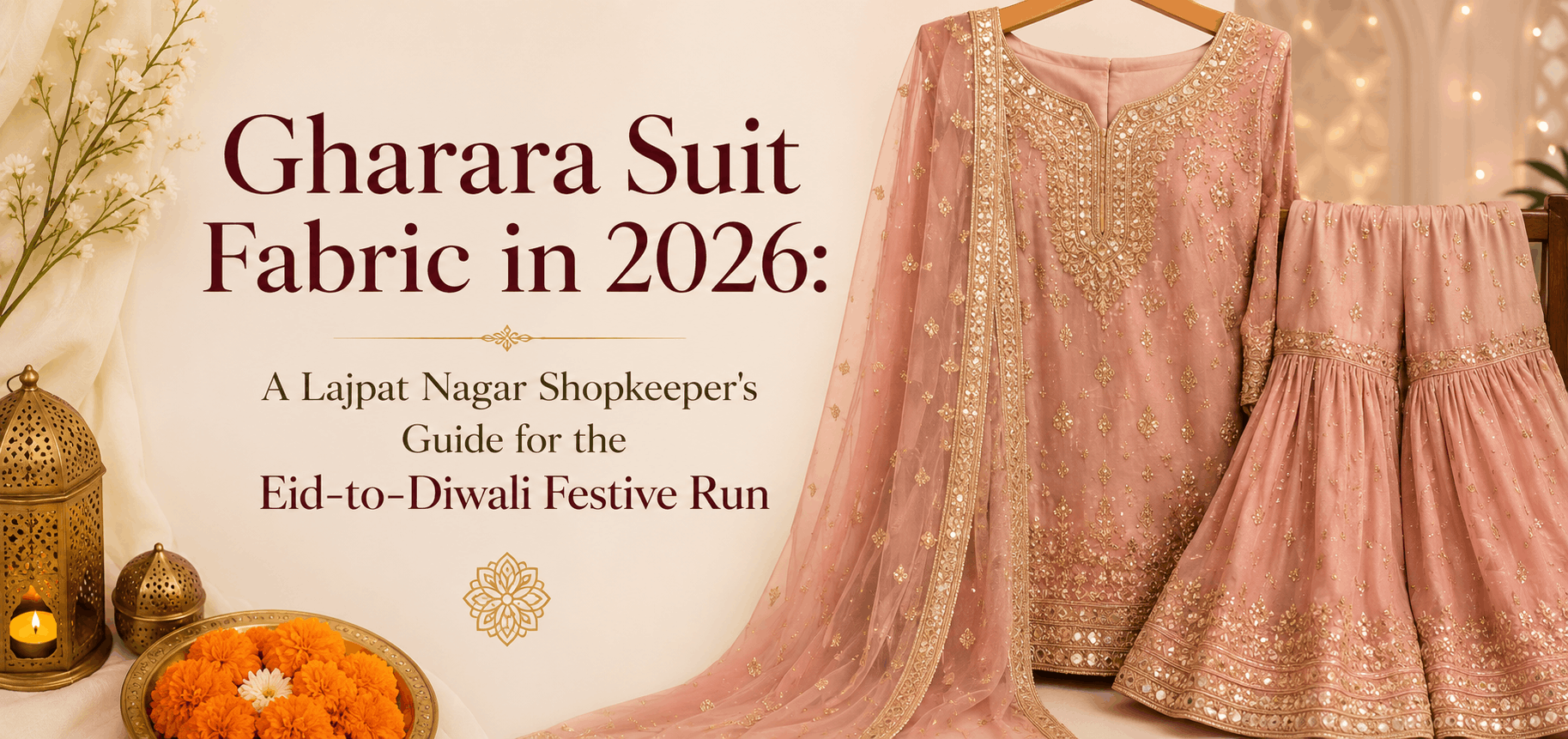
Gharara Suit Fabric in 2026: A Lajpat Nagar Shopkeeper's Guide for the Eid-to-Diwali Festive Run
Yesterday a young customer from Saharanpur called the shop about a gharara. Her sister-in-law's nikah is in Lucknow this September. She wanted one thing settled before anything else: Lucknowi ya Pakistani? That single question decides the whole fabric range.
Lucknowi chahiye, she said, par modern. Comfortable bhi hona chahiye. One outfit that reads traditional without looking like a costume.
This is the call I take ten times a week from June to October. So which gharara suits which function? And what should a boutique actually stock?
Sit for ten minutes and I will walk you through the fabric, the functions and the stocking plan.
Quick answer. Gharara suit fabric is the wide-flared bottom cloth for the Awadhi three-piece: short kurti, flared gharara pants and dupatta. Lucknowi gharara runs lighter bases like chanderi, georgette or art silk. Pakistani gharara runs heavier banarasi, jamawar or kamkhab with a wider ankle flare. A full outfit takes 8 to 12 metres for the legs, 2 for the kurti and 2.5 for the dupatta.
Where gharara comes from
The gharara is Awadhi, from the Nawabi courts of eighteenth-century Lucknow. The original was cut for the begum of the household, an heirloom piece. Each leg joins a fitted thigh to a wide ankle flare at a dropped knee seam called the gota or chatapati. That knee join is what defines a real gharara.
By the early twentieth century, the begums of Lahore and Karachi took up the silhouette for weddings, in heavier fabrics like banarasi, jamawar and kamkhab. The Lucknowi version stayed light, on chanderi, georgette and art silk.
In 2026 it has come back hard. Bollywood weddings, regional cinema, Instagram reels. Gharara is now a bride's pick for nikah, mehendi, walima and engagement. Even Hindu sangeets are using it now.
Lucknowi vs Pakistani: the fabric difference
This is where most buyers get confused. A Lucknowi gharara uses lighter cloth. Chanderi silk is the original Awadhi pick. Georgette with hand zardozi has been the favourite since 2010. The everyday budget option is art silk.
A Pakistani gharara uses heavier cloth. Banarasi silk carries the wedding piece. Jamawar suits the sister-of-bride. Kamkhab brocade goes to the most formal events. The dupattas run heavier too, bandhani or a banarasi pallu with a deep zari border.
The cut differs as well. Lucknowi keeps a narrower ankle flare, around 32 to 40 inches. Pakistani opens wider, 44 to 56 inches, so that wider flare needs heavier fabric to hold the drape. If a customer just says gharara, ask one question: Lucknowi ya Pakistani style? The answer tells you which range to pull.
Fabric weight matters more than the name
A common mistake: people ask for chanderi gharara and receive thin chanderi with no drape, so the flare hangs limp at the ankle. For Lucknowi, chanderi should be 60 to 80 gsm minimum and georgette 60 gsm or above. Below that the flare collapses. For Pakistani, the banarasi should be heavy-weight and the jamawar brocade-weight rather than soft. Kamkhab is naturally heavy, so no worry there.
Always run the drop test. Hold a metre off the counter and let it fall. If it folds into soft architectural cones, it has the weight for a gharara. If it collapses flat, it belongs on a kurti or saree.
2026 Lajpat Nagar wholesale prices
| Fabric | Wholesale per metre |
| Chanderi | Rs 540 to 980 |
| Georgette with zardozi | Rs 920 to 2,400 |
| Art silk | Rs 380 to 720 |
| Banarasi | Rs 1,400 to 3,800 |
| Jamawar | Rs 1,800 to 4,200 |
| Kamkhab | Rs 2,400 to 5,800 |
Ready-stitched runs Rs 4,500 to 18,000 for a Lucknowi three-piece and Rs 9,500 to 48,000 for a Pakistani set. A standard gharara needs 8 to 12 metres for both legs, with 2 more for the kurti and 2.5 for the dupatta. Boutique rates need a verified Paras Gallery account. The wholesale page carries the form.
When to wear which gharara
- Nikah of the bride. Pakistani in banarasi or jamawar, heavy zari, kamkhab dupatta with a deep border.
- Sister of the bride, walima. Pakistani in lighter banarasi or georgette, mid-range zari.
- Mehendi. Lucknowi chanderi or georgette, pastel shades, mirror or gota work.
- Engagement, sangeet. Lucknowi georgette zardozi in jewel tones.
- Eid. Lucknowi in a cool fabric, cotton silk for summer, chanderi for autumn.
- Karwa Chauth, Diwali pooja. Lucknowi chanderi in red, maroon or kesari, light enough for all-day wear.
- Office Diwali, family parties. Art silk in soft tones, comfortable and affordable.
Boutique stocking advice, Eid to Diwali
Stock three Lucknowi ranges as your daily flow. Chanderi in pastel pink, mint and butter yellow. Georgette zardozi in jewel red, royal blue and emerald. Art silk in muted maroon, kesari and beige.
Hold two Pakistani pieces as the high-margin turn, banarasi in maroon and jamawar in royal blue. Even at one sale a fortnight, the unit margin earns its shelf space.
Keep the dupattas separate. A bandhani dupatta over a plain chanderi gharara is a fast mover for sangeet buyers. Stock unstitched fabric on the top shelf, since boutique customers want the cut tailored to their measurements. Pre-stitched carries too many size variables to stock deep.
One seasonal caution: skip heavy banarasi in the summer-onset months. September Delhi still touches 34 degrees and no bride enjoys heavy zari in that heat. Bring the heavy banarasi in closer to November.
In short. Ask Lucknowi or Pakistani first, it decides everything. Lucknowi runs light on chanderi, georgette and art silk with a 32 to 40 inch flare. Pakistani runs heavy on banarasi, jamawar and kamkhab with a 44 to 56 inch flare. Weight matters more than name, so run the drop test. Stock three Lucknowi ranges for daily flow and two Pakistani pieces for margin.
What to check before you buy
Five quick checks at the counter. The drop: real gharara fabric falls into soft cone folds over your forearm, thin fabric falls flat. The zari: real zari gives a faint metallic ring when two threads tap together, plastic zari is silent. The dye: rub a damp white cloth on it, real dyed silk does not transfer, cheap dye does. The width: gharara needs at least 44-inch fabric because each flared leg is panelled, below that you buy extra metres. The lot: buying kurti, gharara and dupatta cloth separately, confirm the same dye lot, since even small variation shows under indoor wedding lighting.
Care and storage
Store gharara fabric flat or rolled, never in a sharp fold, or the flare crease sets permanently over months. Use cotton garment bags, since plastic traps humidity and damages the zari.
Dry-clean only for the first three cleans. After that, a gentle hand-wash suits chanderi and art silk, while banarasi and jamawar always go to dry-clean. Air the gharara every fortnight through the monsoon, two hours on a wide hanger, then refold along a fresh line.
Questions boutiques and buyers ask me
What is gharara suit fabric made of?
Chanderi, georgette, art silk, banarasi, jamawar and kamkhab. Lucknowi gharara leans lighter, Pakistani gharara heavier.
How much fabric does one gharara need?
A standard gharara takes 8 to 12 metres for both legs depending on the flare, with 2 more for the kurti and 2.5 for the dupatta.
What does gharara suit fabric cost in 2026?
At Lajpat Nagar wholesale, chanderi starts at Rs 540 per metre. Georgette zardozi runs Rs 920 to 2,400. Banarasi sits between Rs 1,400 and 3,800.
Lucknowi vs Pakistani gharara, what is the difference?
Lucknowi uses lighter fabric with a narrower ankle flare. Pakistani uses heavier banarasi or jamawar with a wider flare and a heavier dupatta.
Which gharara fabric is best for September weddings?
Georgette with zardozi. It is light enough for the Delhi NCR heat that still touches 32 degrees, so the drape holds under indoor reception lighting.
Can resellers stock gharara fabric for online sales?
Yes. Unstitched gharara fabric ships well, packed flat in butter paper inside a flat box. Avoid tube packaging, since the fabric width is too wide for a clean tube fit.
Planning a September wedding? Stock early
Planning a nikah, walima or sangeet from September on? WhatsApp the shop for same-day swatch couriers across Delhi, Lucknow, Hyderabad, Mumbai, Bengaluru and Kolkata. Browse the live ranges in banarasi and wedding while you plan the palette, then place your first bulk order through the wholesale catalogue.