Patola Silk Saree Fabric in 2026: A Lajpat Nagar Shopkeeper's Honest Guide for Festive Season Buyers
I am sitting at my Lajpat Nagar shop and a young customer walks in last Saturday. She has a wedding card for September. She wants something her mother will approve and her friends will not have seen on Instagram. Achha, she says, dikhao kuch alag.
I open the Patola section. She gasps when she sees the price tag. One lakh eighty thousand. Then she sees the Rajkot version next to it. Four thousand eight hundred. Same pattern. Same colours almost. What is the difference?
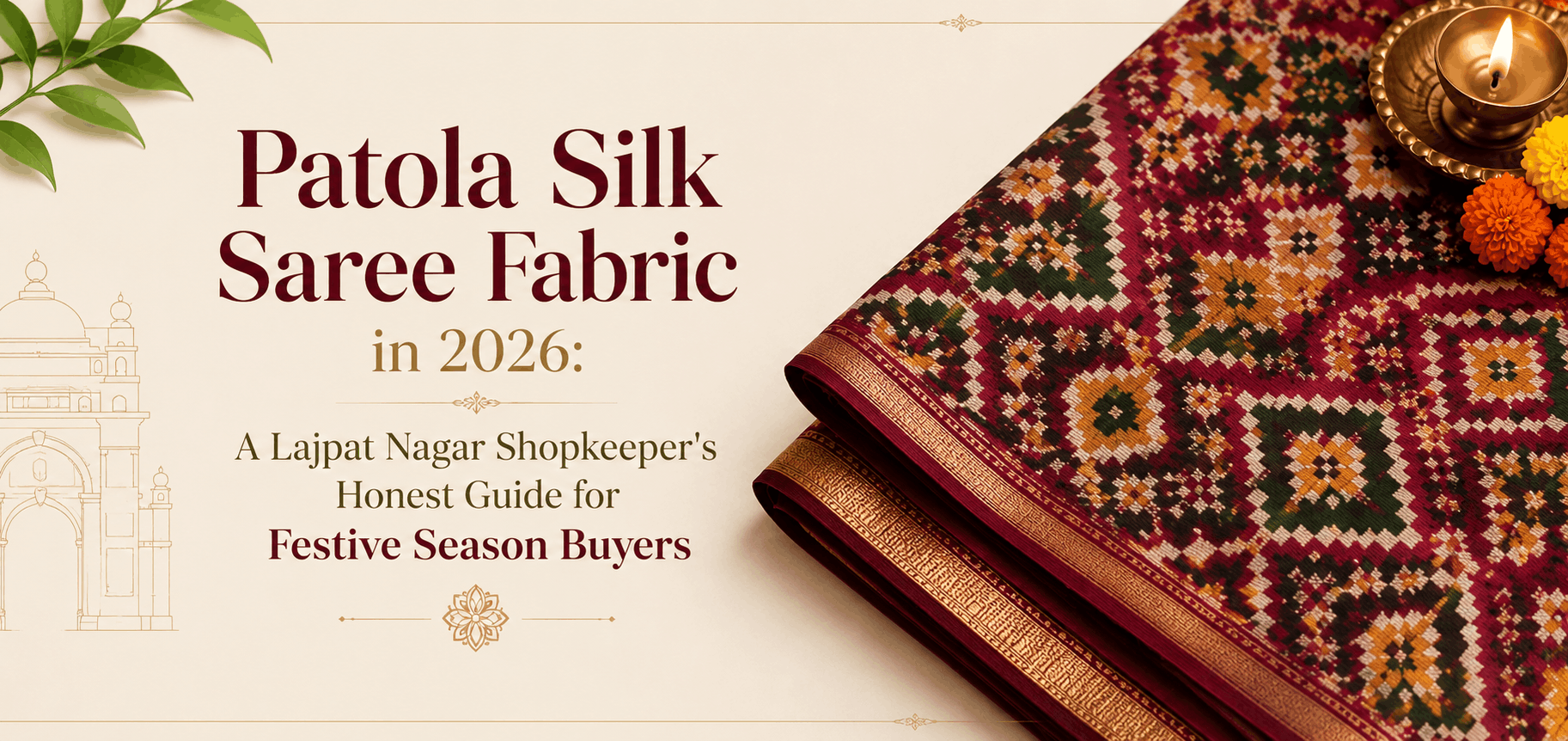
Patola silk saree fabric is a hand-woven ikat textile from Patan and Rajkot in Gujarat where both warp and weft threads are tie-dyed before weaving. Authentic double ikat Patan patola begins at 1.8 lakh rupees retail. Rajkot single ikat patola starts at around 4,500 rupees per piece.
Where patola really comes from
The original patola of India is Patan in north Gujarat. Three Salvi families have been weaving this cloth since the eleventh century. Yes, eleven hundred years. The Salvi loom is the only loom in the world that does true double ikat at this complexity. One pure silk saree takes between four and seven months on the loom.
The second home is Rajkot in Saurashtra Gujarat. Rajkot patola began in the early twentieth century as a more affordable cousin. The Rajkot weavers do single ikat. That means only the weft threads are tie-dyed. The warp is plain.
A third version has appeared in the last decade. Banaras has started weaving patola-look silk sarees on the Imperial brocade loom with printed or partial ikat weft. These are sold as Banarasi patola fusion. Beautiful in their own right. Not the real Patan or Rajkot piece.
Double ikat vs single ikat the simple test
This is what you need to remember.
In Patan double ikat patola, both warp and weft threads are tied and dyed separately before the weaving starts. When the karigar weaves, the tied dots line up to form the motif. The pattern appears on both sides of the saree with identical sharpness. Flip the saree. The motif is the same.
In Rajkot single ikat patola, only the weft is tied. The warp is plain. The pattern still forms but it appears slightly less sharp. The reverse side shows the motif with very small misalignments.
Run your fingertip across the saree. A Patan piece has the pattern visible on both surfaces equally because the colour goes all the way through. A Rajkot piece is slightly more visible on the front.
Printed patola is the third category. The motif is screen-printed on woven silk. The back of the cloth is much fainter than the front. No ikat depth.
The motifs that define this cloth
Real patola silk saree fabric carries a small vocabulary of traditional motifs.
Nari kunjar bhat. The elephant and dancer pattern. This is the most expensive motif. It signals a high-occasion buyer.
Pan bhat. The pipal leaf pattern. Family weddings, religious functions, mother-of-bride pieces.
Phulwadi bhat. The flower-garden pattern. Most popular for sangeet and reception.
Ratan chowk bhat. The jewel square pattern. Architectural geometry. Younger buyers love this.
Chowkadi bhat. The simple checkered grid. Daily-wear festive option in lighter colour.
If a saree is sold to you as patola without one of these recognised motifs, ask questions. The motif is the signature.
2026 Lajpat Nagar wholesale price band
- Patan double ikat patola saree, 5.5 metre cut, with kalash or nari kunjar motif. 1,80,000 to 4,50,000.
- Patan single-side ikat patola saree. 65,000 to 1,40,000.
- Rajkot single ikat patola saree, 5.5 metre cut. 4,500 to 18,000.
- Rajkot patola dupatta. 1,800 to 4,200.
- Banaras silk fusion patola saree. 8,500 to 22,000.
- Printed patola-look georgette saree. 1,800 to 3,800. Do not pay above 4,000 for printed.
- Boutique wholesale rates require a verified Paras Gallery account. The Wholesale page carries the verification form.
Who should buy which patola
The bride or mother-of-bride who wants an heirloom piece. Patan double ikat in nari kunjar or pan bhat. This is the kind of piece that belongs in your Bridal Bliss shelf. It will travel down two generations.
The wedding guest who wants to dress rich without spending a lakh. Rajkot single ikat patola in royal blue, maroon or kesari. Photographs identical to Patan from across the room. This is also where the Reception Royale range fits the evening reception slot well.
The reseller and boutique stocking for the Raksha Bandhan to Diwali window. Rajkot patola in five colours from the broader saree collection. Red, royal blue, mustard, emerald, rani pink. Stock dupattas alongside sarees because the dupatta has become its own product.
The bride looking for a sangeet piece with traditional weight but contemporary cut. Banaras fusion patola saree, which sits in the same family as our Sangeet Serenade range. The patola body with a soft zari pallu sits beautifully on a lehenga blouse.
The everyday festive buyer for office Diwali parties and family pujas. Printed patola in georgette. Easy to drape. Easy on the budget. Just know it is not the real cloth.
What to check on the shop floor before paying
Look at the selvedge. Real patola has small unwoven thread loops where the ikat pattern transitions. These look like tiny imperfections. They are the signature of hand-weaving.
Pull the cloth across light. Real ikat has slightly soft motif edges. Printed patola has sharp factory-perfect edges. The softness is the proof.
Ask for the weaver mark. Genuine Patan patola from Salvi looms carries a registered handloom mark. Rajkot pieces from cooperative weavers carry the Geographical Indication tag for Patola of Gujarat.
Check both sides. If the reverse pattern is faded or absent, you are not looking at double ikat.
Smell test. Real silk patola has a faint dye and silk smell. Synthetic prints have a chemical hint.
Care and storage
Patola silk saree fabric is fragile in the first year. Air every fortnight. Fold along weave lines never against them. Store wrapped in pure muslin or butter paper. Never in plastic.
Dry clean only for the first three cleans. After that gentle silk wash with a soft hand and cold water.
In monsoon humidity, place a small camphor pouch in the storage box. This is what the Gujarat grandmothers have done for centuries. It works.
Avoid hanging patola sarees long term. The weight stretches the ikat. Fold in soft pleats. Refold every three months.
Boutique stocking advice for September weddings
Stock Rajkot patola in five colours for September to November weddings. Red, royal blue, mustard, emerald, rani pink. These five colours cover ninety percent of walk-in demand.
Hold one Patan double ikat as your showpiece. Even if it does not sell every season, it positions your shop in the buyer's mind. Customers remember the shop with the real Patan piece.
Stock patola dupattas separately as add-on units. A Rajkot patola dupatta paired with a plain chanderi or Banarasi suit base is one of the fastest-moving combinations in Lajpat Nagar.
Avoid stocking printed patola-look pieces in your top shelf. Mix-up between real and printed inventory has cost more than one boutique its long-term customer base. Run your stocking yardage through the Fabric Estimator before placing the patola order so the per-saree cuts roll up cleanly into the seasonal budget.
Patola silk saree fabric refers to the double ikat or single ikat woven cloth from Gujarat. Patan patola uses both warp and weft tie-dye and is made by only a handful of Salvi families. Rajkot patola uses weft-only ikat and is more affordable. Both feature geometric and motif-based designs with reversible patterning.
FAQ
What is patola silk saree fabric made of?
The cloth is pure silk dyed using the ikat resist technique. Patan uses double ikat with both warp and weft tied. Rajkot uses single ikat with only the weft tied.
Why is Patan patola so expensive?
One Patan patola saree takes between four and seven months on the loom. Only three Salvi families weave it. The labour and skill scarcity drives the price.
How can I tell real patola from printed patola?
Real patola has soft motif edges. The pattern is identical on both sides for double ikat. Small thread loops appear at the selvedge. Printed patola has sharp factory edges and a faded back side.
What is the price of patola silk saree fabric in 2026?
Patan double ikat begins around 1.8 lakh. Rajkot single ikat starts near 4,500 for a full piece. Banaras fusion patola sits between 8,500 and 22,000.
Which colour patola is best for a wedding guest?
Royal blue, maroon and kesari work hardest under indoor reception lighting. They photograph rich on phone cameras and do not wash out under chandelier.
Can boutique resellers stock patola for online sales?
Yes. Rajkot patola sarees ship safely if folded flat with butter paper. Avoid tube packaging for patola because the silk creases against the natural fold.
CTA
If you are planning a September to November wedding or stocking for the festive run, message me on WhatsApp for same-day swatch couriers across Delhi, Mumbai, Bengaluru, Hyderabad, Ahmedabad and Surat. Browse live ranges on Bridal Bliss, Reception Royale and Silk Fabric. Run your numbers through the Fabric Estimator before placing your first wholesale order. The Wholesale page has the bulk-order form ready when you are.