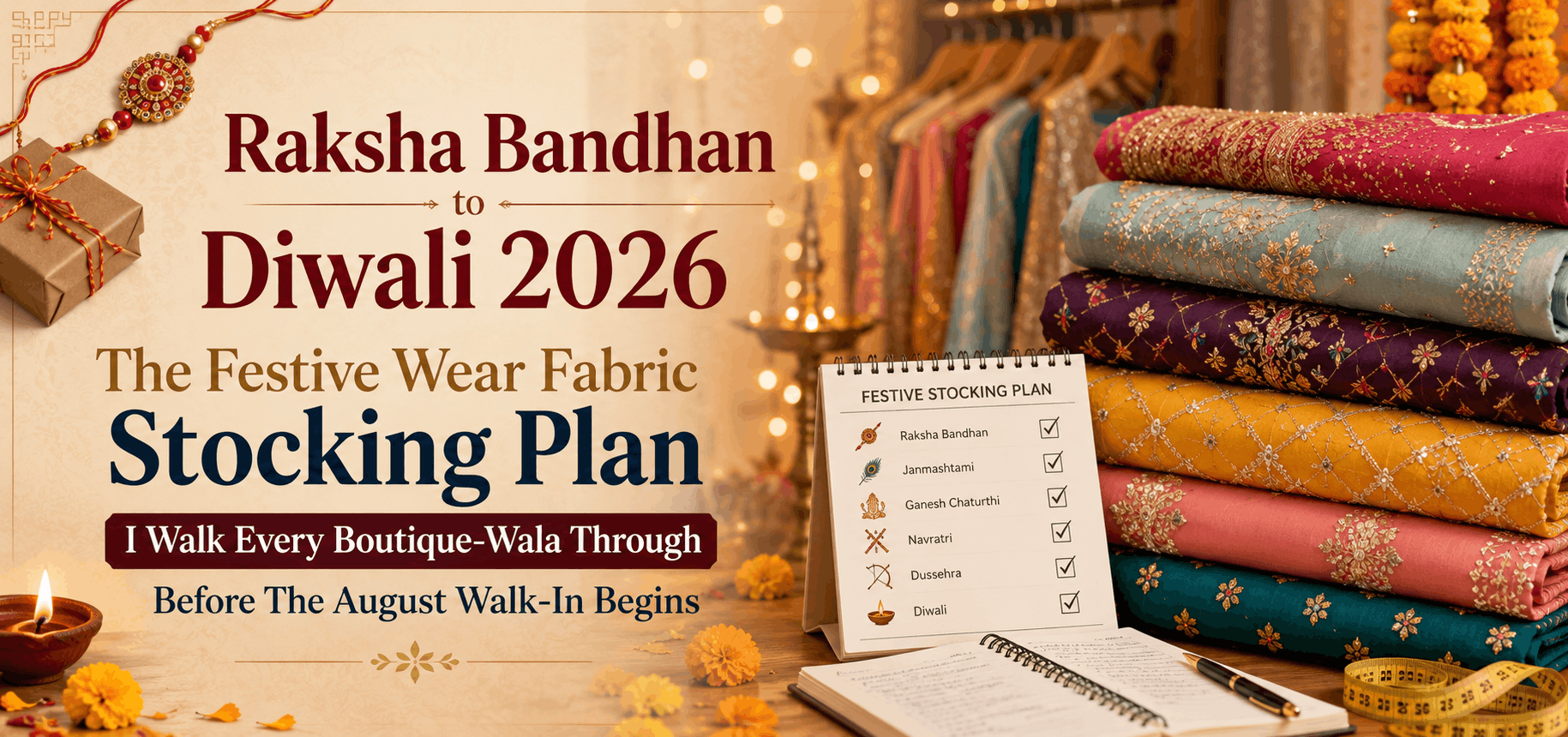
Raksha Bandhan to Diwali 2026: The Festive Wear Fabric Stocking Plan I Walk Every Boutique-Wala Through Before The August Walk-In Begins
Every late June the boutique-walas from Patna, Pune, Lucknow, Ahmedabad walk into my Lajpat Nagar shop with the same question. Same brief every year.
August se Diwali tak kya chalega. September wedding side-events ke liye kya stock karein. What carries the shop through Karwa Chauth without dead stock in January.
Two weeks late on red sarees in October? Season lost. Cloth on shelf two weeks before each date? Full nine-week cycle rings the till.
Here is the plan I walk every boutique-wala through before the August walk-in wave begins.
Quick answer: Raksha Bandhan 2026 falls on 28 August. Janmashtami on 4 September. This year Karwa Chauth is on 28 October. Diwali on 8 November. Boutique stocking for this nine-week window should begin in mid-July with georgette, Korean soft net, silk organza, raw silk plus chiffon-based festive wear fabric ranges. Red, royal blue, mustard, kesari, emerald plus rani pink are your six-colour core.
The 2026 festive calendar that drives walk-ins
Raksha Bandhan lands on Friday 28 August this year. Onam runs two days earlier on 26 August, so Kerala plus South-coast diaspora orders overlap with the Rakhi rush. Janmashtami follows on Friday 4 September. Ganesh Chaturthi begins 14 September through Anant Chaturdashi.
Then a quieter stretch. Sharad Navratri begins 10 October. Dussehra closes on 20 October. The Karwa Chauth date this year is 28 October (Wednesday, which helps office-going wives plan the puja day). Dhanteras 5 November. Diwali 8 November (Sunday, which matters for boutique footfall the day before). Bhai Dooj wraps the run on 11 November.
Mid-July is when boutique stocking should genuinely begin. Walk-in traffic peaks two weeks before each major date. Sangeet-wedding bookings overlap from late September onward.
The week-by-week stocking plan
Mid-July to Rakhi (28 August)
Light cotton bandhani is your opening move for the Rakhi family-lunch crowd. Rs 1,400 to Rs 2,400 per saree cut. Behind it, chiffon plus georgette suit fabric in pastel pink, mint, peach. Working women buy festive suits for the office Rakhi function and the family meet, both.
Heavyweight georgette saree moves next in dusty rose, mehendi green, beige. Pair on shelf with Banarasi cotton silk saree for the elder buyer. Lightweight body with festive look.
Mulmul cotton anarkali suit in floral block prints is your Onam-overlap pull. Kerala plus South-coast cities buy in volume during the same week the North is busy with Rakhi. Double-duty SKU.
Late August to Ganesh Chaturthi (4 to 22 September)
Bandhani in jewel red, mustard, royal blue for the Janmashtami evening puja crowd. Maheshwari silk cotton saree in off-white, beige, dusty pink moves for Ganesh Chaturthi day visits. Lightweight chanderi suit fabric is the Maharashtra buyer's pick, especially Pune and Nashik counters. Rs 480 to Rs 920 per metre wholesale.
Mid-September to early October (wedding-prep plus Navratri build)
Mid-September to early October is where Korean soft net takes over your shelf. Sharara, anarkali, lehenga: all three pull on the same fabric. Rs 320 to Rs 680 per metre wholesale. The single largest fabric category for the entire September to November cycle.
Behind it, mid-weight georgette in royal blue, maroon, emerald for sangeet wear. Then raw silk in kesari, mehendi green, dusty rose for Navratri garba outfits in Gujarat, Mumbai, plus Delhi diaspora communities.
Navratri to Dussehra (10 to 20 October)
Chaniya choli fabric in mirror-work cotton, gota patti georgette, embroidered net. Rs 240 to Rs 980 per metre depending on embroidery density. Bandhani odhni at Rs 320 to Rs 540 per piece for Gujarat plus Rajasthan customers. Phulkari dupatta at Rs 480 to Rs 920 for the Punjabi diaspora buyer.
Karwa Chauth (28 October) and pre-Diwali
This single date drives one of the strangest stocking spikes in the calendar. Every red saree on every shelf moves in a 48-hour window. Red bandhani, red Banarasi, red raw silk. Pure single-day demand across North Indian markets.
Behind the sarees, embroidered net suit fabric in red, maroon, kesari for the evening gathering. Boutiques in Faridabad and Noida have called me at 9 PM the night before asking for emergency red restock. The 48-hour window does not care about lead times. Learned that in 2021.
Dhanteras to Diwali (5 to 11 November)
Bridal-grade raw silk saree in kesari, maroon, royal blue for Lakshmi puja and Diwali night. Embroidered net lehenga fabric for sangeet plus family Diwali functions. Sequins fabric for the cocktail crowd at Rs 540 to Rs 1,400 per metre. Heavy zari Banarasi-look sarees for the corporate gifting market. Tissue saree plus tissue suit fabric for the upper-budget Diwali wardrobe.
The 6-colour core that moves stock
Red is the single heaviest colour across the entire cycle, no debate. Carries every festive function from Rakhi to Diwali. Stock heaviest in red.
Royal blue is the indoor-function workhorse. Photographs beautifully under chandelier and tube light both. Which matters because half of Diwali night shooting happens on phone cameras with terrible white balance.
Mustard plus kesari pull Janmashtami, Navratri, Diwali-day demand. Emerald plus mehendi green sit in the sangeet-and-engagement evening slot. Rani pink and dusty rose are your crossover colours, the warm pastels that walk from daytime puja into evening sangeet without a wardrobe change.
Six colours. That is your shelf in a sentence. The rest is variation around those six.
Budget allocation for the 9-week cycle
Fifty percent of your stocking budget goes to net, georgette, organza. These three move fastest from Rakhi straight through Diwali.
Twenty percent to raw silk plus embroidered options. These carry the high-margin wedding-side cycle.
Fifteen percent to handloom (bandhani, maheshwari, chanderi, phulkari). Daytime-function buyers pay full price for handloom heritage and rarely negotiate.
Ten percent to sequins, tissue, zari for the Diwali night plus gifting market. Hold the last five percent as reorder buffer for the post-Janmashtami restocking wave, which catches most first-time boutiques flat-footed.
5 mistakes that kill festive stocking
I have watched first-time boutique buyers burn Rs 1.5 lakh on the wrong stock. Five things go wrong.
Stocking polyester synthetics in 2026. The walk-in this year is reading fabric labels. She was not doing this two years ago. Polyester-only sarees sit on shelf.
Bridal-heavy brocade in light pastel shades. Does not move from September to November. The buyer wants either daytime-light or evening-rich. Middle dies on shelf.
Flat printed bandhani-look polyester. The walk-in cannot tell on photograph but returns the saree once she sees the cloth in hand. Lost Rs 80,000 to a Surat supplier's "bandhani print" lot in 2019.
Cold tones for Karwa Chauth plus Diwali week. Ice blue, silver, ash grey. Warm tones carry the festive demand. The cold palette dies on shelf those two weeks every year.
Late stocking of red sarees. Two weeks late on red in October and you have lost the season. Order red raw silk plus red bandhani by mid-September.
Colour cheat sheet for the 9-week cycle: pastel pink, mint, peach chiffon for pre-Rakhi; dusty rose, mehendi green, beige georgette for Rakhi week; jewel red plus royal blue bandhani for Janmashtami; Korean soft net through September; red Banarasi through Karwa Chauth; kesari plus maroon raw silk for Diwali. Avoid cold tones from mid-October through mid-November.
Questions boutique-walas ask me before stocking begins
What festive fabric sells fastest from Rakhi to Diwali in 2026?
Korean soft net first. Mid-weight georgette second. Silk organza third. Behind those, the daytime-function buyer pulls bandhani or maheshwari or chanderi.
Konsa colour sabse zyada chalega festive season 2026 mein?
Red, easily. Royal blue, mustard, kesari, emerald plus rani pink complete the six-colour core stocking plan.
Karwa Chauth ki date kya hai 2026 mein?
28 October, Wednesday. Stock red bandhani, red Banarasi, red raw silk from mid-October at the latest.
Walk-in traffic kab shuru hota hai?
Mid-July for Raksha Bandhan stocking. First peak the week of 22 to 28 August. Next peak mid-October for Navratri-Dussehra. Largest peak late October to Diwali week itself.
Embroidered ya plain, kya zyada stock karein for Diwali?
Seventy percent plain, thirty percent embroidered. Plain georgette, organza, net move at the everyday festive end. Embroidered net or embroidered raw silk move at the bridal end.
Ready to stock?
Planning your August-to-November festive stocking? WhatsApp the shop before mid-July to lock the soft net plus georgette ranges. These two book out first every year. Same-day swatch courier to Delhi NCR, Mumbai, Hyderabad, Kolkata, Bengaluru, Jaipur, Patna, Pune, Lucknow. Boutique buyers picking ten metres or more per shade should use the wholesale page for thaan-level pricing.