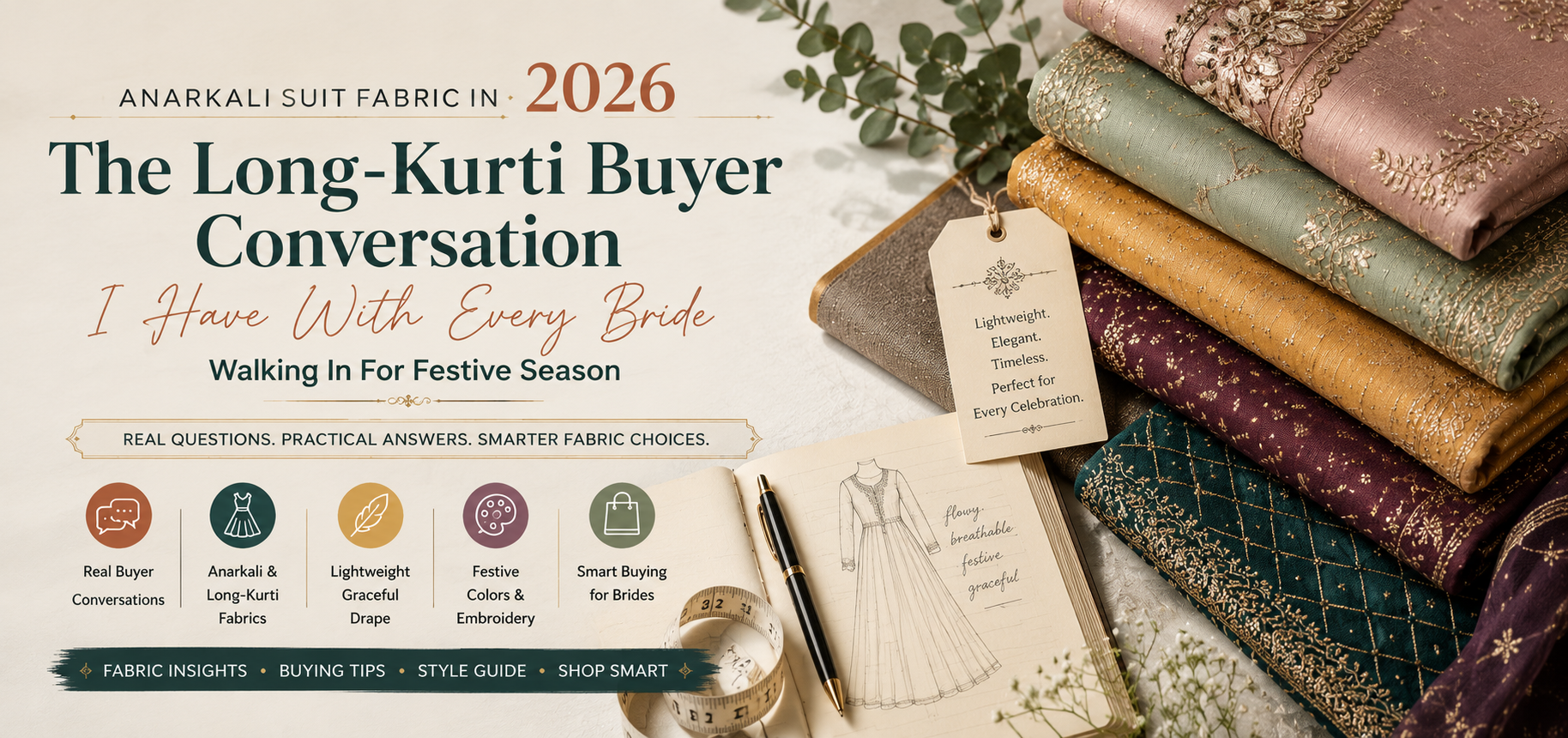
Anarkali Suit Fabric in 2026: The Long-Kurti Buyer Conversation I Have With Every Bride Walking In For Festive Season
Stacking kurtis for the Rakhi-to-Diwali function run? Every August my Lajpat Nagar counter fills up with women shopping four to six kurtis in one trip. Same brief every visit.
One kurti for the Rakhi family lunch. Another for the Teej pooja. A third for a cousin's mehendi afternoon. Plus one each for the office Diwali and the Karva Chauth evening.
Wrong fabric picked? Sits unworn by Onam. Right fabric picked? Rotates through three functions plus daily wear till November.
Here is the guide I send wedding-guest customers before their monsoon-to-winter shopping trip.
Quick answer: The seven kurti fabrics a multi-function guest should stack are cotton (daily), chanderi silk (evening festive), silk cotton (Rakhi lunch), rayon (office day), organza (party wear), mulmul (daytime pooja), plus modal for comfort. Delhi wholesale runs Rs 220 per metre for pure cotton to Rs 1,600 per metre for embroidered silk. Buy 2.5 metres for a straight kurti, 3 metres for an A-line.
When kurti fabric works, plus when to skip it
Each fabric wins a specific function and loses at another. Cotton owns daytime pooja. The Rakhi lunch belongs to silk cotton. Organza owns the party evening. Nothing owns everything.
Where to skip. Skip pure silk for daily wear. Skip polyester for outdoor Ganpati visarjan in Mumbai humidity. Skip heavy embroidered cotton for a Diwali office party where photographs matter, because embroidery flattens under fluorescent office lighting.
Match the fabric to the specific occasion, not to a shopkeeper telling you "yeh sab mein chalega." No single fabric handles morning pooja plus office Diwali plus a cousin's sangeet. Different weaves for different slots.
The 7 kurti fabrics I recommend for the multi-function guest
1. Pure cotton (the everyday workhorse)
Breathable across every Delhi season. Handles machine wash without shrinking after the pre-shrunk cycle. Sits at Rs 220 to Rs 420 per metre wholesale. My default for the mid-week office day plus the small Sawan Somvar pooja at home.
Stock at least three plain cottons in ivory, mustard, indigo. Adds a plain-body rotation base to any wardrobe.
2. Chanderi silk cotton (the evening festive)
Half-shine half-matte character. Photographs honestly under indoor yellow lighting. Wholesale runs Rs 540 to Rs 980 per metre.
My top pick for the evening Teej pooja plus a small Diwali dinner at your sister's place. Buy in dusty pink, mint, ivory to keep it neutral against your existing dupattas.
3. Silk cotton (the Rakhi lunch pick)
Mid-weight blend. Reads dressy without going full silk. Wholesale sits at Rs 380 to Rs 720 per metre. Best in maroon, deep green, kesari.
The Rakhi family lunch usually has photography plus close family. This blend reads pulled-together without looking bridal.
4. Rayon or viscose (the daily office rotation)
Drapes soft. Colours print beautifully. Wholesale Rs 160 to Rs 320 per metre. Machine washable on gentle cycle.
This is the fabric for four office days plus a casual weekend brunch. Avoid pure viscose in high humidity, though. Fabric clings by hour three.
5. Organza with light embroidery (party wear)
Crisp fall. Sheer body over an inner slip. My party-slot pick for Diwali office parties plus wedding cocktail functions. Wholesale festive organza kurti sits Rs 720 to Rs 1,600 per metre.
Always add a cotton or satin inner slip. Non-negotiable. Organza scratches directly against skin by hour two otherwise.
6. Mulmul cotton (daytime pooja plus summer wear)
Feather-light. Dries fast in humidity. Wholesale Rs 180 to Rs 380 per metre. My default for outdoor daytime functions like Ganpati visarjan or a Karwa Chauth morning fast.
Small block prints in indigo, madder, mustard photograph well in daylight. Skip solid colours in mulmul, the weave shows better in prints.
7. Modal (all-day comfort)
Softer than cotton, silkier than rayon. Sits Rs 240 to Rs 480 per metre wholesale. My underrated pick for the twelve-hour Karwa Chauth day from morning fast through evening pooja.
Not for weddings. But for family functions where you will sit, walk, cook, sit again, this fabric moves with you comfortably.
5 mistakes that ruin a kurti buy
I have watched customers spend Rs 3,500 on a kurti then wear it once. Five things go wrong.
Machine washing pure silk or Chanderi. Dry clean or gentle hand wash only for the first three cycles. Machine agitation dulls the silk sheen permanently by wash four.
Buying polyester organza at silk-organza price. Silk organza has uneven subtle sheen. Polyester organza reflects light in mirror-flat patches. Rub a corner briskly. Real silk warms up, polyester stays cool.
Ignoring the lining question. Sheer fabrics need a cotton or satin inner. Chikankari cotton wears against skin comfortably without. Pure silk needs a mulmul inner. Ask the seller what lining is standard for the fabric before ordering.
Wrong measurement for online buys. Chest measurement is where returns happen. Measure yourself at the fullest bust, not against an old kurti. Old kurtis have already stretched a size.
Over-embroidered kurta for daily use. Heavy zari or mirror work needs dry cleaning after every wear. Nobody rotates a daily kurti through dry cleaning. Buy embroidered pieces only for occasions.
Delhi wholesale prices this week
Real numbers from our Lajpat Nagar Central Market counter for 2026.
- Plain pure cotton. Rs 220 to Rs 420 per metre.
- Cotton with block print. Rs 320 to Rs 620 per metre.
- Rayon or viscose printed. Rs 160 to Rs 320 per metre.
- Silk cotton blend. Rs 380 to Rs 720 per metre.
- Chanderi silk-cotton blend. Rs 540 to Rs 980 per metre.
- Modal blend. Rs 240 to Rs 480 per metre.
- Mulmul cotton. Rs 180 to Rs 380 per metre.
- Organza with light embroidery. Rs 720 to Rs 1,600 per metre.
- Heavy embroidered silk. Rs 1,400 to Rs 3,200 per metre.
Boutique buyers picking ten metres or more per shade should use the wholesale page for thaan-level pricing plus GST invoicing.
Kurti sizing quick reference
Straight kurti needs 2.5 metres of fabric. A-line needs 3 metres. Anarkali starts at 4.5 metres.
Chest measurements. XS 34 inches. S 36. M 38. L 40. XL 42. XXL 44. Add 4 inches of ease for a comfortable fit, 2 inches for slim fit.
Colour cheat sheet for the multi-function guest: ivory, mustard, indigo cotton for daily wear; dusty pink, mint Chanderi silk for evening festive; maroon, deep green, kesari silk cotton for Rakhi lunch; block-print rayon for office rotation; ivory, champagne, powder pink organza for party wear; indigo, madder, mustard printed mulmul for daytime pooja.
Questions the wedding guest asks me at the counter
Which kurti fabric is best for a Rakhi lunch?
For a Rakhi lunch, silk cotton in maroon or deep green reads dressy without going bridal. A pastel Chanderi silk cotton also works well. Both photograph honestly under indoor family lighting.
How much fabric do I need for one kurti?
2.5 metres for a straight kurti. 3 metres for an A-line. 4.5 metres for a floor-length Anarkali. Add half a metre if you like longer length or extra flare.
How can I identify pure cotton vs cotton-polyester blends?
Burn a tiny fibre. Real cotton burns to grey ash smelling like paper. Cotton-polyester blend melts into a hard black bead. Or check the invoice, since real sellers list composition percentages.
Can I wear the same kurti to multiple functions?
Yes with dupatta and jewellery changes. Same silk cotton kurta with a plain dupatta for Rakhi lunch, then a heavier embroidered dupatta for the evening pooja. Two functions from one piece.
Where can I buy kurti fabric online with pan-India delivery?
Parasgalleryfabrics.com ships across India from our Lajpat Nagar hub in three to six working days. Same-day swatch courier if you want to check drape and hand-feel before committing to the full length.
Ready to buy?
Stacking your Rakhi-to-Diwali kurti wardrobe? Or picking pieces for cousins and sisters together? WhatsApp me for same-day swatch courier across Delhi NCR, Mumbai, Bengaluru, Hyderabad, Chennai, Kolkata, Ahmedabad.