Why Maheshwari Is the Saree I Sell for Three Functions in One Weekend
Maheshwari is the name most Delhi boutique-walas still underestimate. Maybe the saree does not shout on a shelf, or the dusty palette reads too quiet for a festive display. Either way, it has quietly out-sold its shelf neighbours for as long as I have stood at this counter.
The buyer is usually a working woman in her thirties. Three function dates on her phone, one weekend. Office Friday, cousin's sangeet Saturday, temple visit Sunday.
Three sarees is too expensive and the cupboard has no room. So what single cloth carries office dignity, sangeet colour and a Sunday temple visit without three care routines?
My answer is the same word every single time. Here is the buyer-side case for it.
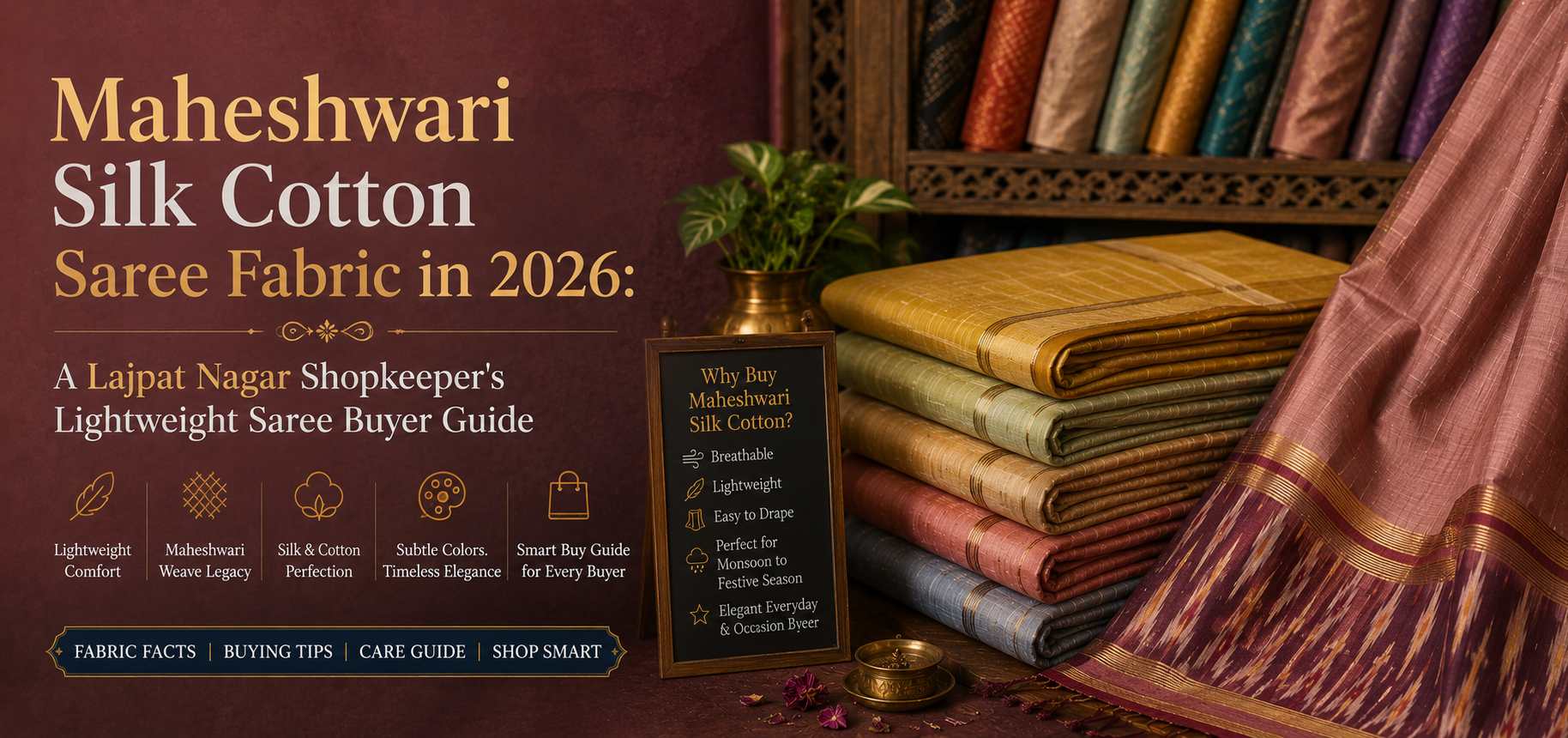
Quick answer. Maheshwari saree fabric is a handloom silk-cotton blend from Maheshwar town in Madhya Pradesh, on the Narmada river. It runs silk in the warp and cotton in the weft, which is why it photographs like silk but breathes like cotton. The signature is a reversible five-stripe bugdi border. Wholesale for a 5.5 metre cut starts around Rs 1,400 in 2026.
Where the cloth actually comes from
Maheshwar sits on the southern bank of the Narmada, in Khargone district, Madhya Pradesh. The weave nearly died by the 1970s, then the Rehwa Society revived it and the Holkar foundation carried it into the 1990s. Around 1,200 looms still run there today, small for a cloth this well known.
Ahilyabai Holkar introduced the weave in the 1760s. She wanted something light enough for the MP summer but rich enough for court, so her weavers built the silk-warp cotton-weft compromise that stuck for 260 years. Real Maheshwari now carries a GI tag, so look for the Geographical Indication stamp on the fall or the wholesale bill, especially above Rs 4,500 retail.
An uncle of mine swore a real Maheshwari survives three generations. Two of his 1990s sarees still turn up on my cousins at weddings. Personal proof beats any Wikipedia line.
What makes Maheshwari different
The structure is almost embarrassingly simple. Silk runs lengthwise as the warp. Cotton runs across the width as the weft. That one fact governs everything: silk gives the sheen, cotton the breathability, so it photographs as silk while sitting like cotton on the skin.
The border is reversible too. Both sides of an authentic pallu finish almost equally clean, which is the test most printed imitations fail in five seconds. The classic border is a five-stripe bugdi. Younger karigars now weave three-stripe and seven-stripe versions. Both still count as authentic, since the stripe count was never strict.
And it is featherweight. A 5.5 metre cut weighs about 380 grams. A Banarasi of the same length runs 700 to 900 grams, literally double the weight on the shoulder.
How to spot the real thing in five minutes
Pull the cloth toward the light. A genuine Maheshwari shows the warp-weft grid clearly, silk and cotton threads crossing like a fine net. Flip the pallu. Authentic cloth reads near-identical on the reverse, while printed knock-offs show a faded back.
Touch it. Cool to the hand but not slippery. Silk-cotton sits between the warmth of pure cotton and the slick of pure silk, so slippery means polyester has sneaked in.
For the burn test, snip a thread near the selvedge, never the body (a 2017 lesson learned the hard way). Silk warp burns like hair with crumbling ash. Cotton weft burns like paper with clean grey ash. Synthetic burns black with hard plastic beads. The burn test never lies, even when the shopkeeper does.
Then the price test. Anything below Rs 1,800 retail is almost certainly machine-made. Handloom labour alone sits above Rs 1,200 per saree before a single rupee of margin.
Delhi wholesale prices this week
Quick rundown for the 5.5 metre saree cut, Lajpat Nagar wholesale, 2026.
| Grade | Wholesale (5.5m cut) |
| Plain, no zari | Rs 1,400 to 2,400 |
| Simple zari border | Rs 2,200 to 3,800 |
| Bugdi five-stripe border | Rs 2,800 to 4,800 |
| Chatai geometric body | Rs 3,400 to 5,800 |
| Heavy full-pallu zari | Rs 5,400 to 9,800 |
Most boutique buyers land on the bugdi border grade. On the suit-piece side, fabric runs Rs 480 to 920 per metre and dupattas Rs 680 to 1,400 apiece, the hand-rolled-selvedge ones a little more. Boutique rates need a verified Paras Gallery account, so call the shop and we will set you up.
Where Maheshwari earns its keep
Office Friday wear is the bread and butter, a plain-blouse, simple-bun look that carries dignity without overdressing. Daytime puja and temple visits are where it really shines, one of the rare sarees that reads devotional and modern at once. The office-to-evening crossover is the same: office at 10, blouse swap at 6, sangeet by 8, same saree.
Summer destination weddings in Rajasthan, Goa and Kerala are the other stronghold. This handloom takes 38 to 42 degree heat without collapsing the way pure silk does. Two Mumbai brides told me the cloth saved them at their Goa receptions, both saying the same line: "Bhaiya kapde mein dam tha aur sweat nahi dikha."
It works for mother-of-bride at a morning haldi or lunch reception too, the light drape letting older women move easily across a six-hour function. As a gift to a daughter in her early twenties, it is the polite present that says heritage without saying heavy. Resellers on Instagram and Etsy love it too: ships flat, photographs honestly by a window, returns in my circle below 8 percent.
Stocking advice for the festive run
Six base colours move fastest from Raksha Bandhan through Diwali: off-white, beige, dusty pink, dusty blue, mehendi green, deep maroon. Stock those and you cover roughly 85 percent of festive walk-in demand. Then run three contrast borders on the same body, gold, copper and silver zari. That triples your sellable units off one warp.
Hold one heavy zari piece as the counter showpiece. Most shops sell only one or two heavy pieces a season, but the unit margin justifies the weight sitting on the shelf for months.
One warning I will repeat as often as needed: keep synthetic Maheshwari-print sarees off the high-end shelf. The customers who spot the difference quietly stop walking in. That recovery takes years. Two Karol Bagh boutiques lost their high-spend regulars over exactly this.
Last thing. Stock suit fabric and dupatta SKUs separately. An unstitched Maheshwari suit set with dupatta out-sells the saree itself in tier-two cities like Jaipur, Lucknow and Indore, where buyers do not always want the full saree commitment.
In short. Maheshwari is the one handloom that does office, daytime puja and a summer function on a single 5.5 metre cut. Stock the six festive base colours, run gold, copper and silver borders off each body, keep one heavy zari showpiece. Wholesale starts around Rs 1,400, with the bugdi grade at Rs 2,800 to 4,800 where most boutiques buy.
Care and storage
Dry-clean the first three times, non-negotiable. After that, hand-wash cold with a mild liquid soap. Never wring it. Roll the saree in a cotton towel to press the water out, since wringing breaks the silk warp slowly over repeated washes.
Store it folded in cotton bags with butter paper between the folds. Do not hang it long term, because the cotton weft stretches under its own weight. Plastic is a slow killer in monsoon humidity, so air the saree once a week through the wet months.
Questions boutiques ask me at the counter
What is Maheshwari saree fabric made of?
A handloom blend of silk and cotton. Silk warp lengthwise, cotton weft across the width. A standard 5.5 metre cut weighs about 380 grams.
Is Maheshwari good for Indian summer?
Yes, the most summer-friendly cloth in the silk-cotton family. It beats Banarasi and Kanjivaram for May-to-September wear and stays cooler than Chanderi past 38 degrees.
Maheshwari or Chanderi, which should I stock?
Two different beasts. Chanderi carries a higher silk ratio and a sheer, tissue-like drape. Maheshwari runs a roughly even silk-cotton balance with a heavier, opaque fall. For office wear, Maheshwari. For a festive evening, Chanderi.
What does Maheshwari cost wholesale in 2026?
Plain starts at Rs 1,400 wholesale for a 5.5 metre cut. The bugdi border grade runs Rs 2,800 to 4,800. Heavy zari sits at Rs 5,400 to 9,800.
Does Maheshwari work for weddings?
For daytime functions, absolutely: morning haldi, family puja, lunch reception. For an evening sangeet or the ceremony itself, stock something heavier like Banarasi, Kanjivaram or a pure-silk bandhani.
Ready to stock it for the festive run?
Stocking Maheshwari for the August-to-Diwali stretch? WhatsApp the shop for a same-day swatch courier to Delhi, Mumbai, Bengaluru, Indore and Jaipur. Browse the live ranges in silk and zari while you plan the colour mix, then place your first bulk order through the wholesale catalogue.