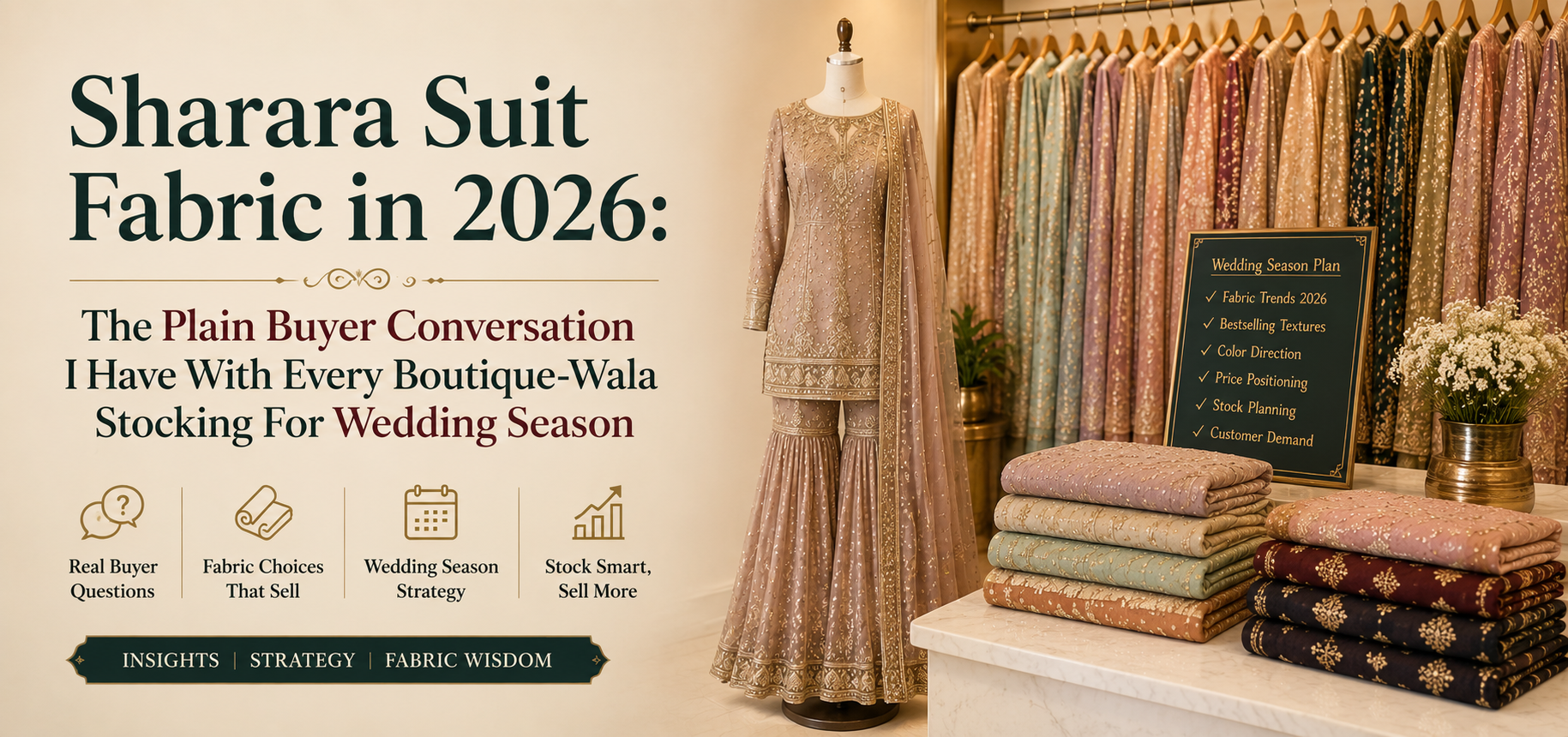
Sharara Suit Fabric in 2026: The Plain Buyer Conversation I Have With Every Boutique-Wala Stocking For Wedding Season
Achha, sit down. I want to tell you what I see every July to October at this Lajpat Nagar counter.
Every bridesmaid, every cousin-of-bride, every boutique-wala stocking for the September wedding season asks me the same question. Bhaiya, sharara ke liye kaunsa fabric leke jaayein? Which cloth holds the flare? Which one does not collapse after the second function? Which one travels by car to Lucknow or by flight to Hyderabad without losing shape?
Twelve years of selling sharara fabric and I can tell you, the answer is not one cloth. It is five clothes for five purposes. Let me walk you through the way I would walk a boutique buyer through the shop floor.
Why sharara fabric is different from other suit fabric
A sharara has six to ten kalis stitched at the hip flaring down to the ankle. That flare needs body. The cloth must hold its own weight. A flat georgette suit fabric will collapse into a tube. A heavy brocade will not gather at the hip. The sharara fabric has to do both: gather at the waist and flare wide at the ankle.
This is why thin tissue, thin chiffon and thin silk are wrong picks for sharara. They look beautiful on the hanger and disappoint in the photograph.
The five sharara fabrics that actually work
Soft net is the bestseller in 2026 across the Lajpat Nagar wholesale floor. Korean soft net especially. It holds the flare. It accepts embroidery. It photographs beautifully under indoor light. Wholesale runs 320 to 680 per metre.
Georgette is the second-most stocked sharara fabric. Heavyweight georgette in 65 to 80 GSM. Not the flimsy 40 GSM georgette. The heavier variety drapes with weight. Wholesale 280 to 540 per metre.
Organza is the pick for summer-to-monsoon brides who want a crisp flare. Silk organza holds shape brilliantly. Wholesale silk organza runs 480 to 920. Polyester organza is cheaper at 240 to 380 but it does not breathe.
Raw silk is the heritage pick. Heavy raw silk sharara in jewel tones is the Lucknowi-Hyderabadi bride favourite. Wholesale 580 to 1,400 per metre. Pair with a chikankari kurti for the niqaah morning.
Crepe is the indoor-function workhorse. Heavy crepe in 110 to 140 GSM holds flare without bulk. Wholesale 320 to 560 per metre.
Yardage you actually need
This is where most boutique-walas miscalculate.
A standard sharara needs 5 to 6 metres for the pant alone. The kurti needs another 1.5 to 2 metres. The dupatta needs 2.5 metres. Total cut is 9 to 10.5 metres per suit.
For a heavy ten-kali sharara pant you need closer to 7 metres. Add the kurti and dupatta and you reach 11 metres.
Always add half a metre buffer for matching the print pattern or the embroidery placement. Karigars will thank you. Customers will not see the second-cut joins.
2026 Lajpat Nagar wholesale price band
- Korean soft net sharara fabric. 320 to 680 per metre.
- Heavyweight georgette sharara fabric. 280 to 540 per metre.
- Silk organza sharara fabric. 480 to 920 per metre.
- Heavy raw silk sharara fabric. 580 to 1,400 per metre.
- Heavy crepe sharara fabric. 320 to 560 per metre.
- Embroidered net sharara fabric (sequins + cutdana). 980 to 2,400 per metre.
- Embroidered raw silk sharara fabric (zardozi + dabka). 2,200 to 4,800 per metre.
- Wholesale rates require Paras Gallery boutique account verification.
When to pick which sharara fabric
Mehendi morning. Soft net in pastel mint or peach with mukaish dots. Light enough for outdoor sun.
Sangeet evening. Embroidered net or embroidered raw silk in jewel tones. Sequins photograph beautifully under indoor light.
Walima reception. Heavy raw silk in maroon, gold, deep purple. The drape is the statement.
Cocktail function. Heavy crepe in midnight blue or wine. Pair with a stone-work short kurti. The fabric carries movement on the dance floor.
Engagement and roka. Silk organza in ivory or champagne. The crisp flare reads as nawabi without acting bridal.
Festive Eid or Diwali for boutique customers in the 25 to 35 age band. Heavyweight georgette or Korean soft net is the easy-care pick. Both forgive monsoon humidity.
Bridesmaids in pairs and trios. Korean soft net is the easiest to colour-match across 6 to 8 pieces. Same dye lot keeps tonal consistency.
Boutique stocking advice for the September to January cycle
Stock Korean soft net in eight colours. Mint, peach, ivory, dusty rose, navy, maroon, emerald, gold. This covers ninety percent of sharara walk-in demand.
Add two to three embroidered net designs as your high-margin display pieces. Customers walk in for the plain net and walk out adding the embroidered topper for the bride.
Carry one heavy raw silk roll in either deep maroon or kesari. This is your wedding day showpiece for the Lucknowi-Hyderabadi customer.
Avoid lightweight chiffon for sharara stock. It looks beautiful at the swatch and collapses in the fitting room.
Display sharara fabric folded with the flare visible, not rolled. Customers buy what they can see flowing.
Pakistani sharara vs Indian sharara fabric
The Pakistani sharara fabric tradition leans toward heavier fall and bolder embroidery. The Indian sharara tradition (revived from the Lucknow nawabi era) tends toward lighter fall and finer chikankari. Both are stocked at Paras Gallery. The Pakistani suit shelf carries heavier net and raw silk. The Indian shelf carries lighter georgette and organza.
If you are stocking for a Pakistani-influenced clientele in Hyderabad, Lucknow, Bhopal, lean heavier. If you are stocking for a Delhi-Mumbai-Bangalore boutique floor, lean lighter.
Care and stitching practicality
A sharara needs a stiff lining for the flare. Use cotton mulmul lining for crepe and silk shararas. Use organza lining for net shararas. The lining holds the flare shape when the girl walks.
Stitch the kalis with a French seam. Avoid raw edges inside the sharara. Heavy walking puts pressure on the inner seams.
Store sharara hanging upside down by the waistband, not by the ankle. The flare distorts if hung from the hem.
FAQ
What is the best fabric for sharara suit in 2026?
Korean soft net, heavyweight georgette, silk organza, heavy raw silk and heavy crepe are the five workhorse picks. Pick based on function. Net for sangeet. Crepe for cocktail. Raw silk for walima.
How many metres of fabric do I need for a sharara suit?
Standard cut is 5 to 6 metres for the pant, 1.5 to 2 metres for the kurti and 2.5 metres for the dupatta. Total 9 to 10.5 metres. For a heavy ten-kali sharara add another metre.
What is the price of sharara suit fabric in Lajpat Nagar wholesale 2026?
Korean soft net runs 320 to 680 per metre. Heavyweight georgette runs 280 to 540. Heavy raw silk runs 580 to 1,400. Embroidered options run 980 to 4,800.
Can I wear sharara suit in summer?
Yes for indoor evening functions in air-conditioned halls. Avoid heavy raw silk and embroidered net in May to August. Silk organza and heavyweight georgette are the summer-friendly picks.
Which sharara fabric is best for bridesmaids?
Korean soft net is the easiest to colour-match across multiple pieces because dye lots stay consistent in net. Heavyweight georgette is the second-best pick. Avoid embroidered options for bridesmaid coordination because the embroidery never matches piece to piece.
Where to buy sharara suit fabric online wholesale?
Paras Gallery Fabrics ships sharara fabric across India and to overseas boutique buyers. Net, georgette, organza, raw silk and crepe options are live on the site. Swatch courier on request.
Your next step...
If you are stitching a sharara for your own wedding or stocking sharara fabric for the September to January boutique cycle, WhatsApp me before you commit. Same-day swatches go to Delhi NCR, Lucknow, Hyderabad, Mumbai and Bengaluru. Browse the live ranges of Net Fabric, Georgette and Organza. Use the Fabric Estimator before placing a wholesale order.