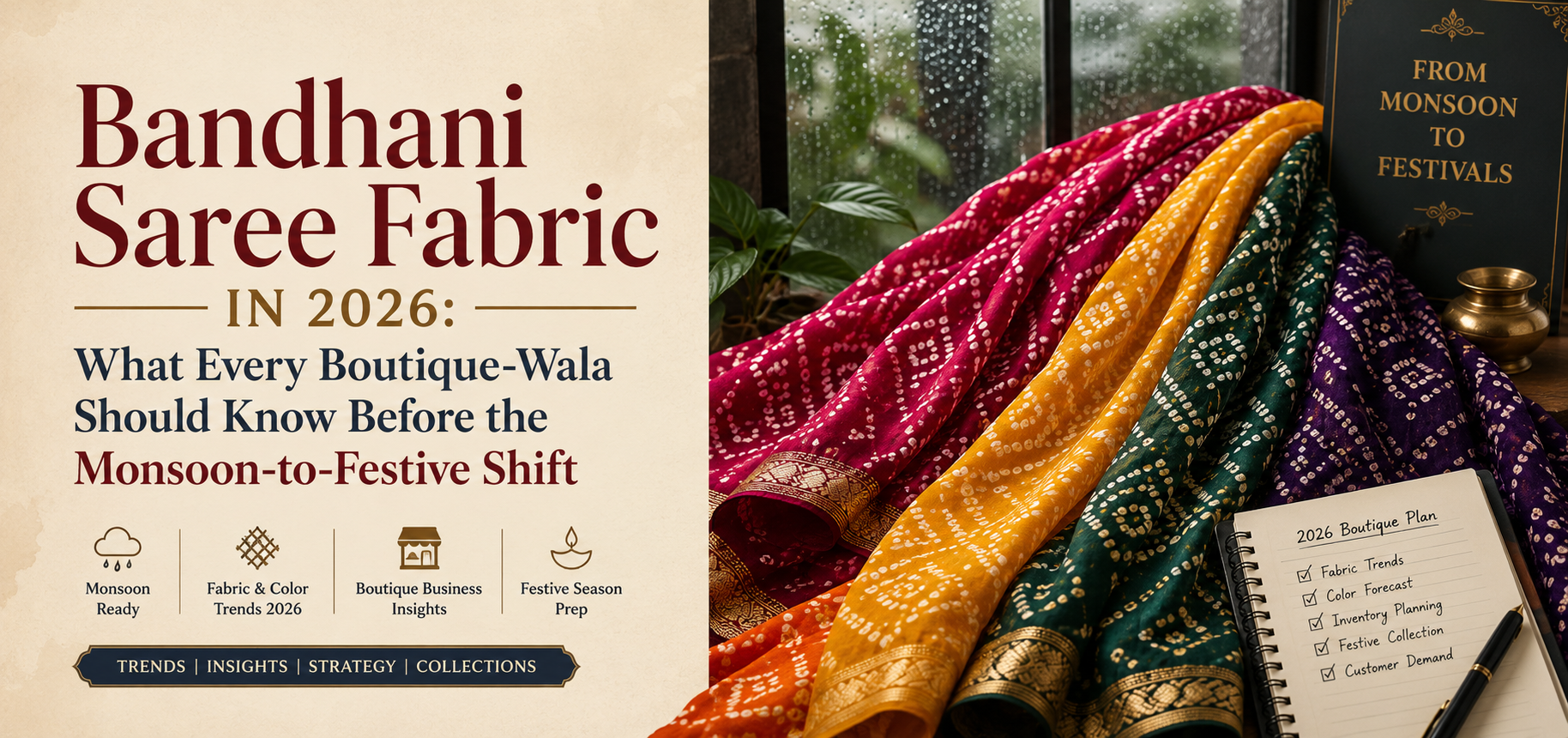
Bandhani Saree Fabric in 2026: What Every Boutique-Wala Should Know Before the Monsoon-to-Festive Shift
Bandhej. That is what we still say on this gali. Not bandhani, not tie-dye, bas bandhej. The way my mausa-ji said it back in 2013, when he sat me down with a yard of red Kutch cloth and told me to count the dots. I gave up around six hundred.
Now every June-July the same scene plays out at the counter. A boutique-wala from Karol Bagh standing there scratching his beard. Some reseller-bhabhi from Pune with three swatches pinned to her dupatta. Mother-of-bride from Faridabad who wants something that will photograph well at her daughter's mehendi. They want one answer to one question. Achha bhaiya, monsoon mein kya chalega?
Bandhej. Always bandhej. This is the cloth that has carried my floor through every Raksha-Bandhan-to-Karwa-Chauth run since I started selling.
Let me just sit with you and tell it straight.
Bandhani (also called bandhej) is a tie-dye saree fabric tied by hand on a base of cotton, georgette, art silk, pure tussar, chiffon or mulmul. In 2026, georgette bandhani is the bestseller for the monsoon-to-festive cycle from August through Diwali, with Lajpat Nagar wholesale rates running Rs 1,900 to 3,800 for a 5.5-metre saree cut.
Overview
Bandhani saree fabric in 2026 is a tie-dyed cloth from Kutch (Gujarat) and the Sikar-Jodhpur belt (Rajasthan). Kutchi bandhani is finer and more expensive; Rajasthani bandhej is bolder and cheaper. Genuine bandhani has small puckered dots you can feel with a fingertip; printed lookalikes are flat and one-sided.
Where the cloth actually comes from
Two original homes. Kutch in Gujarat and the Sikar-Jodhpur belt up in Rajasthan. Both call it the same thing but the cloth is not the same.
Kutchi bandhani is finer. Dots tighter. More honest. A single yard can carry eight thousand dots, sometimes one lakh dots, all tied by hand on a karigar's lap. One saree, two to three weeks. I had a Kutchi karigar once tell me, "Bhaiya, ye haath ka kaam hai, machine se nahi hota." He wasn't wrong.
Rajasthani bandhej is bolder. Bigger dots. More open palette. Marwari red. Jaipuri pink. Jodhpuri yellow. Bikaneri green (which is genuinely the strangest green you will ever see, I cannot explain it). Costs less because the tie density is lower, simple as that.
Then there is Surat. Surat does what Surat does, which is screen-print the bandhani pattern and ship it cheap. Quarter the price. Zero resale value. If a customer who knows bandhej walks into your shop and sees Surat-print on your top shelf, she will quietly stop coming back. I lost two boutique accounts that way, both in 2019, both because I had not yet learned to check the back of the cloth.
The four base fabrics you will see in 2026
Cotton bandhej is your daily-wear runner. Soft to the hand, breathes through July-September Delhi humidity. Wholesale from Rs 380 a metre.
Now georgette. This one is the monsoon-festive workhorse. Light fall. Packs well into a courier box. Photographs sharp under tube light. Rs 540 to 920 wholesale per metre. Every August this is what flies off my shelf first.
Silk splits two ways. Pure tussar, Rs 1,800 to 2,800 a metre, the real stuff. Art silk sits at Rs 480 to 780 and looks the part for a fraction. The Banaras-Kutch fusion sarees (bandhej body with zari pallu) have been the unexpected hit of this year. Sold out twice in March alone.
Chiffon and mulmul are your summer-into-monsoon picks. Featherweight. Slightly see-through. Made for haldi mornings and daytime functions where the cloth has to behave itself in sticky weather.
How to spot the real thing
This is where most buyers get cheated. Genuinely. Most of them.
Pull the cloth toward the light. Real bandhani has tiny puckered dots, the place where the thread was knotted. They are not flat. They have texture. Slide your fingertip slow across the surface and you feel the little ridges, almost like braille. A printed version has flat dots. Nothing to feel.
Flip the cloth. Genuine bandhej shows the dots on both sides almost equally because the dye soaked through tied fabric. The printed kind shows a strong front and a faded back, every single time.
The thread test, this is my favourite. Hand-tied cloth often has small thread bits or knot remnants near the selvedge because the karigar did not bother pulling every thread clean. Machine-printed cloth has none. Spotless. Suspicious.
And the price test. A cotton bandhani saree under Rs 2,200 retail is almost certainly print. Kutchi silk bandhani under Rs 4,500 retail, also print. If the number sounds too kind, it usually is.
2026 Lajpat Nagar wholesale price band
|
Fabric type (5.5m saree cut) |
Wholesale range |
|
Cotton bandhani saree |
Rs 1,400 to 2,400 |
|
Georgette bandhani saree |
Rs 1,900 to 3,800 |
|
Art silk bandhani saree |
Rs 1,700 to 3,200 |
|
Pure tussar bandhani saree |
Rs 6,400 to 12,000 |
|
Chiffon bandhani saree |
Rs 1,500 to 2,600 |
|
Bandhani lehenga fabric (per metre) |
Rs 540 to 1,400 |
|
Bandhani dupatta (per piece) |
Rs 380 to 980 |
Boutique pricing needs a verified Paras Gallery account. Just call the shop, we will set you up.
Which bandhani for which function
For haldi and mehendi morning, cotton bandhej in yellow or mustard or hot pink, paired with a mirror-work blouse and a contrast Jaipur dupatta. That combination has worked for me since I started. Nahi badla.
Sangeet evening is where georgette does the heavy lifting. Pick from jewel red, royal blue, or deep emerald. Pin the pallu open. Add stone-work blouse. You are set.
Daytime reception, go for art silk Banarasi fusion in maroon or kesari. Looks expensive without acting expensive on the pocket.
For the bride's mother and the chachi-mausi crowd at the wedding ceremony itself, pure tussar in muted tones with a zari pallu. Photographs beautifully under chandelier light. Every single time.
Karwa Chauth and Teej festive day, chiffon in red with golden booti. Light enough to wear from sunrise to moonsight without the in-laws noticing your discomfort.
Office-to-festive crossover for working women, mulmul in pastel pink, mint, beige. Tuck the pallu and walk into office. Open it out for the evening puja. Yes ji, it really is that practical.
Boutique stocking advice for August through Diwali
Five colours of georgette bandhani is your base. Red, royal blue, mustard, emerald, rani pink. That covers ninety percent of festive walk-in demand from Raksha Bandhan through to Diwali.
Add cotton bandhani in lighter shades for the early Teej and Janmashtami crowd.
Hold three pieces of pure tussar bandhani. Showpiece-grade. Most boutiques sell only one or two pieces in a season but the margin on a single piece justifies sitting on the stock for six months.
Printed bandhani, please, I am asking you, keep it off the high-end shelf. The customers who can tell the difference are also the customers who tell six other women.
Stock bandhani dupattas separately as add-on units. A bandhej dupatta paired with a plain chanderi suit sells faster than the suit alone. Tried-and-tested.
Care and storage
Cold wash for the first three washes. Non-negotiable. Hot water releases excess dye and the colour comes out cloudy. Store folded with butter paper between the layers because dot-on-dot wears the texture down. And please do not hang bandhani sarees long term. The weight stretches the dots into ovals. I have seen it happen on my own family's saree, the dots were once round and now they look like little fish.
Monsoon care, air the saree once a week, no exception. Humidity is the quiet killer of bandhej dye stability. You will not notice until you do.
Frequently Asked Questions?
What is bandhani saree fabric actually made of?
Could be cotton. Sometimes georgette. Often art silk, pure tussar, chiffon, or mulmul. The base changes. The bandhani technique itself, that tie-and-dye work, is what sits on top.
Will bandhani fabric survive Indian monsoon?
Both georgette and chiffon bandhani, yes. They dry fast, do not bleed if you washed them right the first three times. They travel well to Mumbai-Pune-Kolkata humidity.
Real bandhani or printed, how do I check fast?
Touch test first. Genuine cloth has dots you can feel with a fingertip. Printed cloth is flat. Also flip the saree, the back should show the pattern almost as strongly as the front.
Kya hai 2026 ka bandhani saree fabric ka price?
Cotton bandhani saree starts at Rs 1,400 for 5.5 metres wholesale. Georgette runs Rs 1,900 to 3,800. Pure tussar sits between Rs 6,400 and 12,000.
Sangeet ke liye konsa colour bandhani sabse best hai?
Royal blue, deep emerald, jewel red. These photograph richest under indoor sangeet lighting and they do not wash out on phone cameras.
Resellers ke liye, can we stock bandhani for online sale?
Georgette bandhani sarees, yes. They ship safely. Pack flat in a box with butter paper between layers. Avoid tube-style packaging because the pallu wears at the fold.
Your next step...
Stocking for the August-through-Diwali run? WhatsApp the shop for same-day swatch courier to Delhi, Mumbai, Bengaluru, Hyderabad, Jaipur. Browse live ranges on Bridal Bliss, Designer Fabrics, Georgette. Use the Fabric Estimator before placing your first wholesale order. The Wholesale page has the bulk-order form ready when you are.