


Shopping Sangeet Fabric Online: Checks Before You Buy
Buying Online Guides · Draft 23 October 2026 Buying sangeet fabric online starts with a dance plan, not a colour swatch alone....

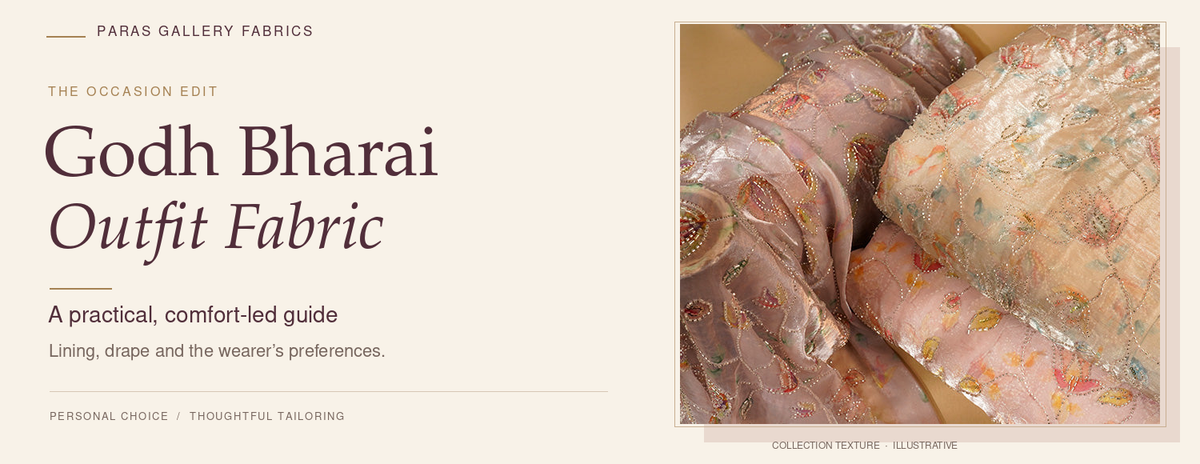
Occasion fabric guide · Draft 23 October 2026
The short version: Choose godh bharai outfit fabric by how the complete outfit feels while sitting, standing and reaching. Start with the wearer’s preferred silhouette, then check the cloth’s reverse, lining, drape and fastening plan. Compare the actual material rather than assuming a fibre name or festive photograph guarantees comfort.
A family celebration does not need a prescribed colour, a heavy border or a particular body shape. Let the person wearing the outfit decide what feels festive. These are garment-selection questions, not medical advice or pregnancy-safety assurances.
Let comfort lead the design. Let decoration follow.
Quick answer: The best godh bharai outfit fabric is the actual cloth the wearer likes with a comfortable lining and a workable fit. Browse the Festive Celebration edit for ideas, then verify each shortlisted item’s details.
Ask what she already reaches for at family gatherings: a saree, a kurta set or a skirt with a separate top. Use that answer as a starting point rather than turning tradition into a rule. A familiar silhouette may still need changes to its neckline, sleeves or fastening. Discuss those details before buying a decorative cloth that restricts the design.
For godh bharai outfit fabric, write down three personal priorities. These might be a soft inside surface, a dupatta that stays manageable or an outfit that can be worn again. Ask about the ceremony’s seating arrangement too. A chair, a floor cushion and repeated standing each raise different practical questions for the tailor.
Inspect the reverse of embroidery as carefully as the front. Ask where knots, backing or decorative edges would sit once the pattern is cut. A cloth that looks delicate may still feel textured against an arm. If possible, compare a swatch with the proposed lining underneath. Touch is personal; no fibre label guarantees softness, cooling or freedom from irritation.
Lay the sample in folds rather than judging it flat. Notice whether it builds up at the waist or needs frequent rearranging. With a saree, discuss pleats and pallu placement. With a kurta set, think about the side opening, hem and dupatta together. The aim is a design the wearer can manage without constantly protecting the embellishment.
When comparing godh bharai outfit fabric, ask the tailor to consider chair contact, arm movement and the weight of the complete garment. Lining, borders, fasteners and finishing all contribute. A light outer cloth can become a much more substantial outfit after those additions.
A fluid-looking option may suit a softly falling silhouette if its actual weight and opacity work with the chosen cut. A more structured option may suit a defined outline if the wearer enjoys that shape. Silk, georgette, organza and blend labels are not enough to settle the question. Ask for composition percentages, usable width, available weight information and item-specific care directions.
If sheer fabric appeals, first decide where coverage is wanted. Check the outer cloth over the intended lining in ordinary light. The daytime organza styling guide can offer visual ideas; it does not establish the composition or comfort of a new purchase. Colour preferences need not be limited to pastels.
For a decorative godh bharai outfit fabric, consider placing the strongest detail away from areas that need frequent adjustment. Ask whether a border can sit at the hem rather than across a bending point. This is a pattern discussion, not a promise that any embroidered cloth will behave the same way.
 COLLECTION EDIT
Build a comfort-led festive shortlist
Use the collection as a browsing starting point. Ask about the exact cloth, lining and decoration before deciding.
Browse Festive Celebration →Take the preferred silhouette and current fitting requirements to the tailor. Ask which closures and adjustments are practical for that design. A wrap, tie or elastic detail is not automatically right for everyone; the wearer should be comfortable operating it. Discuss how the neckline and sleeves will behave during greetings, photographs and seated rituals.
The godh bharai outfit fabric quantity depends on usable width, garment length, sleeve design, border direction and motif matching. Request a cutting plan for the actual material. Use the fabric estimator guide to frame questions, not as a validated calculator. Do not add a universal allowance or buy a fixed number of metres without the pattern.
Confirm the lining choice, seam finish and placement of closures before cutting. Ask whether a decorated edge needs covering on the inside. Check the finished outfit while seated at a fitting, with the intended underlayers. Reach forward and stand up as normally as possible. If something pulls or rubs, discuss an alteration rather than expecting the fabric to solve it.
Keep one note for each godh bharai outfit fabric candidate. Record the item reference, composition information, width, lining choice, care directions and questions still unanswered. Confirm the selling unit and what is included, especially when a photograph shows several coordinating pieces. A styled image is not proof that every component comes with the purchase.
Set your decision around the wearer’s preferences and the tailor’s actual availability. No universal stitching timetable applies. Leave room in your own plan for checking the cloth and trying the finished outfit. Keep supplier care directions with the garment so its next outing does not depend on guessing how the surface should be treated.
There is no single best fabric. Compare the actual cloth with its lining, then choose a silhouette the wearer likes. Seated comfort, manageable drape and suitable finishing matter more than a category name.
No. The wearer can choose a quieter base, a decorative dupatta or another detail that suits her preferences. Check how any embellishment feels where it touches the body.
Start with what the wearer enjoys wearing. Discuss pleats, fastening and dupatta management with the tailor, then assess the complete outfit while seated. Neither silhouette guarantees comfort.
No. A fabric name does not establish medical suitability or guarantee comfort. This guide concerns clothing choices only. Take individual health questions to an appropriate healthcare professional.
Related fabric inspiration
Illustrative collection imagery, not exact product recommendations.
Choose godh bharai outfit fabric with the wearer’s preferences in front of you. Save item references and send specific questions about width, lining and decoration. Ask about an appointment if you want to discuss your options.
WhatsApp: +919654440254
Buying Online Guides · Draft 23 October 2026 Buying sangeet fabric online starts with a dance plan, not a colour swatch alone....
Occasion Guides · Draft 23 October 2026 The short version: Choose anniversary dinner outfit fabric by testing how it feels while seated,...
Fabric education · Draft prepared 23 October 2026 A beautiful fabric name can still leave basic questions unanswered. To read fabric label...


