


Shopping Sangeet Fabric Online: Checks Before You Buy
Buying Online Guides · Draft 23 October 2026 Buying sangeet fabric online starts with a dance plan, not a colour swatch alone....

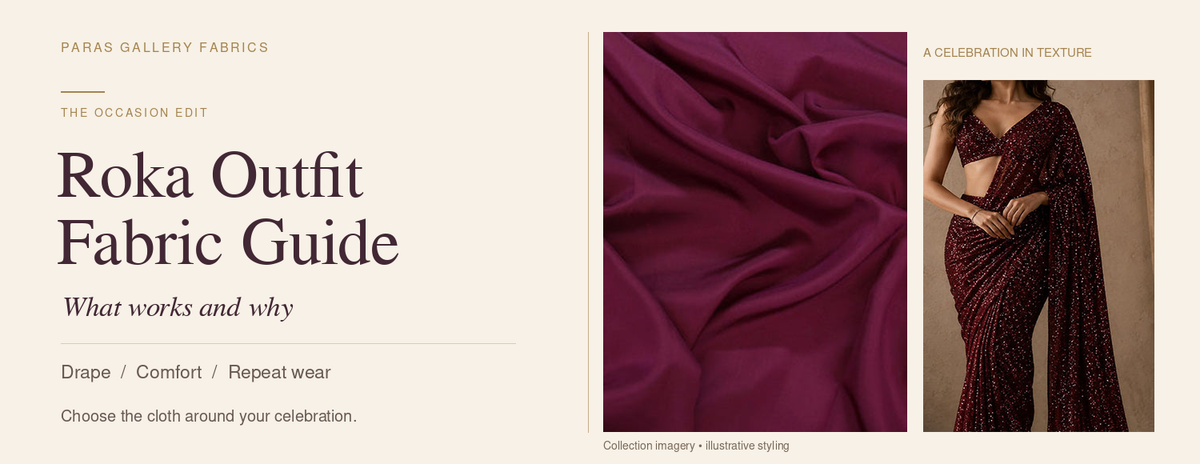
Occasion fabric guides · Draft 23 October 2026
The short version: Choose roka outfit fabric around your ceremony, the shape you want and how you will sit and greet people. Compare actual swatches with lining before deciding. No colour or fabric is compulsory: the best choice respects your preferences, family customs and the finished outfit’s comfort.
A roka can be an intimate gathering at home or a larger celebration. Start with that setting, not a photograph of someone else’s outfit. A beautiful cloth is only a starting point; its lining, cut and finishing determine how useful it becomes.
THE WINNING MOVE: CHOOSE THE OUTFIT FIRST. CHECK THE CLOTH WITH ITS LINING. KEEP THE CEREMONY YOUR OWN.
Quick answer: Good roka outfit fabric should support the intended shape without making sitting or greeting awkward. Use the Engagement Enchantment collection as a browsing starting point, then ask about the exact item’s composition, width, drape and care.
Ask what the gathering actually involves. Will you sit on a sofa, move between rooms or stand for family photographs? Will you carry a dupatta throughout? These questions make a useful roka outfit fabric brief because they turn a vague wish for “something festive” into practical needs.
Agree on any family preferences before choosing a shade. There is no universal rule that a roka outfit must be pastel, red or heavily decorated. Compare shortlisted colours near your face with the intended jewellery. Photographs and screens can alter their appearance, so request clearer images or examine a swatch where possible.
Ask your tailor or draper to assess whether the chosen cloth forms the pleats you want and whether the pallu feels manageable. Check border placement before cutting a blouse. A dramatic border may be the main detail, allowing the rest of the outfit to stay simple. Do not infer fibre content from shine.
A straight suit or anarkali needs a different cutting plan from a saree. Check how decoration lands near the neckline, armholes and elbows. Smooth lining may help isolate textured embroidery from skin, but judge the whole layered sample rather than assuming any lining solves every comfort problem.
Take a silhouette reference to the tailor, then discuss whether the fabric needs support to achieve it. More volume is not automatically more appropriate. Your roka outfit fabric should suit the planned flare, waistband and hem. Ask how the complete skirt will feel while sitting, not just how it looks on a hanger.
For a fluid look, you might consider cloth sold as georgette, crepe or satin. For a more defined silhouette, compare organza, jacquard or brocade options. These are starting points, not performance promises: composition, weave, weight and finish vary. A trade name alone cannot tell you softness, purity or care.
If translucent layers appeal, assess opacity over the proposed lining. If texture is the attraction, feel the reverse and edges too. The useful roka outfit fabric comparison is between actual candidates for your garment, not a blanket ranking of fabric names. Note which sample folds neatly and which holds the shape you prefer.
 COLLECTION EDIT
Build a roka shortlist with purpose
Browse the occasion edit, then check each candidate against your outfit plan. Collection imagery is inspiration, not proof of a particular product’s specifications.
Explore Engagement Enchantment →Hold the sample and lining together at the shoulder, waist and forearm. Notice whether raised work catches against jewellery or feels rough where an arm rests. With a fitting sample, sit down, stand up and bring your hands together. This can reveal sleeve restriction or a waistband that needs adjustment.
Think about the dupatta as a separate decision. Its weight and edge treatment can change how often you need to adjust it. Ask the tailor about secure placement that does not pull the neckline. Comfortable roka outfit fabric still needs sensible construction; buying a softer-looking cloth is not a substitute for a fitting.
Limit the first comparison to a few candidates for the same garment. Write down what attracts you to each: the surface, fall, border or colour. Then record what remains unknown. A striking photograph with no usable width or composition information is not yet ready for a buying decision. Ask for those details before comparing quantities.
Consider where the outfit will touch a chair or sofa during the ceremony. Raised decoration at the back or along a seated hem deserves a closer check with the tailor. Also compare your jewellery against the neckline sample so you can spot possible contact points. These small checks help distinguish an appealing design from one that fits the way you plan to wear it.
Give the tailor the usable width, motif direction, border repeat and complete outfit sketch. Request a cutting plan that includes sleeves, lining and any separate pieces. Use the fabric width and meterage guide for questions to ask, not a universal quantity recipe. There is no fixed extra length that fits every design.
For repeat wear, separate the statement element from the rest. A detailed dupatta might work with a plainer suit later, while a versatile blouse may change a saree’s mood. Check seller care directions for the exact cloth and decoration before committing. Choosing roka outfit fabric with later use in mind should fit your wardrobe, not create another difficult purchase.
Keep a small decision note: chosen silhouette, preferred sample, lining, confirmed width, required length and unanswered questions. The fabric estimator guide can help frame a quantity discussion, but the final amount needs your tailor’s approval. Confirm the selling unit and what is included before paying.
No single colour applies to every family or ceremony. Ask about any customs that matter to you, then choose a shade you enjoy wearing.
Yes. Consider the gathering and your own preferences. Thoughtful fit, a chosen accent and manageable layers can be more useful than adding decoration everywhere.
Not always. Opacity, surface texture and the garment design determine the need. Assess the actual cloth with your tailor rather than using its name as the answer.
Confirm composition, usable width, the unit of sale, care directions and the tailor-approved length. Clarify lining and matching pieces separately. Ask for missing details instead of guessing.
Explore related occasion edits
Illustrative tiles suggest styling directions, not exact products or fibre specifications.
Save your preferred roka outfit fabric options with the garment sketch and outstanding questions. Ask for exact item details before deciding; browse the appointment page if you want to discuss the next step.
WhatsApp: +919654440254
Buying Online Guides · Draft 23 October 2026 Buying sangeet fabric online starts with a dance plan, not a colour swatch alone....
Occasion Guides · Draft 23 October 2026 The short version: Choose anniversary dinner outfit fabric by testing how it feels while seated,...
Fabric education · Draft prepared 23 October 2026 A beautiful fabric name can still leave basic questions unanswered. To read fabric label...


