
Shopping Sangeet Fabric Online: Checks Before You Buy
Buying Online Guides · Draft 23 October 2026 Buying sangeet fabric online starts with a dance plan, not a colour swatch alone....

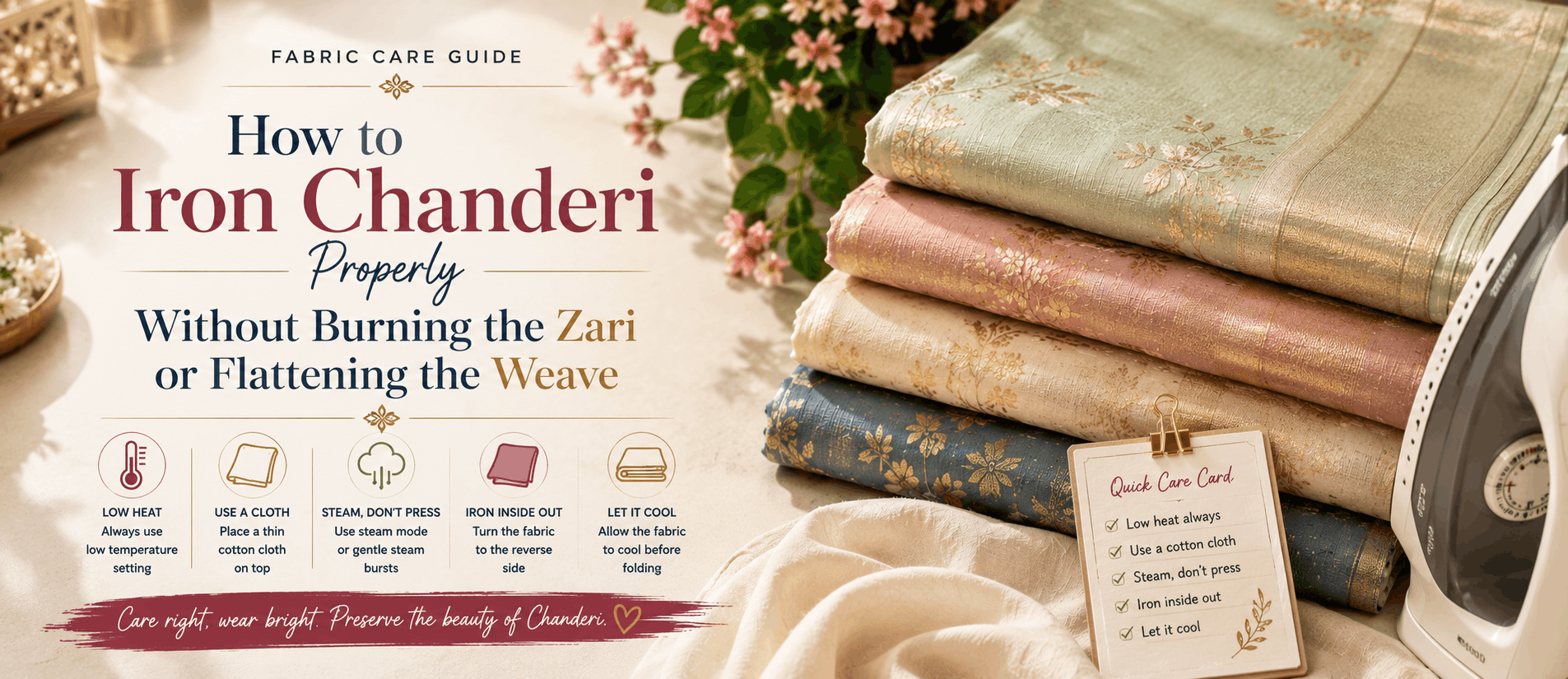
Every wedding season my counter sees 4 to 6 women walking in with a burn-marked chanderi saree asking whether the damage can be repaired. Answer is usually no. Chanderi burn marks do not lift with dry cleaning.
Wrong iron temperature. Wrong pressure. No protective cloth. Direct heat on zari kara.
Chanderi is a delicate silk-cotton weave. It photographs beautifully when ironed correctly, and it collapses into a scorched limp piece when ironed carelessly. The difference is one damp cotton cloth and a 30-degree temperature adjustment.
Here is exactly how to iron chanderi properly at home so the piece survives 15 to 20 wear cycles without the zari flattening, the body scorching, or the drape losing its signature sheen.
Quick Answer: Iron chanderi at low-medium heat (110 to 140 degrees Celsius, silk or wool setting) with a thin damp cotton cloth placed over the fabric as a protective layer. Iron in one direction, light pressure, no lingering. Flip the saree inside out for the zari border and iron from the reverse side. Steam off unless the iron has a controlled burst. Total time 6 to 10 minutes per saree, 2 to 3 minutes per dupatta. Store folded in a cotton pouch away from sunlight and moth balls.
Iron chanderi at home when the piece has light everyday creases from folded storage, when you have a temperature-controlled iron with a silk or wool setting marker, and when the zari border is a simple plain kara without heavy raised gota work. Home iron works well for the routine pre-wear press of a chanderi saree, dupatta or kurta.
Iron at home also when you own a plain cotton pillowcase or a thin plain white cotton dupatta that can serve as the protective layer. Any thin plain cotton cloth works. Skip synthetic cloth because synthetic melts under the iron and transfers residue to the chanderi.
Send to a professional dhobi if the chanderi has heavy raised zardozi work, embellished sequins, mirror work or stone work along the border. Domestic irons cannot navigate the raised embellishment safely and either scorch the embellishment thread or crack the stones. A professional dhobi uses a padded ironing table and hand-held steam gun for embellished pieces.
Send also if the chanderi is 15 plus years old and the weave has softened with age. Old chanderi tears at fold lines under domestic iron pressure. A dhobi with a rolling press flattens old chanderi without the concentrated point-heat that a hand iron delivers.
Indian household irons usually have 4 to 5 temperature marks: nylon, silk, wool, cotton, linen. Chanderi sits at silk or wool setting, roughly 110 to 140 degrees Celsius. Never go above wool because cotton or linen setting reaches 180 to 200 degrees which scorches chanderi within 3 seconds of direct contact.
Let the iron heat for 2 to 3 minutes to stabilise at the set temperature. Digital irons show the exact temperature on display. Analog dial irons need a 3-minute stabilisation because the dial mark and the actual plate temperature lag on early heating.
Take a plain white or off-white thin cotton pillowcase or a plain cotton dupatta. Sprinkle water on it evenly with a spray bottle until the cloth is damp but not dripping. Place the damp cloth flat over the chanderi surface, covering the section you plan to iron.
The damp cloth serves two purposes. It absorbs the direct heat from the iron plate and prevents the chanderi from scorching. It also creates a small amount of steam trapped between the cloth and the chanderi which relaxes the crease without needing the iron's steam function.
Move the iron from top to bottom of the saree section, one smooth pass. Do not go back over the same spot immediately. Do not press hard. Chanderi does not need pressure; the heat plus the damp cloth do the work.
If a crease is stubborn, wait for the section to cool for 30 seconds, then repeat one more single-direction pass. Two passes maximum. Third pass risks flattening the weave.
Zari on chanderi is the metallic thread woven into the kara border. Direct heat on the zari from the top flattens the metallic thread against the fabric and dulls the shine. Instead, flip the saree so the back of the zari border faces up, then iron over the damp cloth from the reverse. The heat passes through the fabric and reaches the zari indirectly.
Two passes on the reverse. Then flip the saree back to the correct side and check the zari border from the top. If needed, one gentle final pass over the damp cloth from the top with very light pressure.
Mistake 1: Using the iron's steam function on high setting. Steam on high can drip water onto the chanderi and leave a spot mark that dries as a dark ring. If your iron does not have a controlled steam burst, keep steam off entirely. The damp cotton cloth provides all the moisture the chanderi needs during ironing.
Mistake 2: Ironing chanderi immediately after a wash without letting it dry to slightly damp. Wet chanderi under a hot iron creates trapped moisture that damages the silk fibre and weakens the weave. Let chanderi air-dry inside a plain cotton pillowcase in the shade until only slightly damp (about 90 percent dry) before ironing. Or fully dry, then spritz lightly with water before the damp-cloth iron pass.
Mistake 3: Placing the hot iron directly on the zari border to smooth a crease quickly. Direct heat on zari flattens the metallic thread within 5 seconds. The zari loses its raised texture and reads dull in the wedding photograph. Always iron zari from the reverse side over a damp cotton cloth.
Mistake 4: Storing the ironed chanderi in a plastic cover or with moth balls. Plastic traps humidity and yellows the chanderi over 6 to 12 months. Moth balls (naphthalene) chemically react with silk zari and darken the metallic thread. Store folded in a plain cotton pouch or wrapped in a plain white cotton sheet in a dry wooden almirah shelf.
| Iron setting | Temperature range | Chanderi safe? | Notes |
| Nylon | 90 to 110 degrees C | Too cool | Crease will not release |
| Silk | 110 to 130 degrees C | Yes, safe | First-choice setting for chanderi |
| Wool | 130 to 160 degrees C | Yes with damp cloth | Second-choice, faster iron time |
| Cotton | 180 to 200 degrees C | No, scorches | Never iron chanderi here |
| Linen | 200 to 220 degrees C | No, burns | Never approach this setting |
Iron time per piece: chanderi saree 6 metre (5.5 body plus 0.5 blouse) 8 to 10 minutes; chanderi dupatta 2.5 metre 2 to 3 minutes; chanderi kurta 2.5 metre 3 to 5 minutes.
Fold the ironed chanderi along its original loom-fold creases. Rotate the fold once every 60 to 90 days by re-folding along a slightly different line. Same-fold storage for more than 90 days creates permanent white lines along the crease which do not iron out.
Store in a plain cotton pouch or wrapped inside a plain white cotton sheet. Skip plastic covers, silk bags with dyed lining, or any bag with printed graphics because print ink can transfer to chanderi over time. Almirah shelf should be lined with a plain cotton dhoti or plain white sheet before placing the folded chanderi on top.
Add 2 or 3 dried neem leaves inside the storage sheet as a natural moth repellent. Replace neem leaves every 3 to 4 months. Skip naphthalene balls and camphor because both chemically react with silk fibre and gold zari.
Yes, a handheld garment steamer works well on chanderi if held 4 to 6 inches away from the fabric surface. Steamer relaxes the crease through steam without any direct plate contact. Steam the saree hanging on a padded hanger for even coverage. Avoid holding steamer too close because concentrated steam creates spot moisture that dries as a water ring.
Light scorching (small yellow tint) can sometimes lift with a gentle cold water rinse and shade drying. Deeper scorching (brown mark or dulled zari) is usually permanent. Take the piece to a specialist dry cleaner for assessment; they may recommend a colour-refresh or a chemical restoration for 60 to 70 percent recovery. Full restoration is rare.
Every 60 to 90 days, take out the folded chanderi, refold along a slightly different crease line, and give a light iron with damp cloth to smooth the fresh fold. Skipping this refresh causes permanent white lines along the same crease which do not iron out. 4 to 5 iron sessions per year keeps a stored chanderi in wearable condition for 10 plus years.
Dry cleaning is better only if the saree has visible stains, food marks or perfume oil deposits from wear. For a clean chanderi with just wrinkles, home iron with the damp cloth method is safer than dry cleaning because dry cleaners occasionally over-heat chanderi in the drum press. Ask specifically for a hand-press dry cleaner if you must send it out.
Yes, same 4-step method. Kurta has fewer folds so iron time is shorter (3 to 5 minutes). Iron the front panel first, then the back, then sleeves, then the yoke and neckline. Iron the neckline from the reverse if there is embroidery. Skip ironing over embroidered plackets from the front; always flip and iron from the reverse.
For chanderi care questions on specific pieces bought from Paras Gallery Fabrics, WhatsApp +91 96544 40244 with a photograph of the current condition and the crease pattern. Counter shares a temperature and damp-cloth recommendation for your specific chanderi weight and zari style. Or walk in to Shop No. 06, Pushpa Central Market, Lajpat Nagar II, New Delhi 110024, between 11 am and 8:30 pm on any weekday for an in-person care consultation.
Browse the full handloom silk fabric range online to explore chanderi and related silk family fabric, or the pure cotton fabric collection if you want a plain cotton dupatta to use as your ironing protective layer. Boutique orders for chanderi lots go through our wholesale fabric page.
Take good care of your chanderi and it takes good care of your wedding-guest photograph, ji.
Sneh, Paras Gallery Fabrics, Lajpat Nagar.
Buying Online Guides · Draft 23 October 2026 Buying sangeet fabric online starts with a dance plan, not a colour swatch alone....
Occasion Guides · Draft 23 October 2026 The short version: Choose anniversary dinner outfit fabric by testing how it feels while seated,...
Fabric education · Draft prepared 23 October 2026 A beautiful fabric name can still leave basic questions unanswered. To read fabric label...


