
Shopping Sangeet Fabric Online: Checks Before You Buy
Buying Online Guides · Draft 23 October 2026 Buying sangeet fabric online starts with a dance plan, not a colour swatch alone....

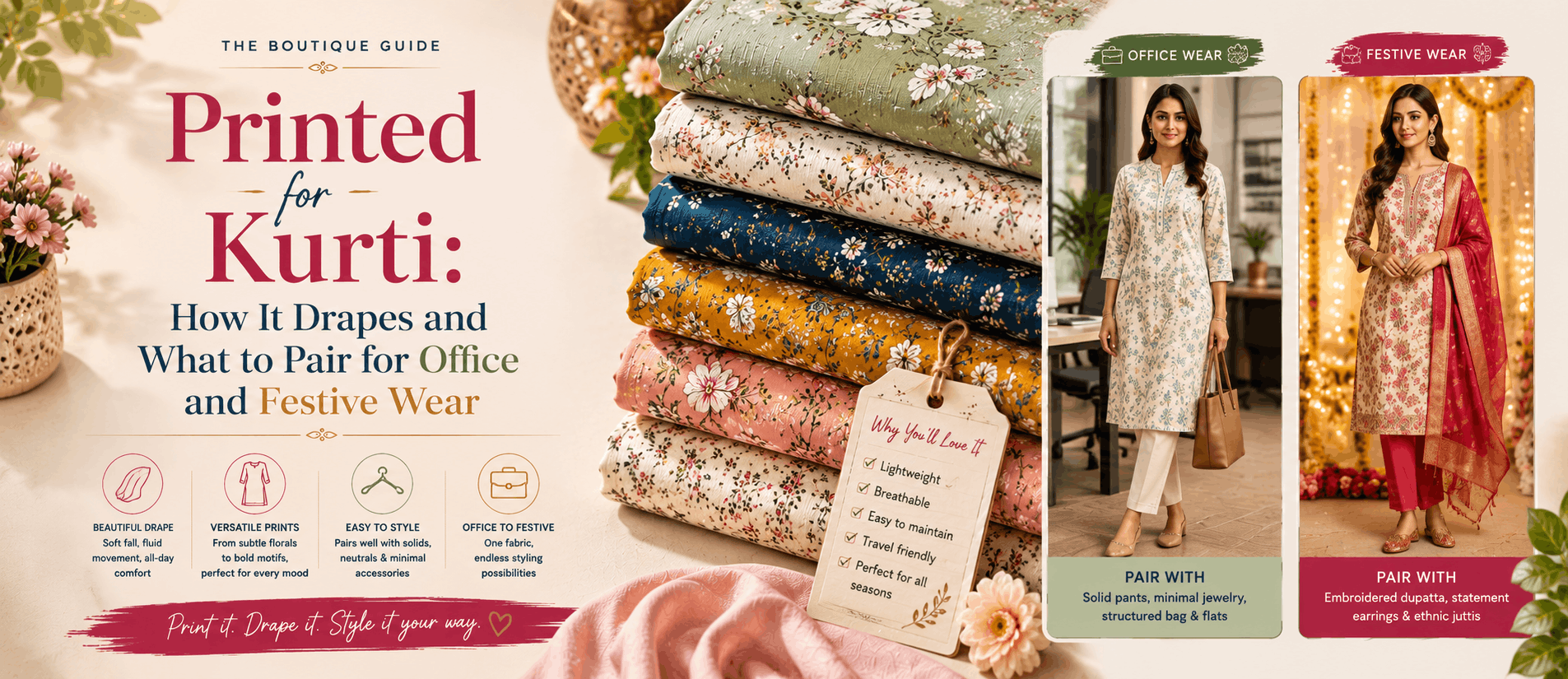
Every second working woman at my counter this month is asking about printed kurti fabric. Which base drapes best. Which print scale reads office versus festive. What to pair.
Printed kurti is not a single category. Printed cotton, printed rayon, printed crepe, printed silk-blend all drape differently.
The print is the visual. The base is the structure. The pairing is what holds the outfit together. Get all three right and the printed kurti reads clean; get any one wrong and the piece reads costume.
Here is exactly how printed kurti fabric drapes across the 4 main base families and what to pair with each one for office, festive and casual wear without over-thinking the wardrobe.
Quick Answer: Printed kurti fabric drapes by base fabric. Printed cotton (100-140 GSM, Rs 140-Rs 320/m) drapes crisp for A-line and straight cuts. Printed rayon (90-120 GSM, Rs 160-Rs 340/m) drapes soft fluid for Anarkali. Printed crepe (110-140 GSM, Rs 200-Rs 380/m) drapes matte skim for straight-cut office. Printed silk-blend (120-180 GSM, Rs 340-Rs 720/m) drapes semi-structured for festive. Pair with a solid churidar in one print shade plus a plain solid dupatta. Never pair two printed pieces. Kurti 2.5 metre cut, karigar 2 to 3 days.
Printed kurti works when your kurti rotation needs visual variety without buying multiple base colours. A single printed kurti replaces 2 to 3 solid kurtis in the wardrobe because the print carries visual weight. It also works when you want a piece that hides everyday stains from tea, food or metro dust because print camouflages small marks that show clearly on solid colours.
Printed kurti also works for the office-to-evening transition. A well-chosen small ditsy print or geometric micro-print reads professional at 10 am and reads styled at 7 pm without a wardrobe change. Solid kurti needs an accessory swap for the same transition.
Skip printed kurti if you already own 5 plus printed pieces and your solid rotation is thin. Solid kurti is the wardrobe foundation. Printed pieces should be 30 to 40 percent of the total kurti count, not 70 percent. Over-printed wardrobe reads inconsistent.
Skip printed also if your office has a strict monotone dress code (banks, legal firms, government offices with a specific colour rule). Solid navy, solid ivory or solid dove grey is the safer pick for those environments.
The wardrobe workhorse. Printed cotton drapes crisp because cotton fibre holds a structured shape. Small block print, screen print or Jaipur hand-block print in 2 to 3 muted shades. Rs 140 to Rs 320 per metre.
Best for straight-cut kurti with side slits or A-line kurti with pintuck yoke. Karigar 2 days. Pre-wash before stitching to handle 3 to 5 percent shrinkage.
Rayon drapes soft and fluid because the fibre lacks cotton's crisp memory. Print scale is usually medium to large digital print because rayon takes digital printing cleanly. Rs 160 to Rs 340 per metre.
Best for floor-length Anarkali, angrakha cut kurti or layered anaarkali-jacket combo. 3 to 3.5 metres for a full Anarkali. Karigar 3 days including flare pleating.
Crepe drapes matte and skim-the-body without clinging. Small geometric or abstract print in muted tones reads office. Rs 200 to Rs 380 per metre.
Best for straight-cut office kurti with 3 percent side slit and elbow sleeve. Skip pre-wash for crepe; ask counter to confirm the piece is pre-shrunk before cutting. Karigar 2 to 3 days.
Silk-blend (typically 40 to 70 percent silk with cotton or viscose) drapes semi-structured with a soft sheen. Print is usually mid-scale digital or screen with a metallic-thread accent border. Rs 340 to Rs 720 per metre.
Best for a Karwa Chauth family gathering, Diwali card party or a Sangeet function. 2.5 metres for A-line, 3 metres for Anarkali. Karigar 3 days plus 1 day for inner lining if the silk content is above 50 percent.
Very lightweight cotton with an airy weave. Small ditsy print or Jaipur block print in pastel shades. Rs 120 to Rs 260 per metre.
Best for a summer weekend brunch kurti, home wear kurti or a light travel kurti. Needs a full inner cotton lining because mul is translucent. Karigar 2 days plus 1 day for lining.
Mistake 1: Choosing a large-scale digital print for a straight-cut office kurti. Large print on a straight cut reads costume, not office. The print scale needs to match the kurti silhouette. Small ditsy or geometric print for straight cut, medium print for A-line, larger print for Anarkali and angrakha where the fabric drape spreads the print visually.
Mistake 2: Pairing a printed kurti with a printed dupatta and a printed bottom. Three printed pieces on one outfit reads over-styled. Follow the one-loud-one-quiet rule: printed kurti + solid churidar + solid dupatta, or solid kurti + printed dupatta + solid churidar. Never three prints at once.
Mistake 3: Skipping the pre-wash on printed cotton and finding the print bleeds on the first wash. Low-quality print jobs bleed on the first cold-water wash and stain the inner lining or the churidar. Ask counter to confirm the print method (screen, block, discharge, digital, azo-free digital). Discharge print and azo-free digital are the safest for repeated washing.
Mistake 4: Buying a rayon printed kurti fabric without checking the pre-shrunk certification. Rayon shrinks 5 to 8 percent on the first hot wash if not pre-shrunk. That is roughly half a size. Ask counter to confirm the piece is mill-pre-shrunk. If not, pre-wash the piece in cold water before karigar handover.
| Printed base | GSM | Price per metre | Kurti 2.5 metre piece | Karigar stitching |
| Printed cotton (office A-line) | 100 to 140 | Rs 140 to Rs 320 | Rs 350 to Rs 800 | Rs 350 to Rs 500 |
| Printed rayon (Anarkali) | 90 to 120 | Rs 160 to Rs 340 | Rs 400 to Rs 850 | Rs 400 to Rs 600 |
| Printed crepe (office straight) | 110 to 140 | Rs 200 to Rs 380 | Rs 500 to Rs 950 | Rs 380 to Rs 520 |
| Printed silk-blend (festive) | 120 to 180 | Rs 340 to Rs 720 | Rs 850 to Rs 1,800 | Rs 450 to Rs 700 |
| Printed cotton mul or mulmul (summer casual) | 60 to 90 | Rs 120 to Rs 260 | Rs 300 to Rs 650 plus lining | Rs 400 to Rs 550 |
Wholesale rates for boutique orders start 20 to 25 percent below these numbers at 15 metre minimums.
Rule 1: One printed piece per outfit. Printed kurti pairs with a solid churidar or cigarette pant and a solid dupatta. Solid kurti pairs with a printed dupatta and a solid churidar.
Rule 2: Pick the churidar or bottom colour from one of the print's dominant shades. If the print is white base with maroon and mustard motifs, the churidar can be solid maroon or solid mustard. Skip white churidar because that repeats the base colour and washes out the print.
Rule 3: Pick the dupatta colour in a complementary or contrast shade. If the kurti print is maroon-mustard, the dupatta can be plain cream, plain ivory or plain dusty pink. Or a contrast plain bottle green if you want the outfit to read bolder for a festive occasion.
Rule 4: Match jewellery to the print scale. Small print reads office and pairs with small stud earrings, thin chain, single bangle. Medium print reads festive and pairs with slightly larger earrings, layered chains, 2 to 4 bangles. Large print reads party and pairs with statement earrings, no chain, cocktail bangle set.
Ask counter to rub a corner of the print with a wet white cotton swab or plain white cloth. If colour transfers to the swab, the print is not colour-fast and will bleed in wash. Skip that piece. Azo-free digital print and discharge print are the safest colour-fast options; ask counter to confirm the print method.
Yes. Rayon and cotton work together well because both are natural or semi-natural fibres with a matte finish. Skip pairing rayon printed kurti with a shiny satin or synthetic dupatta because the shine competes with the print. Plain solid cotton or cotton silk dupatta is the cleanest pairing.
Depends on the print scale and the office code. Small ditsy print silk-blend in muted shades reads office-appropriate for corporate, media, PR or creative offices. Large festive print with metallic-thread accent reads festive-only. For strict corporate dress code (banks, legal firms) skip printed silk-blend entirely for daily office wear.
Screen print uses a physical stencil to transfer ink to fabric one colour at a time. Print reads slightly raised, colours are limited to 4 to 6 shades per design. Digital print uses a printer to spray ink directly onto fabric. Print reads flat, colours can be unlimited including photographs. Screen print is more durable through wash cycles; digital print offers more colour variety.
Yes. Printed cotton with an A-line cut and a slightly loose fit works well for maternity because cotton breathes and A-line accommodates the changing shape. Ask karigar for a 2 to 3 inch extra ghera at the hip and a slightly higher waist line to accommodate growth through the trimester.
For printed kurti fabric selection, WhatsApp +91 96544 40244 tonight Friday 14 August with your wear intention (office daily, office-to-evening, festive, summer casual) plus preferred base fabric (cotton, rayon, crepe, silk-blend, mul). Counter shortlists 4 to 6 printed options with print scale and colour palette photographs. Or walk in to Shop No. 06, Pushpa Central Market, Lajpat Nagar II, New Delhi 110024, on Saturday 15 August between 11 am and 6 pm to feel the hand and see print scale at arm's length.
Browse the full kurti fabric range online for the widest printed cotton, rayon and crepe rotation, or the printed fabric collection if you want to explore print-first across saree, dupatta and dress material. Boutique orders on printed kurti lots start at 15 metre minimums through our wholesale fabric page.
Have a happy print-hunting Saturday, ji.
Sneh, Paras Gallery Fabrics, Lajpat Nagar.
Buying Online Guides · Draft 23 October 2026 Buying sangeet fabric online starts with a dance plan, not a colour swatch alone....
Occasion Guides · Draft 23 October 2026 The short version: Choose anniversary dinner outfit fabric by testing how it feels while seated,...
Fabric education · Draft prepared 23 October 2026 A beautiful fabric name can still leave basic questions unanswered. To read fabric label...


