Kanjivaram Silk Fabric in 2026: A North Indian Boutique Owner's Honest Guide to Buying the South Indian Wedding Saree
Kanjivaram Silk Fabric in 2026: A North Indian Boutique Owner's Honest Guide to Buying the South Indian Wedding Saree
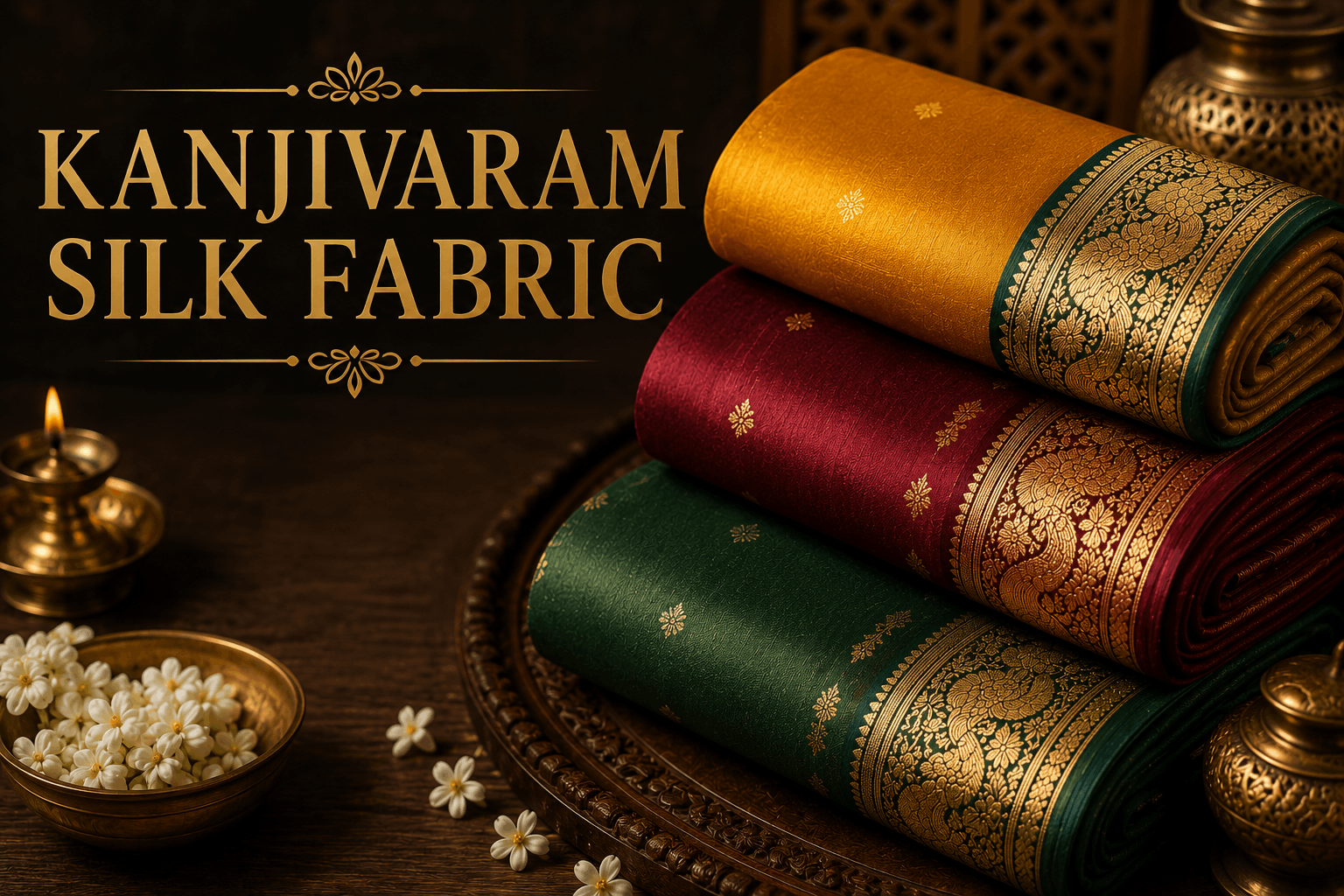
Kanjivaram silk fabric is a handloom-woven pure mulberry silk cloth from the Kanchipuram region of Tamil Nadu, distinguished by its heavy three-shuttle weave and pure zari border. In 2026 it ranges from Rs 850 per metre for soft silk Kanjivaram to Rs 4,800 per metre for pure tested zari handloom Kanjivaram.
Twelve years I have been sitting at this counter in Lajpat Nagar. Kanjivaram still surprises me. Not the fabric itself. What surprises me is how regularly people pay Kanchipuram prices for Surat cloth without knowing it.
Last October a boutique owner from Bhopal came in holding a bolt she had paid Rs 2,400 per metre for, calling it pure Kanjivaram. I checked it under my loupe in about four seconds. Art zari. Power loom. Worth maybe Rs 380.
She wasn't foolish. The copies have genuinely gotten that convincing.
The Kanjivaram market in 2026 has gotten harder to navigate than it was two years back. Pure tested zari costs roughly 35 percent more because silver and gold raw material prices have not moved downward. Salem soft silk has swept through the sub-Rs 25,000 saree segment almost completely, offering the same visual at a third of the Kanchipuram price. Surat machine copies flood every online marketplace. Most buyers genuinely cannot separate them from handloom in a photograph.
So here is the conversation I have with every North Indian bride and every boutique-wala who walks in asking for Kanjivaram. Grades, zari hierarchy, weaver clusters, and what to check before committing real money.

The best Kanjivaram silk saree fabric in 2026 depends on use. Pick soft silk Kanjivaram at Rs 850 to Rs 1,400 per metre for festive and reception wear. Choose pure mulberry silk Kanjivaram at Rs 1,800 to Rs 2,800 for bridal commissions. Reserve pure tested zari handloom Kanjivaram above Rs 3,500 for heirloom-grade bridal sarees and wedding investments that hold value.
What Kanjivaram silk fabric actually is
Pure mulberry silk. Handloom woven. Kanchipuram cluster, Tamil Nadu. That is the base.
What most buyers miss is what separates the genuine cloth from the machine copy sitting two shelves over. The weave structure tells you everything. In authentic Kanjivaram, the body, border, and pallu are each woven on separate shuttles and joined using the petni interlocking technique. Run your finger along the inside of the border on a real piece. There is a slight ridge where the two separately-woven sections meet. Machine copies have a flat seam at that join. No ridge. Completely different cloth, even when the photograph looks identical.
Zari grade is what drives the price gap more than anything else. Pure tested zari uses silver wire coated with real gold, which is why it holds its brightness across decades without tarnishing. Half-fine zari drops the gold coating. Art zari and polyester zari are what the Surat copies use. This single variable accounts for nearly half the price difference between two Kanjivaram pieces that look almost identical in a photograph.
Silk grade matters. Pure mulberry silk from Karnataka and Tamil Nadu sericulture clusters is the standard. Mixed silk and blends sit in the budget tier. Beyond silk and zari, weaving authenticity is what the GI system certifies. Real handloom Kanjivaram from Kanchipuram carries both the Silk Mark of India and a Geographical Indication tag. No machine-made copy can carry either.
Every Kanjivaram bolt in our silk fabric collection is tagged with weaver cluster, zari purity, and silk grade. Nothing left to guess.
The four Kanjivaram silk grades I stock in 2026
Salem soft silk, festive wear entry point
Most buyers shopping under Rs 22,000 for a finished saree are getting this, even when they believe they're buying pure Kanchipuram. Salem looms produce genuine pure mulberry silk Kanjivaram at lighter GSM, 280 to 360, with a softer drape and a lower price per metre. I charge Rs 850 to Rs 1,400 per metre.
In a WhatsApp photo, it looks identical to Kanchipuram weave. Pick it up and it feels noticeably lighter. The shine holds ten-plus years with reasonable care. Boutique owners from Pune and Surat stock this grade heavily for reception sarees and second-saree wedding outfits. Practical cloth, honest price.
Kanchipuram cluster with half-fine zari, the standard bridal Kanjivaram
This is where most North Indian brides land when they buy their first real Kanjivaram. Three-shuttle handloom weave from the Kanchipuram cluster, GSM 380 to 460, half-fine zari border. Rs 1,800 to Rs 2,800 per metre.
Pick it up and the difference is immediate. Heavy fall, slight stiffness in the drape that softens after a couple of wears, the characteristic crispness that Salem soft silk simply does not produce. The half-fine zari border holds brightness for five to seven years before gradual darkening begins. Most commissions in the Rs 25,000 to Rs 80,000 retail bracket are this grade.
Pure mulberry Kanjivaram with pure tested zari, the heirloom cloth
Gold-coated silver wire. That is what pure tested zari actually is. GSM 420 to 500, Rs 3,500 to Rs 5,800 per metre depending on motif density and weaver attribution.
The gold coating is what prevents tarnishing across generations. The weight of the fabric gives bridal sarees that dramatic fall that photographers are always chasing. For commissions above Rs 1,20,000, this is almost always the grade brides want once they understand what the price difference is actually buying. Our bridal bliss collection holds master weaver pieces in oxblood, forest green, and peacock blue for 2026 bridal orders.
Master weaver Kanjivaram, named attribution and bespoke commission
Hand-commissioned from a named weaver in the Kanchipuram cluster. Custom motifs, often temple-inspired. GSM 450 to 540. Rs 6,500 to Rs 12,000 or more per metre, with a lead time of three to four months from commission to delivery.
I sourced one of these last year for a family in Lucknow. They wanted a specific paisley motif from an ancestral saree translated into a new piece. Four months later the weaver delivered it with his signature in the corner of the pallu and a verified GI tag. The family sends me photos of it at every wedding since. That is what bespoke Kanjivaram means. There is no shortcut version.
How much Kanjivaram silk fabric you actually need
Kanjivaram is sold mostly as finished sarees, but boutique buyers ordering by the metre need to plan yardage correctly. For ready-to-drape pieces sorted by wedding occasion, the saree collection lists pre-finished Kanjivaram by grade.
| End product | Fabric needed |
|---|---|
| Standard saree (5.5m with blouse) | 6 to 6.5 metres |
| Saree with separate blouse fabric | 7 to 7.5 metres |
| Half saree set (skirt + dupatta + blouse) | 6.5 metres |
| Kanjivaram lehenga fabric (6 kali) | 5.5 to 6 metres |
| Choli blouse only | 0.8 to 1 metre |
| Dupatta only | 2.5 to 3 metres |
Most pre-finished Kanjivaram sarees come as 5.5 metre pieces with 0.8 metre blouse attached, totalling 6.3 metres. If you are buying by the metre for custom stitching, plan for the full saree-with-blouse yardage without fail. The fabric estimator handles Kanjivaram blouse cutting calculations for boutique stitchers.
How to spot a fake Kanjivaram before you pay handloom prices
A burn test on a selvedge thread takes thirty seconds and costs nothing. Pull one thread from the selvedge edge and hold a flame to it. Pure mulberry silk burns slow, leaves soft grey ash, smells like burnt hair. Polyester or nylon melts fast into a hard black bead with a chemical smell. Pure tested zari leaves a tiny silver bead with a brief flash. Art zari leaves a darkened copper bead. If the cloth is sold as pure handloom Kanjivaram, it should produce grey ash and a silver bead. Anything else is a different answer entirely.
After the burn test, check the petni interlock at the border join. Run your finger along the inside of the border where the body cloth meets the border panel. Handloom Kanjivaram has a slight ridge at that join. That is the petni technique, where two separately-woven sections interlock. Power-loom copies have a flat seam. No ridge means not handloom, whatever the label says.
Then ask for the Silk Mark and Geographical Indication tags. Authentic Kanjivaram from the Kanchipuram weaving cluster carries both. Machine-made copies cannot carry either legally. If the seller cannot produce both tags on request, walk away. Not necessarily because they are dishonest. Maybe they bought it in good faith themselves. The cloth is still not what it is being sold as.
For verified GI-tagged Kanjivaram with documentation on every bolt, our imported fabric section carries authentication certificates with each piece.
Why two similar-looking Kanjivaram sarees can cost completely differently
The Delhi customer came in maybe three weeks back. Two WhatsApp photos. One saree at Rs 11,000, one at Rs 82,000. In the photographs, they looked close enough to genuinely confuse someone who had not handled Kanjivaram before.
Not even close to the same cloth. Not even the same category.
I explained it to her the way I explain it to most buyers. At the entry level, Salem soft silk with a basic zari border finishes somewhere between Rs 7,500 and Rs 18,000 as a complete saree. Honest cloth at an honest price. Move up to pure mulberry with half-fine zari and you are past Rs 22,000 easily, sometimes Rs 62,000 or above, because both the raw silk and the zari jump significantly at the source. Pure tested zari is where pricing takes a real turn. Rs 75,000 on the low end, Rs 1,80,000 at the upper range. Most of that money sits in the gold-coated wire and the weaving skill it takes to handle it. The master weaver commission is a different conversation entirely. Rs 2,40,000 to Rs 8,00,000. I have watched people go quiet at that number. But after I explain that a named karigar spent four months on that cloth, most of them nod slowly and understand.
For Kanjivaram silk fabric by the metre, all four grades are available with pricing shown upfront and authentication documentation for each bolt.
What boutique buyers keep getting wrong with Kanjivaram care
Never store Kanjivaram directly inside a plastic garment cover. Fold it in soft muslin cloth first. Trapped moisture darkens half-fine zari over time. It also weakens the silk at the fold lines. Re-fold along different lines every six months or permanent crease damage sets in on cloth that cost thousands of rupees.
For blouse stitching from Kanjivaram body cloth, use a fine machine needle, size 80. A heavier needle pulls the silk warp threads and leaves visible holes along the stitch line. If you are sourcing a separate fabric for the blouse rather than cutting from the saree body, the blouse fabric collection has options that sit well with heavy Kanjivaram weights. Hooks and finishing should be hand-stitched with silk thread, not machine-stitched with polyester.
Never iron directly on the zari border. Iron from the reverse side with a press cloth on top at medium heat. Direct iron on zari flattens the metallic threads permanently, which dulls the border shine in a way you cannot fix after the fact. Steam pressing is safer than dry iron for heavy Kanjivaram. I say this at every delivery and still get the "why is my border looking flat" message six months later, without fail.
FAQ
What is the difference between soft silk and pure Kanjivaram?
Soft silk Kanjivaram comes from Salem looms, lighter GSM, softer drape, typically Rs 850 to Rs 1,400 per metre. The Kanchipuram cluster produces traditional Kanjivaram with a heavier three-shuttle weave, crisper drape, and higher GSM. That version costs Rs 1,800 to Rs 5,800 depending on zari grade. Both are genuine mulberry silk. The difference isn't in the fibre, it's in the weave structure, weight, and fall of the cloth.
How much does Kanjivaram silk fabric cost per metre in 2026?
Four bands. They represent genuinely different categories of cloth. Salem soft silk Kanjivaram comes in at Rs 850 to Rs 1,400 per metre. That is the festive-wear range. Pure mulberry with half-fine zari starts where Salem soft silk ends, roughly Rs 1,800, and goes to Rs 2,800. Pure tested zari is where pricing moves sharply, Rs 3,500 on the lower side and Rs 5,800 at the upper range. Master weaver commissioned pieces start at Rs 6,500 and can go past Rs 12,000, depending on the weaver and the complexity of the motif.
How many metres of Kanjivaram for a saree?
A standard 5.5 metre saree with attached blouse needs 6 to 6.5 metres total from the bolt. Separately cut blouse fabric pushes the requirement to 7 or 7.5 metres. A half saree set with skirt, dupatta, and blouse needs 6.5 metres. Most pre-finished pieces come as 6.3 metre complete sets.
How can I tell real Kanjivaram from a machine-made copy?
Burn test first. Take a selvedge thread and hold a flame to it. Pure silk produces grey ash and smells like burnt hair. Polyester melts into a hard black bead with a chemical smell. That test takes thirty seconds. Next, check the petni ridge on the inside of the border join. Handloom has a ridge where the two sections interlock. Machine copy has a flat seam. Then ask for the Silk Mark and GI tags. If the seller cannot show both, the cloth is not authenticated Kanchipuram Kanjivaram. Do all of that and you are done in under five minutes.
Is soft silk Kanjivaram real silk?
Yes. Salem soft silk Kanjivaram is 100 percent pure mulberry silk in almost every case. The looser weave structure and lighter GSM make it softer and more affordable, but the fibre is genuine. It is a lighter-weave variant of real Kanjivaram silk, not a substitute or a fake, and I stock it openly as exactly that.
Which Kanjivaram grade works best for a North Indian wedding bride?
Depends entirely on the occasion and how many times the saree will actually be worn. Reception saree in the Rs 25,000 to Rs 60,000 bracket? Pure mulberry with half-fine zari in deep wine, peacock blue, or oxblood reads very well on North Indian wedding stages. Muhurtam-style ceremony saree meant to last decades? Pure tested zari in mustard or red with a contrast green border. The contrast border does the visual work without needing additional styling. If you are building a full bridal wardrobe across multiple functions, the most popular bridal lehenga fabrics guide covers how Kanjivaram compares against tissue, organza, and net for different ceremony stages.
The honest word from this counter
Most people come in asking the wrong question. They ask what is the best Kanjivaram when the useful question is how many times will this saree actually be worn in its lifetime.
That question changes everything.
A reception saree worn twice deserves Salem soft silk at Rs 1,200 per metre. Right purpose, right cloth, no waste. A muhurtam saree going into a trousseau box and coming out twenty years later for the next generation needs pure tested zari. Half-fine zari will not survive the storage gap without the border darkening noticeably. This is not a small difference in quality. It is a different category of cloth for a different category of occasion.
In Kanjivaram, zari grade matters as much as silk grade. Maybe more. I have sold pure mulberry sarees with art zari at Rs 14,000 finished, completely right for festive wear. I have also sold Salem soft silk with pure tested zari border at Rs 44,000. Different buyer, different purpose, different cloth. The grade needs to match the occasion, not just the budget number.
The master weaver pieces are the ones I source most carefully. Not everyone needs a named karigar's signature in the corner of the pallu. But the buyers who do come in knowing exactly what they want. Usually they carry a reference photograph of an old family saree, a specific motif from three generations back. That is a different kind of conversation. One I always make time for.
For boutique owners and brides sourcing authenticated Kanjivaram, our silk fabric collection carries all four grades with Silk Mark verification and bulk pricing tiers from June onwards. For occasion-specific styling of silk across a full wedding wardrobe, the versatility of silk guide is worth reading alongside this.
Your Next Step...
Browse the Kanjivaram silk fabric collection sorted by zari purity and silk grade. Pair your Kanjivaram with matching zari border trim for blouse coordination, or ask about bulk order pricing for boutique inventory. WhatsApp for Silk Mark and GI tag verification photos before committing any order. Twelve years of Kanchipuram sourcing. One counter. One promise.