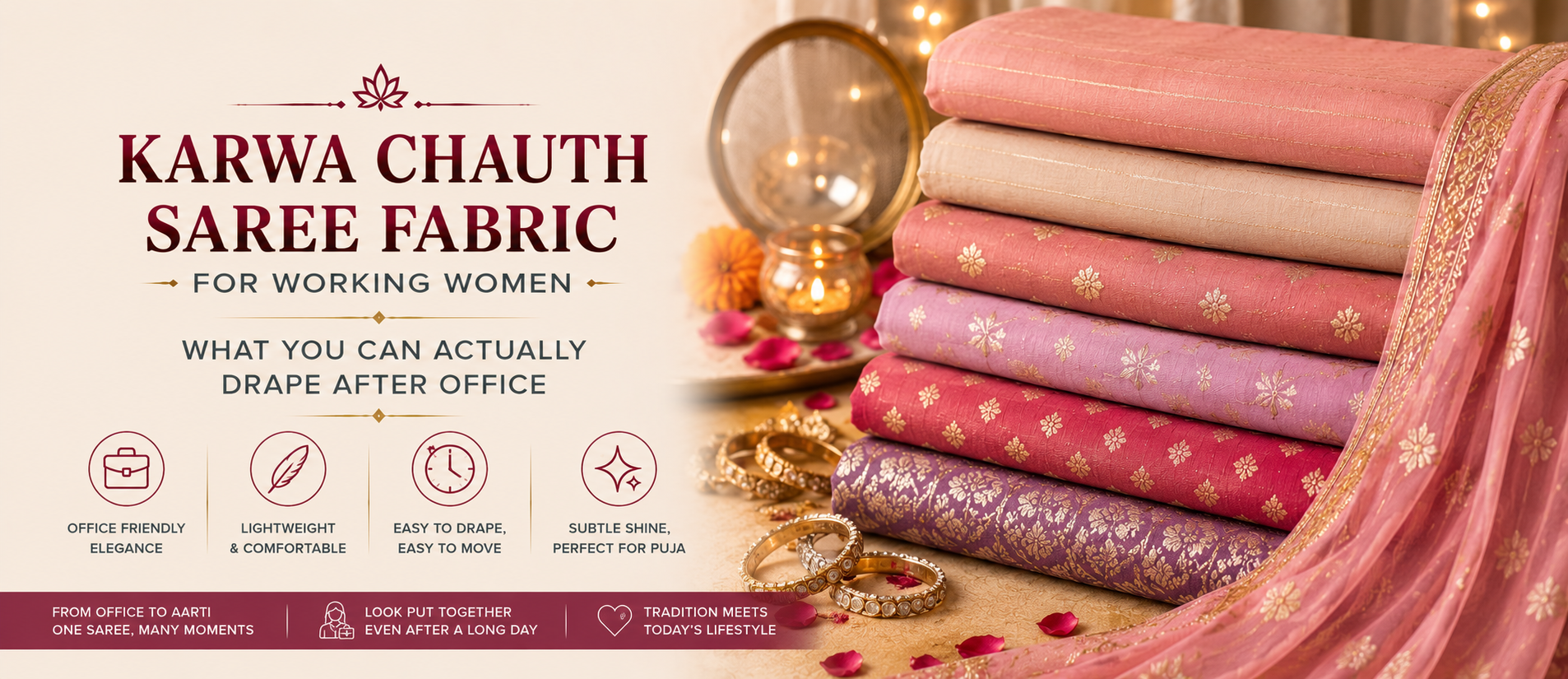
Karwa Chauth Saree Fabric for Working Women, What You Can Actually Drape After Office
Quick Answer
For working women who need a Karwa Chauth saree fabric they can drape at home in 15 minutes after office on Friday, 30 October 2026, pick a red, maroon or sindoori Chanderi silk, cotton silk, or georgette saree with pre-stitched pleats or a light body that folds easily. 5.5 metres for the saree, 0.8 metres for the blouse, 0.5 metres for the fall. Book by 5 October so the fall-and-pico and blouse stitching are done in time. Save Banarasi silk for the sargi morning or the post-puja dinner, not the quick drape.
Why saree, not suit, for the Karwa Chauth puja
Karwa Chauth is a married-woman suhaag ritual. The evening puja and the moon-sighting after are traditionally done in a saree, with sindoor, chuda, mangalsutra and the full solah shringar. Suits, lehengas, or Western wear are not what mothers-in-law and karwa-katha groups expect at the puja circle.
The problem for working women is time. You leave office at 6 pm, reach home by 7, the puja starts by 7.30. That gives you 20 to 30 minutes to change, redo makeup, and drape a saree that photographs well next to the karwa thali.
The saree fabric decides whether that 20 minutes feels calm or panic. Pick the wrong silk and you are still tucking pleats when the katha starts.
The three-fabric rule for a working-woman Karwa Chauth saree
The saree fabric has to pass three tests before I recommend it.
- Folds without a starch iron. You cannot re-iron a saree at 7 pm.
- Body is light enough for a 15-minute self-drape. Heavy Banarasi and Kanjivaram need a helper or a professional draper. Not realistic on a weeknight.
- Border is festive enough for the puja photograph. No plain sarees. There has to be a zari, gota or thread border that catches the diya light.
Three fabrics from my rack pass all three.
Chanderi silk, the working-woman default
Around 90 to 110 grams per metre. Matte body, soft sheen, drapes in soft pleats. The most self-drape-friendly festive saree fabric on the market.
Dye it in maroon, sindoori or kumkum red. Add a fine gold zari border. Reads exactly right for puja without needing a helper.
Our dyeable Chanderi collection has 249 pieces, most of which can be dyed to your exact suhaag shade.
Cotton silk saree, the no-fuss pick
Around 90 grams per metre. Almost no wrinkle. Very soft body. Perfect for women who have never draped a saree without their mother or a helper.
The one trade-off is a slightly matte pallu, which reads softer under a diya than pure silk. Fine for a home puja, less ideal if your society organises a large group Karwa Chauth katha.
The Cotton Embroidery collection has 384 pieces including softly embroidered cotton silk saree bases in the exact red family for Karwa Chauth.
Georgette saree, if you want a fuller drape
Around 80 to 100 grams per metre with embroidery. Georgette drapes with more movement. Reads modern-festive rather than heritage.
Pick this if your Karwa Chauth crowd is younger, if your husband will click a lot of reels or photos, or if you plan a dinner-out after the moon-sighting.
Skip georgette if you sit cross-legged for the full katha. The pleats spread and lose shape.
Our georgette collection has 663 pieces sorted by weight, border density and embroidery style.
The five colours that belong on Karwa Chauth 2026
Karwa Chauth is a suhaag ritual. Red-family colours are the rule. But not every red is right for the puja photograph.
- Sindoori red, the classic suhaag colour with a slight orange undertone
- Kumkum red, deeper, warmer, most photographed shade of 2026
- Maroon, safer for women whose office group might see the outfit
- Deep pink or rani, contemporary alternative, still traditional-adjacent
- Wine or burgundy, newer trend, works if your evening event runs modern-corporate
Avoid: black, navy, cream, white, and any grey-heavy shade. All are wrong for the Karwa Chauth colour code in most North Indian households.
The full metre-count breakdown
For a complete Karwa Chauth saree with blouse, this is the cutting counter list:
| Piece | Metres | Notes |
|---|---|---|
| Saree fabric | 5.5 m | Standard length, pallu included |
| Blouse fabric | 0.8 m | 1 m if princess-cut or full-sleeve |
| Fall for petticoat | 0.5 m | Same tone as saree base |
| Contrast dupatta for ghoongat (optional) | 2.25 m | For the moon-sighting drape |
Total per Karwa Chauth set: 6.8 metres (9.05 metres if you want the layered ghoongat option for the chand-darshan moment).
The office-to-puja saree switch, minute by minute
For a working woman doing the full ritual on 30 October 2026, this is a realistic timeline.
- 5 am, wake for sargi. Wear a simple cotton kurta or nightsuit for eating the sargi.
- 6 am, sargi done, water till moonrise, start fasting.
- 9 am, leave for office in normal work wear. Salwar suit or trousers-kurta is fine. This is not the puja outfit.
- 6 pm, leave office. Reach home by 7.
- 7 pm to 7.20 pm, shower, hair, light makeup.
- 7.20 pm to 7.35 pm, drape the pre-selected saree. Blouse and petticoat should be already fitted, hung on the door.
- 7.35 pm, puja and katha start. Sit through the katha.
- 8.30 pm onwards, chand-darshan, husband breaks your fast, sindoor and water ritual done.
The 15-minute drape window is only realistic if the saree fabric is light and the blouse is fitted in advance. That is why the Chanderi silk or cotton silk is the right pick.
The blouse and shringar readiness checklist
- Blouse stitched and tried on at least a week before. Bring the blouse fabric with the saree, ask the tailor for a fitting appointment by 22 October at the latest.
- Petticoat colour matched to saree base tone. A pink petticoat under a maroon saree shows through when the diya lights up.
- Fall pre-stitched. Do not skip the fall on a puja saree, the pleats will not hold otherwise.
- Chuda bangles, mangalsutra, sindoor daani, karwa, chalni, and karwa katha book kept ready in one puja tray by 28 October.
- One packed suit or ethnic set ready for post-puja dinner if you are going out after chand-darshan.
For dupatta or ghoongat options in matching red shades, the All Dupattas collection has 350 pieces.
The September-to-October booking timeline
- By 20 September: decide saree colour and Chanderi vs cotton silk vs georgette. Buy fabric, drop at dyer if custom shade. Do this before Pitru Paksha (26 Sep to 10 Oct) if your family observes the shopping pause.
- By 12 October (Navratri Pratipada): fabric back from dyer, dropped at the fall-and-pico
- By 18 October: blouse fabric stitched, first fitting done
- By 25 October: second fitting if any, saree pressed and hung
- 30 October evening: ready to drape in 15 minutes at home
If you missed the September window, ready red Chanderi and cotton silk saree fabrics are always on the shelf through October. Skip the dyer route and pick from stock.
FAQs
Which saree fabric is best for a working woman on Karwa Chauth 2026?
Chanderi silk in maroon or sindoori red. Around 90 to 110 grams per metre. Drapes in 15 minutes at home, holds a zari border for the puja photograph, and does not need a helper.
How many metres of fabric for a full Karwa Chauth saree set?
6.8 metres total: 5.5 metres for the saree, 0.8 metres for the blouse, 0.5 metres for the fall. Add 2.25 metres if you want a matched dupatta for the ghoongat during chand-darshan.
Can I wear a suit instead of a saree for Karwa Chauth puja?
Not the tradition. Karwa Chauth is a saree-and-shringar ritual for married women, especially at the family katha and moon-sighting. Suits are fine for office in the day, but change into a saree before the 7.30 pm puja.
Is Banarasi silk saree okay for a working-woman Karwa Chauth?
Banarasi is too heavy for a 15-minute self-drape after office. Save it for the sargi morning if your family does a formal sargi, or for the post-puja dinner. For the actual puja itself, pick a lighter Chanderi or cotton silk.
When should I book Karwa Chauth saree fabric for the 30 October 2026 puja?
By 20 September if you want a custom-dyed shade. By 12 October at the latest for the fall-and-pico plus blouse stitching to finish in 18 days.
Book a Karwa Chauth fabric consultation
Come by in September, before Pitru Paksha, and I will pull sindoori, kumkum and maroon Chanderi silk and cotton silk saree fabrics from the back rack. Blouse fabric, fall, ghoongat dupatta, all matched in one visit.
Book an appointment: parasgalleryfabrics.com/pages/book-an-appointment
WhatsApp: +91 96544 40244