


Shopping Sangeet Fabric Online: Checks Before You Buy
Buying Online Guides · Draft 23 October 2026 Buying sangeet fabric online starts with a dance plan, not a colour swatch alone....
Colour and Styling Guides · 9 minute read · Published 21 October 2026
Pastel organza or pastel chiffon? Every October a sister of the bride walks in with this question. Both work for a haldi or a sagan morning, but each has its slot.
The short version: Pastel organza is crisp, structured, around 180 grams per metre, with slight stand-up pleats. Pastel chiffon is softer, flatter, around 90 grams per metre, with a flowing drape.
Here is how we pick at the counter.
THE WINNING MOVE: ORGANZA FOR THE HALDI OR SAGAN. CHIFFON FOR THE AFTERNOON LUNCH DRAPE.
Quick answer: A pastel organza outfit works best for a daytime function with volume and structure, while pastel chiffon reads better for a flowing afternoon drape. The organza fabric collection has 455 live cuts across pastel, jewel and metallic weaves. For a daylight shade check at the shop entrance, book a counter slot, we will set it up.
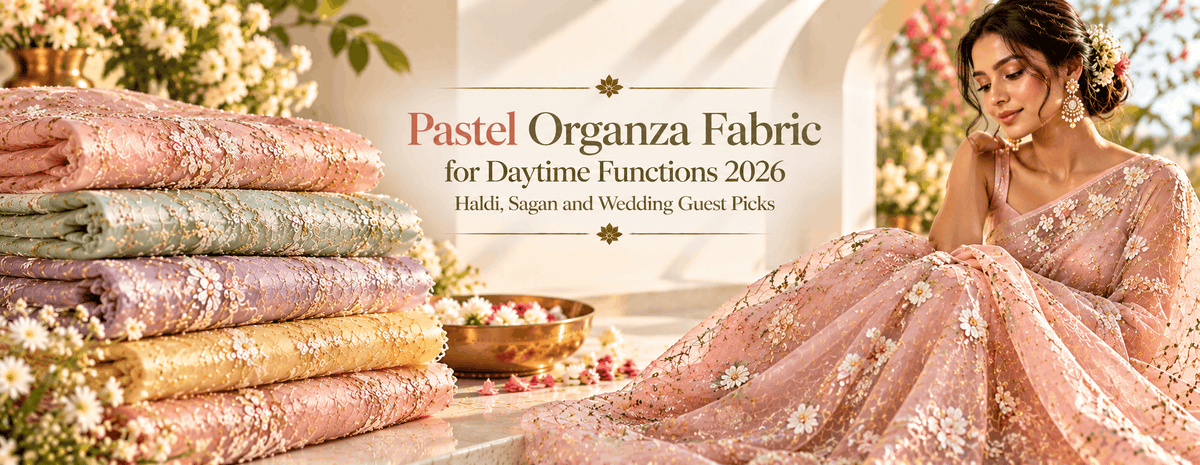
Pastel organza is the cloth sisters of the bride and bridesmaids reach for when the function is a haldi morning, a Sunday sagan or an afternoon wedding guest lunch. The sheer plain-weave base holds a crisp hand that stands slightly off the body, giving sarees a quiet volume at the pleats and lehengas a soft flare at the hem. Shades like mint green, blush pink, powder blue, lemon yellow, ivory and pistachio sit cleanly on organza because the finely-twisted yarn holds pastel dye evenly across the full width.
The honest downside is that pastel organza is a daytime cloth. Under warm hall light the shade can wash out, and the sheer base can read see-through if the lining colour was picked wrong. Across the shop today the organza count sits at 455 live cuts, which gives room to compare three or four pastels side by side before cutting the final length.
Pastel chiffon is the softer, lighter alternative when the function needs flow rather than structure. The weave is looser than organza, the yarn is finer, and the hand feels silky against the skin. Pastel shades on chiffon read softer and slightly more muted because the lighter yarn carries less dye saturation. The drape falls flat and settles with the body movement, which reads beautifully for a seated lunch sari or a long Anarkali.
The honest downside is that chiffon lacks the quiet volume that organza brings to a lehenga or a kurta. For a daytime function where the look needs to photograph with shape, chiffon reads flatter. Across the current shop stock, chiffon lives inside the chinon-chiffon collection at 106 live cuts across pastel and jewel tones.
Organza holds its shape. A pastel organza saree pleats with slight stand-up at the hip, pallu holds a line even in a mild breeze, and the dupatta volume stays through a four-hour function. Chiffon lies flat. The pleats settle flush against the body, the pallu flows soft and the dupatta reads fluid rather than structured. For a function that will be photographed from standing or seated angles, organza carries shape better.
Organza drape is crisp and papery with a slight bounce at the edges. The pleats hold formation without ironing re-set through the day. Chiffon drape is soft and silky, falling in continuous lines across the body. The pleats need pinning more often, but the overall silhouette reads more fluid. For a daytime function with slow seated movement, chiffon reads elegant. For a function with photographs and standing time, organza is the kinder pick.
Organza is sheer, so air moves through the body of the cloth freely. The lining decides the breathability more than the organza itself. A cotton silk lining keeps the saree cool through a Delhi mid-morning function. Chiffon is also breathable, slightly more so at the surface because the loose weave moves with the body. For a hot summer function, chiffon with a cotton lining is marginally cooler. For an October to December daytime function, both breathe well.
Organza takes embroidery firmly because the crisp base gives thread work a stable surface. Gota patti, mukesh, light sequin and thread floral work sit cleanly on pastel organza. The risk is heavy work that fights the sheer base. Chiffon takes lighter embroidery because the softer weave can give way under heavy thread tension. For a pastel suit with intricate work along the dupatta, organza is the firmer canvas. For a pastel saree with scattered motifs, chiffon reads soft and feminine.
Browse the organza edit for the daytime pick
Pastel, jewel and metallic organzas with gota patti, mukesh, sequin and thread work across saree, suit and lehenga bases.
Browse Organza →Studio lighting flattens pastel shades. A mint that looks mid-green on the catalogue page reads almost white in real daylight. A blush that reads coral online reads near-ivory on a bright morning. Always take the shortlisted swatch to the shop entrance and look at the shade under natural daylight for a full minute before cutting the length.
Organza is translucent. A pastel organza saree over a bright white petticoat reads lighter than the same saree over a petticoat in the same pastel. Always decide the lining colour at the same visit as the fabric itself, because the finished look is the saree plus the lining, not the saree alone.
Pastel organza is a daytime cloth. Under warm hall light the shade reads washed and the sheer base reads slightly cheap because the daylight glow that the cloth is built for is missing. For an evening reception or cocktail, switch the base to a silk, net or heavier organza-satin instead.
If you can come in, honestly do, because pastel colours read differently under studio, phone and real daylight. Book a slot and we will set it up. Our guide to organza fabric types and quality tests walks the base weaves further, plus the organza fabric for engagement buyer guide walks the engagement function pick.
Blush pink, mint green and ivory are the three easiest shades across skin tones and function types. Blush suits a Sunday sagan. Mint suits a haldi morning. Ivory suits a formal brunch wedding or a sister-of-the-bride look.
For the daytime functions of a winter wedding, yes. Haldi, mehendi, sagan, daytime wedding guest and brunch functions all suit pastel organza. For an evening winter wedding, a heavier fabric like silk or velvet reads better under warm hall light.
Organza is sheer and crisp. Satin is opaque and reflective. Pastel satin reads formal and almost evening-ready even in a daytime shade, while pastel organza reads soft and daytime-appropriate. For a haldi or morning sagan, organza is the kinder base.
Dry clean only within a week of the function. Store flat in a white muslin cover, keep away from direct sunlight to prevent fade at the folds. Avoid folding tight because the crisp body of the cloth holds crease marks longer than chiffon. Air once every six months to keep the base dye fresh.
Shop related fabric collections
Organza, haldi occasion and dupatta edits for the daytime function wardrobe
Honestly, the only way to really know is to take a pastel swatch out of the shop and look at it under real daylight for a full minute. Pictures lie, phones lie, the shop light lies a bit. Walk in or ping on WhatsApp first and we will have the swatches ready.
Or chat directly: +91 96544 40254
Buying Online Guides · Draft 23 October 2026 Buying sangeet fabric online starts with a dance plan, not a colour swatch alone....
Occasion Guides · Draft 23 October 2026 The short version: Choose anniversary dinner outfit fabric by testing how it feels while seated,...
Fabric education · Draft prepared 23 October 2026 A beautiful fabric name can still leave basic questions unanswered. To read fabric label...


