


Shopping Sangeet Fabric Online: Checks Before You Buy
Buying Online Guides · Draft 23 October 2026 Buying sangeet fabric online starts with a dance plan, not a colour swatch alone....
Colour and Styling Guides · 9 minute read · Published 21 October 2026
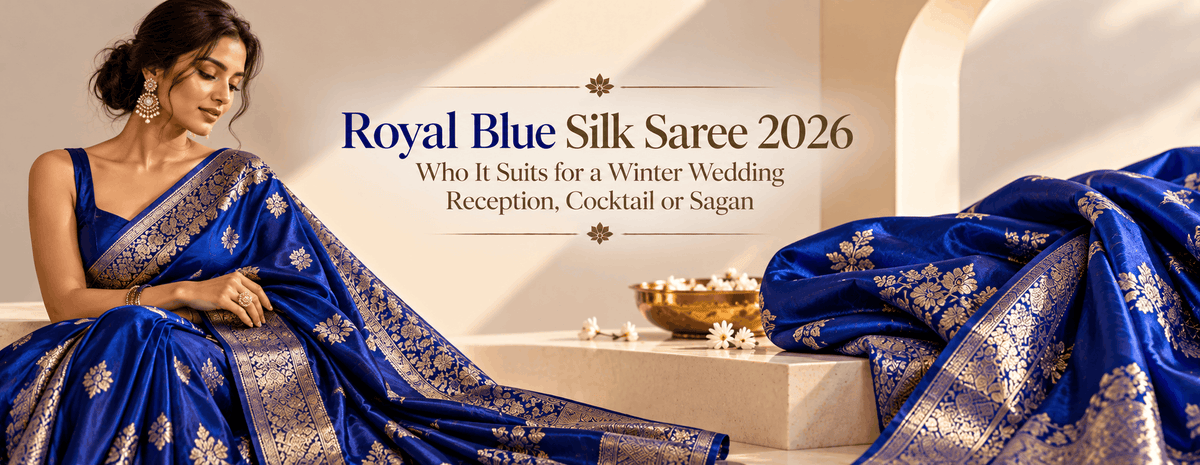
Banarasi silk or upada silk? Every October a sister of the bride walks in with a royal blue reference photo. Both weaves carry the shade for a reception, but each has its slot.
The short version: Banarasi royal blue silk is dense, jewel-rich, around 480 grams per saree with real zari woven in. Upada royal blue silk is finer, cleaner, around 320 grams, with lighter drape and less pattern load.
Here is how we pick at the counter.
THE WINNING MOVE: BANARASI FOR THE RECEPTION. UPADA FOR THE COCKTAIL OR SAGAN.
Quick answer: A royal blue silk saree in Banarasi weave reads richest at a seated reception, while an upada silk reads cleaner for a cocktail or sagan evening. The silk fabric collection has 293 live cuts across Banarasi, upada, chinia and soft silks. For a drape trial under warm and cool shop light, book a counter slot, we will set it up.
Banarasi silk in royal blue is the saree that mothers of the bride and senior guests reach for when the function is a formal seated reception under warm hall lighting. The silk yarn is heavier, the weave is denser, and the real zari sits woven through the pallu and the border rather than printed on top. The depth of the royal blue reads richer on a Banarasi than on any other base silk because the dye sinks further into the firm yarn. Across the shop today the Banarasi silk count is small but hand-picked, each saree carrying either a kadhwa or kadhiyal zari pattern depending on the weaver.
The honest downside is the weight. A full Banarasi royal blue saree with pallu zari runs close to 500 grams. For a seated reception, that weight carries beautifully and holds every pleat crisp through a long evening. For a cocktail where the wearer wants to stand, mingle and move between family seating, the weight starts to show by the second hour.
Upada silk is finer, lighter and cleaner on the body than a Banarasi. The yarn count is higher, the twist is softer, and the drape falls with less structure and more flow. Royal blue on upada reads modern rather than traditional, with a clean reflective sheen that catches warm hall light without the full pattern load of a Banarasi border. Across the current shop stock the upada silk range sits at a healthy count with jewel-tone sarees in royal blue, bottle green, maroon and wine.
The honest downside is that upada silk reads lighter in formal weight. For an elder mother at a traditional seated reception where family tradition expects a Banarasi, upada can read as the daughter-in-law's choice rather than the bride's mother's choice. For a cocktail, a sagan or a sister of the bride, upada is the kinder pick.
Royal blue on Banarasi reads jewel-rich because the dense silk yarn traps dye deep inside the twist. The shade stays uniform across the whole saree even under strong lighting. Royal blue on upada reads clean and modern, slightly brighter at the surface because the finer yarn reflects more light. Both carry the colour evenly, but the Banarasi version photographs richer at a reception stage.
Banarasi drape is firm. Pleats stand crisp, pallu holds its line, border sits level across the hip. The saree carries a slight stiffness that works beautifully for a seated reception photograph. Upada drape is soft. Pleats fall naturally, pallu moves with the shoulder, border reads lighter. For a wearer who wants a cleaner silhouette rather than a formal pleat line, upada is the kinder base.
Banarasi silk runs around 440 to 500 grams per saree when it carries full-pallu zari. Upada silk runs around 280 to 340 grams for the same saree size. The 150-gram weight difference is felt by the end of a long reception where the wearer stands for photographs and moves through family greeting lines. For a seated-majority function, the Banarasi weight is a non-issue.
Banarasi silk takes additional embroidery heavily, since the dense base can carry zardozi, sequin and katdana work without crushing. The risk is that extra embroidery on an already zari-rich Banarasi reads busy. Upada silk takes embroidery lighter and reads cleaner with gota, mukesh or thin sequin work. For a modern reception look that still carries one layer of ornament, upada plus a light embroidered pallu is the current counter pick.
Browse the silk edit for the reception pick
Banarasi, upada, chinia, dupion and soft silks across jewel tones, with royal blue in both heavy pallu-zari and lighter plain-body versions.
Browse Silk →Phone screens render blue in a sharpened saturation that real silk cannot match. A Banarasi that reads electric cobalt on the screen can read deeper indigo in the shop and almost midnight at a warm reception hall. Always see the saree under tube light and under window light before cutting the length. If the shop is far, ask for a swatch cutting first.
Royal blue on silk pairs cleanly with silver, pearl or antique gold. The trap is pairing it with bright yellow gold without a bridge of silver or pearl in the border. The two colours fight at a warm hall light and the saree reads older than it should. Always decide the jewellery before the saree in a wedding wardrobe plan.
Deep blue silk can bleed on the first wear, especially a hand-dyed Banarasi where the depth comes from a natural dye bath. Dab a damp white tissue on the pallu corner at the shop. A tiny stain is normal and will settle after a cold vinegar rinse. Heavy transfer is a signal to ask for a different piece from the same lot.
If you can come in, honestly do, because the royal blue shade reads differently under every lighting type and the hand of the silk cannot be judged on a phone screen. Book a slot and we will set it up. Our longer guide to silk fabric types and quality tests walks the base weaves further, plus the silk fabric for wedding buyer guide walks the full wedding wardrobe choice.
Cool and neutral undertones carry royal blue without extra styling effort. Warm undertones need a Banarasi with a slight purple cast and an antique gold zari to bridge the warm metal against the cool blue. Deep complexions are among the most flattered by this shade in both Banarasi and upada weaves.
The shade is built for warm evening lighting. For a morning pheras or a daytime function, a pastel or mid-tone saree reads better in photographs. Save a royal blue silk for the reception, cocktail or sagan evening of the same wedding week.
Banarasi photographs richer at a seated reception because the dense weave and real zari catch warm hall light evenly across the whole saree. Upada photographs cleaner and more modern, with less pattern load and a softer sheen that reads elegant on a cocktail stage.
Dry clean only after each wear. Fold inside a white muslin cloth, store flat if possible or on a padded hanger, and keep away from direct sunlight to avoid fade at the folds. Air the saree in a shaded space once a year. Refold on a different line every six months to prevent crease marks on the body of the cloth.
Shop related fabric collections
Silk, saree outfits and reception occasion edits for the full royal blue wardrobe
Honestly, the only way to really know is to drape a Banarasi and an upada royal blue side by side at the shop and look at your face in the mirror under both tube and window light. Pictures lie, phones lie, the shop light lies a bit. Walk in or ping on WhatsApp first and we will have the swatches ready.
Or chat directly: +91 96544 40254
Buying Online Guides · Draft 23 October 2026 Buying sangeet fabric online starts with a dance plan, not a colour swatch alone....
Occasion Guides · Draft 23 October 2026 The short version: Choose anniversary dinner outfit fabric by testing how it feels while seated,...
Fabric education · Draft prepared 23 October 2026 A beautiful fabric name can still leave basic questions unanswered. To read fabric label...


