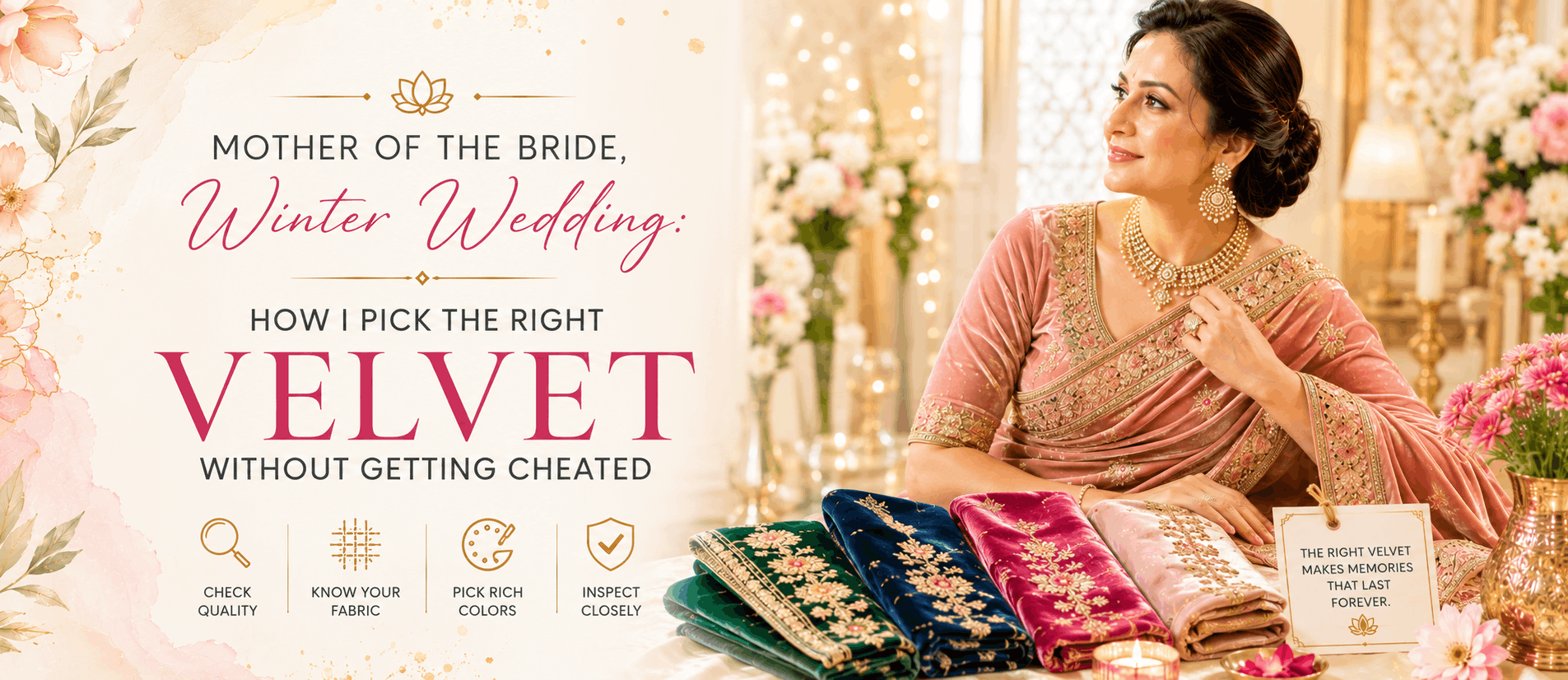
Mother of the Bride, Winter Wedding: How I Pick the Right Velvet Without Getting Cheated
Mother of the bride at a winter wedding is a specific fashion moment. You are in the invitation card, the varmala photos, the bidaai. Everyone looks.
Velvet is the go-to fabric because it reads rich in artificial light, holds embroidery beautifully, and works for both indoor and open-air winter weddings.
But velvet is also the fabric most often faked in the market. Polyester velvet is sold as silk velvet. Stretch velvet is sold as micro velvet. The difference costs you Rs. 3,000 per metre.
Here is what I check when a bride's mother walks into our shop asking for velvet.
Quick Answer: For mother of the bride at a winter wedding, buy micro velvet (240 GSM) or silk velvet (280 GSM) in deep wine, bottle green, plum, or midnight blue. Book fabric by early October if the wedding is in December.
Why velvet works for winter weddings
Velvet has a directional pile that catches banquet lighting in soft bands. That is why the mother of the bride in a wine velvet saree looks luminous in reception photos.
It also insulates. December weddings in Delhi drop to 8°C by 10 pm. Velvet keeps warmth without needing a shawl draped over the pallu, which ruins the drape.
The bad velvets — stretch velvet, crushed velvet, low-GSM velvet — do not hold pile direction. They look flat in photos.
Four velvet fabric picks for mother of bride
1. Micro velvet saree with dabka and sequin border
Best for reception, cocktail, or ring ceremony. Weight 220 to 260 GSM. Micro velvet has a shorter, tighter pile than silk velvet. Easier to drape, less likely to flatten under pin marks. Colour picks: wine, plum, deep coral.
2. Silk velvet anarkali or gown-style suit
Best for sangeet, mehendi, or family lunch. Weight 260 to 320 GSM. Silk velvet has a longer pile and richer sheen. Works better on gown-style silhouettes than saree drapes. Colour picks: bottle green, midnight blue, deep teal.
3. Panelled velvet lehenga with bandhani blouse
Best for mehendi, sangeet, or engagement. Panelled construction means the velvet is stitched in vertical panels instead of one flat sheet. Photographs slimmer. Colour picks: rust with bandhani blouse, mustard with red bandhani.
4. Two-tone velvet saree with zardozi border
Best for reception, evening puja, or family portrait. Two-tone means the pile direction is manipulated to show two shades — e.g., wine that reads plum in the pallu. Requires a skilled karigar to stitch. Book eight weeks ahead.
How to spot real vs fake velvet at the counter
Rub test. Real silk velvet feels cool to the touch. Polyester velvet feels warm.
Burn test (ask the shop for a corner scrap). Silk velvet burns and smells like burning hair. Polyester melts and smells chemical.
Pile direction. Sweep your palm one way, then the other. Real velvet shows a clear directional shine change. Fake velvet shows less.
Weight test. Silk velvet at 280 GSM feels heavy in the hand. Stretch velvet at "280 GSM" often weighs half that.
Mistakes I see at mother-of-bride buys
Buying too late. Karigars for zardozi and dabka work are booked by mid-October for December weddings. Give eight weeks minimum.
Ignoring the lining. Velvet needs a breathable cotton or raw silk lining. Polyester lining traps heat under banquet lights.
Matching the bride's exact shade. If the bride is in maroon lehenga, mother in deep wine is fine. Mother in the same maroon is not.
Skipping shoulder padding. Velvet is heavy. A weighted pallu will slip if the blouse shoulder is not reinforced.
Choosing the bride's palette. Mother-of-bride is a supporting frame. Deep jewel tones work. Pastels do not photograph as authoritative.
What velvet fabric costs in Delhi wholesale
Prices per metre for 44-inch width at Lajpat Nagar and Chandni Chowk wholesale. Retail differs by 25 to 40 percent.
| Velvet type | Per metre (Rs.) | Best use |
| Micro velvet (220–260 GSM) | 650 to 1,200 | Saree, anarkali, blouse |
| Silk velvet (260–320 GSM) | 1,400 to 2,600 | Gown, lehenga, statement saree |
| Dabka-embroidered velvet | 2,500 to 5,500 | Reception, family portrait |
| Zardozi-worked velvet | 4,500 to 9,000 | Mother-of-bride statement |
| Two-tone pattern-woven velvet | 3,200 to 6,500 | Sangeet, unique reception look |
Colour cheat sheet for mother of bride
- Deep wine — universally flattering, works with red and pastel bridal palettes.
- Bottle green — reads sophisticated, pairs with gold jewellery.
- Midnight blue — safest for silver or diamond jewellery.
- Plum — softer alternative to wine, works for older mothers.
- Rust with brocade blouse — mehendi or sangeet, warmer skin tones.
- Deep teal with zardozi — sangeet, evening cocktail.
Skip black (too formal for Indian weddings), pastels (fade under banquet light), and red (bridal-adjacent).
Ready to buy?
If the wedding is in November or December, this is the week to start narrowing velvet swatches. WhatsApp your palette and event dates to +91 96544 40244, or browse our silk velvet fabric for mother-of-bride online.
Boutique planning mother-of-bride packages for the December–February wedding cycle? Our wholesale velvet fabric desk stocks micro and silk velvet in the wedding-jewel-tone palette.
FAQ
How many metres of velvet do I need for a mother-of-bride saree?
5.5 metres of the base velvet saree plus 1 metre of contrast blouse fabric. If the saree is heavily embroidered, add another half metre for karigar cutting allowance. Total: 7 metres.
What is the difference between micro velvet and silk velvet?
Micro velvet has a shorter, denser pile at 220 to 260 GSM. Silk velvet has a longer, richer pile at 260 to 320 GSM and a silk warp. Silk velvet drapes fluidly and photographs richer. Micro velvet is easier to stitch and lighter to wear.
Can I wear velvet in a November Delhi wedding?
Yes. November evenings in Delhi run 10 to 15°C. Velvet works from November through February. In an October wedding, choose micro velvet (lighter GSM) instead of silk velvet.
How do I clean and store a velvet saree between events?
Dry-clean only, never home wash. Store rolled (not folded) on a padded hanger or rolled around a cardboard tube with a muslin wrap. Folding velvet creates permanent pile crease lines.
How long does mother-of-bride velvet stitching take?
Plain velvet saree with blouse: 10 to 14 days. With dabka work or zardozi border: 4 to 6 weeks. With full-body embroidery: 8 to 10 weeks. Book by October for a December wedding.
Paras Gallery Fabrics — Shop No. 06, Pushpa Central Market, Lajpat Nagar II, New Delhi 110024 · WhatsApp +91 96544 40244 · Support@parasgalleryfabrics.com