Woven vs Printed Motifs: Why Jacquard Feels Different
Woven vs Printed Motifs: Why Jacquard Feels Different
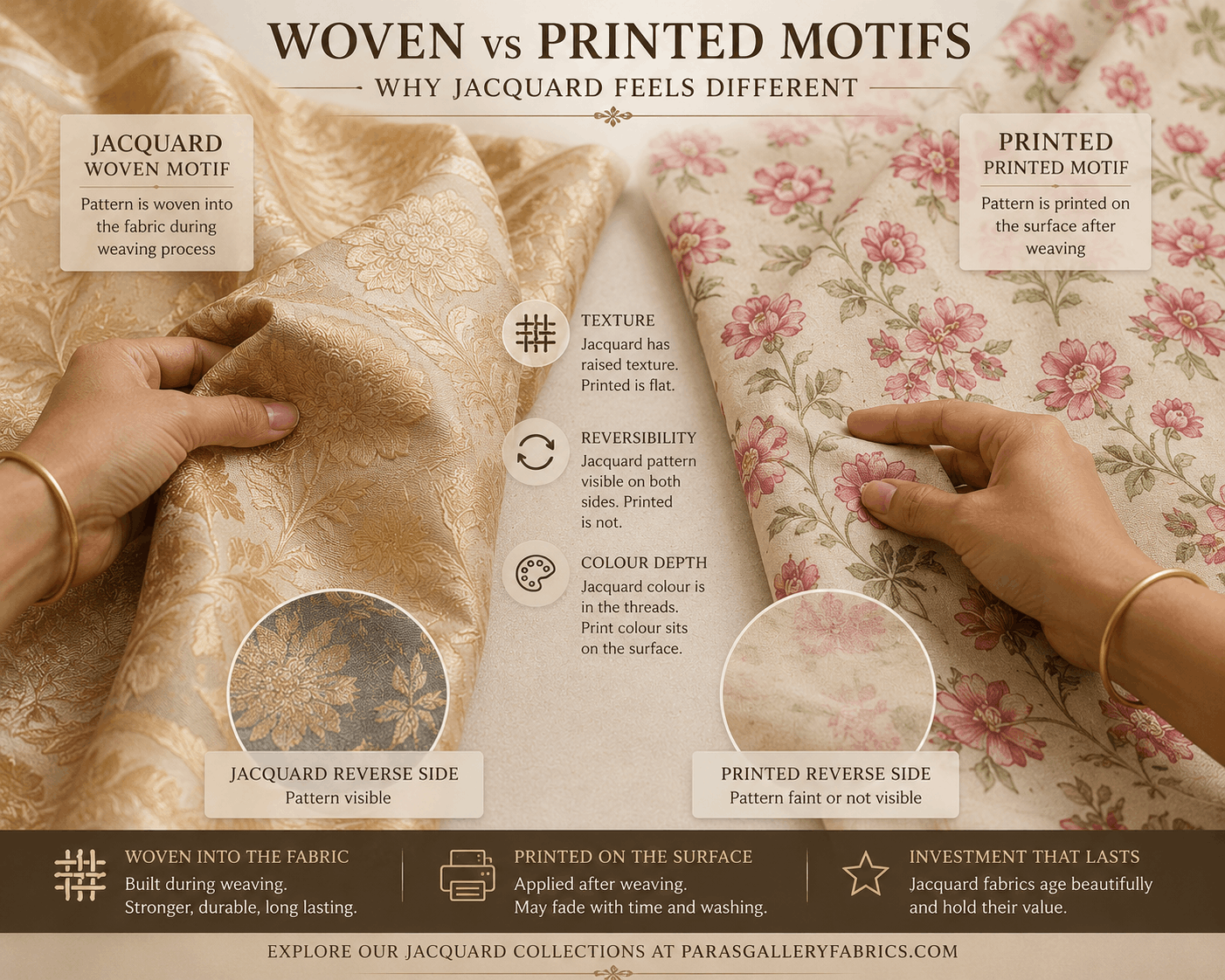
Jacquard is a fabric where the motif is part of the weave itself. The pattern is created by controlling which threads go over and under each other during weaving on a Jacquard loom. This is different from printed fabric, where a pattern is applied onto the surface of an already-woven cloth. In jacquard, the pattern has texture and structure. In printed fabric, the pattern is flat.
A customer last Tuesday brought two fabric pieces to my counter. One jacquard floral. One printed floral with what looked like the same design. She wanted to know why we priced the jacquard at Rs 1,400 per metre when the printed version was Rs 380.
Fair question. I have answered some version of it probably two thousand times over the years.
They are not the same fabric. Look identical in a WhatsApp photo maybe. Feel completely different in hand though. Drape differently. Age differently in storage. The price gap is not arbitrary markup. Once you understand the construction difference the gap actually makes obvious sense.
So here is the whole picture. Construction difference, what drives the jacquard price, when you should choose which one for which kind of project.

Jacquard fabric gets its pattern from the weaving process, not from printing or embroidery. A Jacquard loom, named after Joseph Marie Jacquard who invented the mechanism in 1804, uses punch cards (and now digital programming) to control individual warp threads. This allows complex motifs to be woven directly into the fabric. The result is a pattern with raised texture, dimensional depth, and colour on both sides of the fabric. Printed fabric has a flat pattern on one side only. Brocade is a specific type of jacquard with extra threads added for the motif.
What jacquard actually is
Jacquard is not a fibre.
Worth repeating that line because it confuses almost everyone the first time. Jacquard refers to the weaving mechanism, not what the threads are made of. So silk jacquard exists. Polyester jacquard exists. Cotton jacquard, viscose jacquard, blended jacquard, whatever combination at the base fibre level. The cloth is "jacquard" because of the loom that produced it.
The loom difference is genuinely interesting (at least to people in textile trade, possibly nobody else). A standard plain-weave loom raises and lowers groups of warp threads in fixed repeating patterns. Predictable. Fast. Makes uniform cloth that gets patterns added later through printing or embroidery.
A Jacquard loom raises and lowers each warp thread individually. Not groups, individual threads. Which means you can program the loom (Joseph Marie Jacquard's loom from 1804 was actually one of the earliest programmable machines in human history, predating computers by over a century) to weave any pattern directly into the cloth structure as the cloth is being made.
Pattern becomes part of the cloth. Not painted on top later. The threads themselves get arranged to create whatever motif is supposed to appear.
How printing works in comparison
Completely different principle.
You start with already-woven base cloth. Cotton or silk or georgette or crepe, anything finished. Then colour gets applied to the surface of that cloth through one of several printing methods.
Block printing pressed against the cloth using carved wooden blocks (this is what ajrakh plus kalamkari traditions use, both world-renowned crafts in their own right with their own heritage value). Screen printing pushes ink through a stretched mesh stencil. Rotary printing is the industrial version using cylindrical screens running at high speed. Digital printing is the newest method, treating fabric basically like an inkjet substrate for photo-quality detail.
In every printing method the colour sits on the fibre surface rather than in the weave structure. Which is exactly why printed cloth shows the pattern clearly on the front but the reverse side is either blank or shows just a faded ghost of what is on the front.
Quick note here. Block printing carries massive artisanal value in Indian textile heritage. Ajrakh from Kutch, kalamkari from Andhra, dabu from Rajasthan, these are not "lesser" than jacquard in any meaningful sense. Different construction approach. Different aesthetic. Different price point. Often equally valuable as cloth. So none of this comparison should suggest printing is somehow inferior craft. It is simply a different craft.
What you can actually feel between the two
Run your finger across jacquard cloth with your eyes closed.
The motif feels different from the background. Sometimes raised above the surface. Sometimes denser without being raised. Sometimes the threads cross at different angles creating subtle three-dimensional relief without any actual height change. Your fingers can detect these textural variations even when your eyes might miss them in good light.
Now try printed fabric with eyes closed. Nothing. No textural variation anywhere on the surface. Just smooth uniform cloth from edge to edge regardless of where the pattern is.
Flip both pieces over and look at the back. A jacquard piece shows the pattern on the reverse too, usually as a negative or with different colour distribution from the front but clearly visible. Because the pattern goes through the cloth. A printed piece has either a blank back or shows just a faded ghost of the front pattern. Because the print only ever touched the surface.
Colour over time tells the same story from another angle. Jacquard colour comes from the actual threads themselves. Different coloured threads were loaded onto the loom during weaving to create the motif design. Which means the colour is essentially permanent. It cannot wash off because it was never applied to the cloth as a separate layer in the first place.
Print colour, especially budget screen prints on synthetic base cloth, can fade visibly after maybe ten or fifteen washes. The dye is a coating sitting on top of the fibres and gradually erodes with repeated washing.
This is why your grandmother's Banarasi from her wedding in 1985 still looks the way it does in the photographs. The colour is in the cloth, not on top of the cloth.
Four jacquard varieties we stock
Organza jacquard. Crisp sheer base with a woven motif on top. Highest-volume request in our bridal and festive section by a long margin. Boutique designers buy it constantly. Lehenga panels are the main use case, dupatta borders are the next, saree bodies come up regularly too. The shared logic is wanting a pattern that catches light without adding weight to the garment. Our organza jacquard collection lists current festive options with pattern and colour details per bolt.
Silk jacquard. Heritage tier. Sometimes called kimkhab at the heaviest weights though that term gets used loosely in the trade these days.
Varanasi bunkar weaving community produces the world's finest silk jacquard. These are families that have been on the same kind of loom since their grandfathers' grandfathers were learning the craft. A complex pattern can take a skilled karigar an hour or more to weave for every centimetre of cloth produced. Per centimetre. That is the labour reality behind the price tag. Once you understand it the prices stop seeming unreasonable.
Our silk fabric collection carries silk jacquard for bridal lehengas and heritage sarees.
Polyester jacquard. Modern computer-controlled looms replicate most of the structural complexity of silk jacquard at a fraction of the original labour cost. Texture is similar to silk. Dimensional quality is similar. Fibre is synthetic though you would not always notice unless looking closely.
Polyester jacquard is the workhorse choice for boutique-walas plus designers running production batches across a whole collection. Washes more easily than silk too, which matters significantly for ready-to-wear lines where customers want low-maintenance clothing.
Brocade. Technically a sub-type within the jacquard family. The defining feature is extra weft threads (usually metallic gold or silver) added during weaving to create raised embossed motifs on the cloth surface. Banarasi brocade is the most recognised brocade form in Indian fashion. Our imperial brocade collection holds this heritage fabric category with weaver-cluster attribution per piece.
Why jacquard costs what it does
That price gap is not arbitrary markup. Real production expense drives it from multiple angles at once.
Programming a Jacquard loom for any new pattern takes considerable time plus weaving expertise. A complex floral motif can require hundreds of programming decisions before the very first metre of cloth comes off the loom. This setup expense gets distributed across however many metres of that particular pattern eventually get woven before the loom is reprogrammed for the next design. Limited-edition jacquards therefore cost more per metre because the setup expense amortises across fewer total metres of output. The actual weaving runs slowly compared to plain weave production because the loom is making thread-level decisions at every weft pass through the warp threads. This makes jacquard maybe five to ten times slower per metre than plain cloth of equivalent fibre. Labour cost per metre rises in direct proportion to this slowdown. On top of those two factors, raw material handling adds expense because specific thread colours need to be loaded onto the loom in correct sequences plus used precisely per the program. Wastage runs higher than plain weave production at the pattern transitions where colour changes happen.
So when you see jacquard priced significantly above printed fabric with what looks like a similar motif, you are paying for the loom programming time, slower weaving labour at the karigar bench, plus material precision throughout production. Real costs. Not snob appeal.
How to choose between jacquard and printed
Depends on the use case. Honest answer.
Heavy bridal pieces. Anniversary sarees. Anything meant to be worn three or four times across many years and possibly handed down. Jacquard becomes the right investment for these.
Colour does not fade across decades of careful storage between functions. Pattern retains its texture through repeated wears. Cloth ages gracefully without looking obviously dated or worn out, which matters enormously for pieces meant to last. Our bridal bliss collection carries jacquard specifically suited to bridal commissions across budget brackets.
Festive kurtas where the wear cycle is shorter. Casual occasion wear. Experimental silhouettes where you want pattern variety without committing major budget. This is where modern printed fabric makes more sense. Digital printing has come a long way over the last decade. Good base cloth with quality digital printing looks beautiful in photographs and holds up to ten or fifteen wearings before fading becomes visible.
Boutique production batches across a collection? Jacquard offers consistency between metres that hand-printed alternatives just cannot match reliably. Pattern stays essentially identical from one end of the bolt to the other end because the loom produced it mechanically. Screen prints can show subtle batch-to-batch variations that look fine individually but create real headaches when garments cut from different batches need to match precisely.
Boutique inventory teams should request samples through our bulk order page before bolt-level commitments.
FAQ
What is the main difference between jacquard and printed fabric?
Jacquard pattern is woven into the cloth structure during weaving. Texture you can feel. Visible on both sides. Surface-printed fabric has its pattern applied to already-woven base cloth using ink or dye. Flat to touch. Visible mainly on the front, plain or ghosted on the back.
Is jacquard fabric good for lehengas?
Excellent for lehengas. Jacquard's woven structure gives natural body to the skirt which helps the kali panels flare correctly. You get visual interest without needing the weight of additional embroidery work. The organza variant is especially popular for lehenga panels because the sheer base keeps the overall garment light while the woven motif catches light beautifully whenever the wearer moves.
How do I care for jacquard fabric at home?
Care requirements come from the base fibre, not from the jacquard weave itself. The polyester variety tolerates a gentle delicate-cycle machine wash. Pure silk jacquard needs hand washing in cold water using the same method appropriate for any silk piece. Jacquard's actual weave is structurally robust because it is part of the cloth itself rather than being a vulnerable surface addition.
What is the difference between brocade and jacquard?
Brocade is a sub-type within the jacquard family. Specifically the type where extra weft threads, usually metallic gold or silver, get added during weaving to create raised embossed motifs on the surface. Jacquard as a broader category includes brocade alongside damask, woven florals, plus other designs where the pattern is woven into the cloth rather than applied to its surface afterwards.
Can I find jacquard fabric for sarees?
Yes. Pure silk Banarasi jacquard sarees are central to that weaving tradition and remain very much in demand for weddings plus festivals across India. Hand-woven Banarasi pieces particularly hold value across generations of family use. Sheer organza jacquard variants are also widely used for saree bodies where the requirement is a lightweight base with a woven pattern rather than embroidery or surface prints.
Final word from the counter
The choice between jacquard and printed fabric is not about one being objectively better.
Both have legitimate use cases. Both belong in a well-stocked fabric inventory. The right choice depends entirely on how the finished garment will be worn and how often.
Worn three or four times in twenty years? Jacquard is the investment that holds. Worn twenty times in two years? Printed fabric is the practical choice. That price gap reflects real production effort in either direction. Matching the cloth to the wear cycle is the only sensible buying strategy.
What I tell every customer at this counter is to match the cloth to the wear cycle. Heritage cloth for heritage-grade occasions. Printed cloth for everything else. Both decisions can be the right one in the right context. Neither one is inherently superior to the other as cloth.