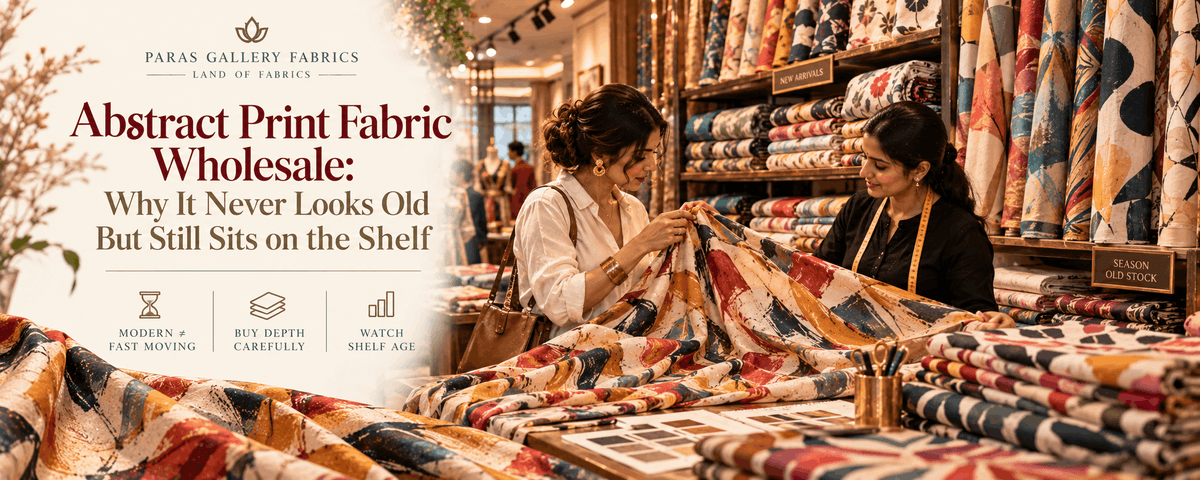
Abstract Print Fabric Wholesale: Why It Never Looks Old But Still Sits on the Shelf
Wholesale Reference Guides · 5 minute read · Updated 24 September 2026
Abstract print never goes out of fashion. That sounds like good news. It is also the reason it sits.
A buyer in Chandni Chowk once told me his abstract stock never goes out of fashion. He did not mean it as a compliment. The pieces had been there two years. No fading. Nothing looking dated. Nobody had ever walked in and asked for them either.
Abstract is safe in one way. It is risky in another. Most buyers only see the safe part.
Here is the simple version. A customer cannot ask for something she has no word for.
Four things an abstract piece has to do for you:
- Stay current without a flower or a trend to date it
- Still look right after it is cut, wherever the print lands on the body
- Give a colour customer something better than a plain
- Earn its quantity even though nobody reorders it by name
Look at the base colour first. Look at the shapes second. That one change fixes most abstract buying.
Quick answer: Abstract print does not go out of date, because it does not copy anything real. So it fails in two other ways. First, customers cannot describe it, so they rarely ask for it again. Second, the shapes are irregular, so the print lands differently on every body. Buy abstract by its base colour rather than by the design. Keep a wide range of shades with a small quantity in each.
Why abstract never goes out of date
A flower looks like a flower. A paisley comes from a tradition. The customer compares both to something she has already seen. That is how a design starts to look old to her.
Abstract copies nothing. There is nothing for her to compare it to. So it stays current for years. On a slow shelf that is a real advantage.
But it costs you something. Nothing about an abstract piece says buy me today. She likes it. She can just as easily buy it next month. So she leaves without it.
Customers cannot name it, so they cannot reorder it
Listen to how a customer points at cloth. She says the one with small flowers. She says the check. She says the paisley.
Those words matter more than you think. They are how she asks for it a second time. They are how she describes it to her sister. They are how she orders it on the phone.
With abstract she is stuck. She says the blue one with the shapes. That could be twenty pieces on your shelf. The first sale still happens while she is standing there. The second one usually does not.
This changes how you should buy. Abstract will not build repeat demand by name, so quantity cannot be based on that. It has to be based on colour instead. Buyers keep abstract because a shade keeps selling, not because a design keeps selling.
If you want prints customers can actually name, the conversational prints customers can name on sight sit right next to this family.
Where the print lands after it is cut
A regular design repeats evenly. You can see where the next motif will fall. An abstract design does not. The shapes are irregular, so the same piece can give you a clean garment for one customer plus an odd one for the next.
The design is not the problem. The problem is where a heavy patch of colour lands on the body. Buyers who get caught by this once start checking it before they check the rate.
Buy the colour, not the design
Most buyers look at abstract the way they look at a painting. They study the shapes, because the shapes are the interesting part. For selling, that is the wrong way round.
On this family the base colour makes the sale. A customer picks up a mustard abstract because she came in wanting mustard. The design only gives her a reason to feel it is not a plain.
So sort a bundle by colour before you sort it by design. Two abstracts in the same shade will fight each other on your shelf, even if the designs look nothing alike.
Three simple shelf rules:
- One piece per colour, in the shades you already know sell
- Never two abstracts in the same shade. They split one sale
- More colours earns more than more designs in one colour
How much to buy
Abstract stays current, so there is no reason to buy thin. It does not get reordered by name, so there is no reason to buy deep. Most buyers get stuck between the two.
Think of it this way instead. Abstract has one job. When a customer walks in wanting a colour, it gives her something better than a plain. That job needs many shades. It does not need depth in any one design.
So buy wide plus shallow. One piece per shade, in the colours you know move. Ask for running availability rather than taking it all at once. Our abstract range laid out shade by shade is arranged for exactly this kind of colour-first buying.
What to do at the counter
- Before you go: write down which colours sold fastest for you last season
- Step 1: sort the bundle by colour. Ignore the designs completely
- Step 2: keep one piece per colour. Put the extras aside instead of arguing over them
- Step 3: fold each one to panel width, hold it against a body, drop any where a heavy patch keeps landing on the chest or hip
- Step 4: turn each piece upside down. If your eye objects, it can only be cut one way
- Then fix quantity: small in every colour, with more held for you rather than one big lot
Questions buyers ask at the counter
Can abstract print be cut both ways?
Usually yes, which is a real advantage. There is no stem, no sky, no object, so most abstracts can be turned upside down without anyone noticing. Your tailor can then fit the panels any way he likes. The exceptions are wide brush strokes that clearly run one way. Turn a piece over and look before you assume.
Why does abstract sit longer than printed florals?
Because there is no hurry to buy it. A festive floral tells the customer to buy before the season ends. Abstract tells her nothing, so she waits. That is not a quality problem. It is just how a design with no deadline behaves. Treat it as stock you carry all year, not stock you clear in a season.
How do I check the print without cutting the piece?
Fold it to about the width of your front panel. Hold it against a body from shoulder to hem. Move it up and down slowly. You are watching for a heavy patch that keeps arriving at the chest or the hip. If it does that in two or three positions, use that design on a longer garment instead.
Should I buy two abstracts in the same colour?
Usually not. The colour is doing the selling here, so two pieces in the same shade will split one customer's decision instead of making a second sale. Spend that money on another colour you know moves.
What should I bring to the counter?
Your colour record, not your taste. Abstract is the one print family where a list of last season's fastest-selling shades will pick better pieces than your eye will.