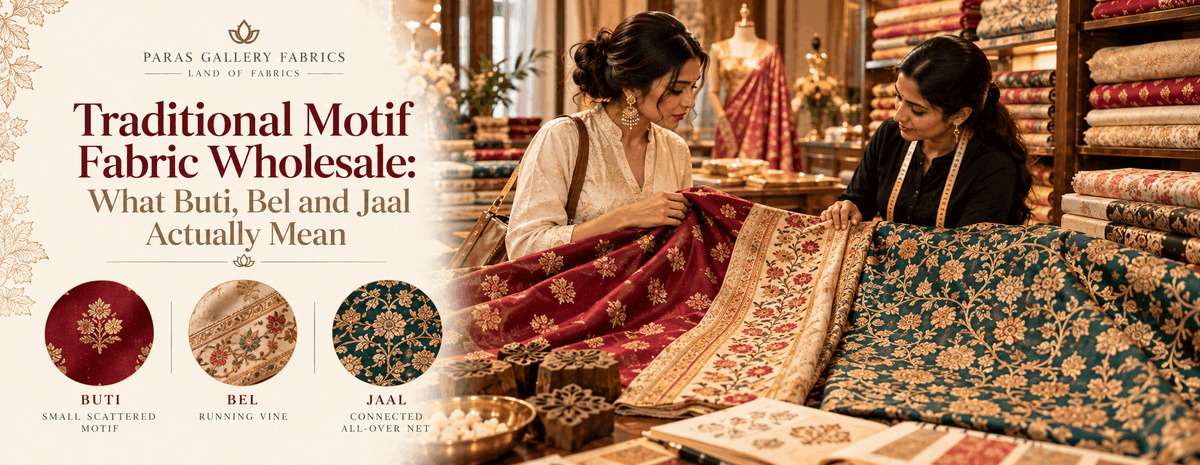
Traditional Motif Fabric Wholesale: What Buti, Bel and Jaal Actually Mean
Wholesale Reference Guides · 5 minute read · Updated 23 September 2026
These words are not design names. They tell you how the motifs sit on the cloth. That decides what you can cut from it.
A boutique owner in Rohini once asked me for forty metres of traditional print in maroon. That is exactly what she got. It was no use to her. She wanted to cut short kurtis, which that particular cloth could never have given her.
Nobody made a mistake. She asked for a type of motif. She got a type of motif. The word she left out was the one that mattered.
Traditional prints come with their own vocabulary. Most buyers use these words loosely. Then they pay for it.
One word on your order decides four things:
- Whether the cloth cuts freely or only one way
- Which garment you can make from it, before you measure a metre
- Where the heavy work sits: along an edge, across the whole cloth or in one corner only
- How much you are paying for plain cloth rather than design
Say the layout word next to the colour. That one word does more for you than any bargaining over rate.
Quick answer: Buti means small motifs spread apart on open cloth. Buta means one bigger motif standing upright with space around it. Bel means motifs joined in a line, like a creeper along one edge. Jaal means motifs joined all over into a net. These four words tell you how to cut the cloth plus what you can make from it. An order that says only the colour plus the word traditional has left out the important half.
Why the word traditional tells you almost nothing
On a floral or an abstract, the design word does real work. It tells you roughly how the cloth looks plus who will want it. With traditional it tells you neither.
Traditional covers paisley, mango, lotus, temple shapes, creepers plus a dozen regional designs. Any of them can be arranged in half a dozen different ways, on any base cloth.
So two pieces can both be honestly called traditional maroon print. One cuts into anything. The other only makes a saree. At the counter, never ask what motif is this. Ask how the motifs are sitting.
The six words, in plain English
Every one of these is used daily in Delhi wholesale markets. It takes about a week to get comfortable with them. After that they save you years of arguments.
Add one of those words to your next order. What arrives will be closer to what you wanted than any rate discussion could have got you.
Traditional stock does not go stale
A trend print has a deadline. You buy it knowing you must sell it before the season ends. That is what makes trend buying stressful.
Traditional works differently. A paisley that sold last year is not embarrassing this year. Your customer does not read it as a season. She reads it as something she already trusts.
This changes your quantity maths completely. A design that sold well can be ordered again without any awkwardness. Unsold stock goes back on the shelf at full rate. You rarely need a sale to clear it.
So the mistake here is almost never buying too much. The mistake is buying too few layouts. Then half your customers find nothing that suits the garment they came in for.
One more thing worth knowing. These same words are used for woven cloth as well. When a customer wants the design inside the fabric rather than printed on top, Banarasi brocade woven with the same traditional motifs gives her that without changing the vocabulary.
What actually goes wrong with traditional prints
Because it never looks dated, buyers assume it cannot fail. It can. The problem is drawing quality, which is harder to spot than a dated trend.
A traditional motif is a copy of a copy of a copy. Every time it gets traced again, the drawing loses a little sharpness. After enough rounds, a paisley stops looking like a paisley. The customer just sees a shape she cannot place.
So look at one motif closely instead of the whole piece. The detail inside should still be clearly separate from the outline. If the inside has blurred into the outside, that design has been copied too many times.
The second problem is size. Sometimes a buti is enlarged to make the cloth look richer, but the spacing stays the same. Now it is crowded instead of spread out, which cuts badly on small pieces. Our traditional range grouped by how the motifs sit is arranged so you can compare layouts directly instead of one piece at a time.
What to do at the counter
- Say the garment first: tell them what you are cutting before you say a colour. Then nothing useless gets shown to you
- Say the layout word: buti, buta, bel, jaal, konia or pallu goes on the order next to the shade
- Look at one motif: the inside detail should still be separate from the outline
- Check the spacing: a big motif with tight spacing is crowded, not rich
- Turn it upside down: a standing buta usually looks wrong, which means a one-way cut
- On a repeat order: hold an old motif next to a new one before you confirm
Questions buyers ask at the counter
What is the difference between buti and jaal?
Spacing. Buti means small motifs sitting apart, with open cloth showing between them, so the fabric looks light. Jaal means those motifs joined together into a net that covers the cloth, so it looks rich. At the same colour, jaal will always look heavier on the body. That matters if you are buying for daily wear rather than functions.
Can I use bel for a plain kurti?
Only if the kurti has a border or a hem you want to show off. Bel runs along one line. Cut across it and the creeper travels sideways up the body, which looks like a mistake. If your customer likes that design, ask for a buti version of the same drawing instead. It looks the same to her, plus your tailor gets full freedom.
How do I know if a motif is well drawn?
Look at one motif, not the whole piece. The detail inside should be clearly separate from the outline. If they have blurred together, the design has been traced too many times, so your customer will see a shape she cannot name. This is the main quality issue with traditional prints, because age itself is not a problem here.
Can I reorder a design I sold last season?
Usually yes, which makes this family easier than any other. Your customer does not treat a paisley or a lotus as last year's fashion. Just check that the new lot is drawn as well as the old one, because designs get retraced between runs. Hold one motif from each next to the other before you confirm.
What should I say when I place the order?
The garment first, then the layout, then the colour. A counter that knows you cut short kurtis will never show you a konia. A counter that only knows you want maroon traditional will show you everything, which is how forty metres of the wrong cloth gets bought politely.