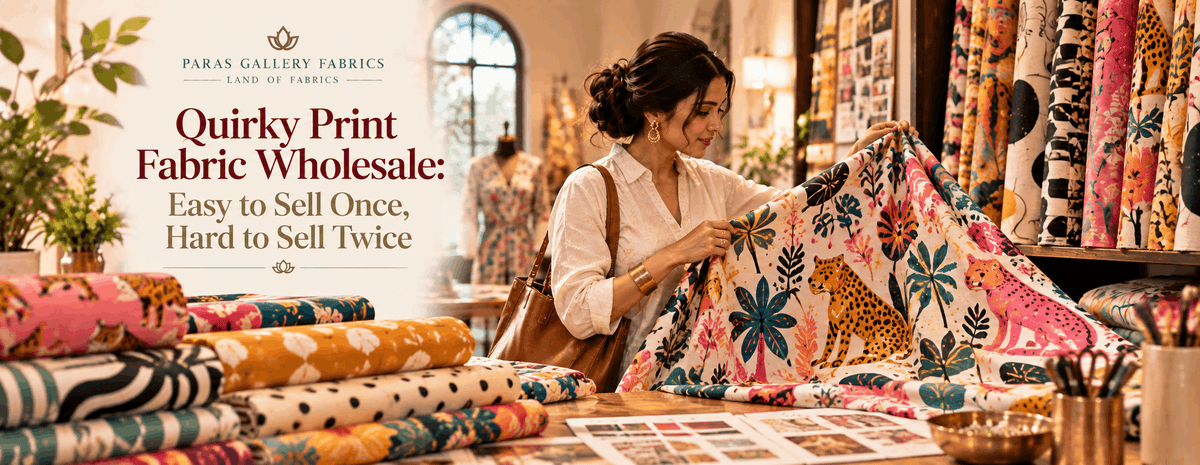
Quirky Print Fabric Wholesale: Easy to Sell Once, Hard to Sell Twice
Wholesale Reference Guides · 5 minute read · Updated 24 September 2026
Cats, teacups, lemons, rickshaws. Quirky prints sell on sight. The trouble starts on the second roll.
A boutique owner from Lajpat Nagar once cleared a whole cat print in ten days. She ordered the same design again straight away. The second lot took four months to go. Nothing was wrong with the cloth. Her customers had simply seen it already, on each other.
That is the whole story of quirky print in one shop. It is the easiest motif to sell the first time. It is also the fastest to wear out.
Abstract print is the motif nobody can name. Quirky is the opposite. Everybody can name it. That changes how you should buy it.
Four things a quirky piece has to do for you:
- Make a customer smile the moment she sees it on the shelf
- Still look good once the tailor has cut it, wherever the motif lands
- Sell out before every woman in her circle owns it
- Leave room on your shelf for the next design
Buy many designs. Buy little of each. Never buy the same one twice in a season.
Quick answer: Quirky print (also called conversational or novelty print) shows a real, fun object such as an animal, a fruit or a vehicle. Customers can name it, so it sells quickly and gets asked for by name. The same thing makes it wear out fast, because a small circle of customers soon sees it everywhere. Buy it wide and shallow: many designs, small quantity in each. Check motif size and print direction before you fix quantity.
Why quirky sells so fast
A customer walks past a rack. She sees a print full of tiny mangoes. She laughs. She picks it up. That is a sale most other prints cannot make.
It also travels by word of mouth. She tells her friend about the mango one. The friend walks in and asks for it by name. You never get that with a plain or an abstract.
So quirky pulls people in. Many buyers keep a few pieces for this reason alone, even if they are not the biggest earners. A fun print in the window gets a customer through the door. Then she buys what she came for too.
Why it wears out just as fast
The same name that sells it also tires it. Once three women in one office wear the cat print, the fourth does not want it. She does not want to look like a copy.
Plain colours never have this problem. A navy kurti looks like a navy kurti. A lemon print looks like that lemon print. It is memorable, so it gets noticed as a repeat.
This is why a second lot of a hit design is risky. The first lot found the customers who wanted it. The second lot is looking for customers who have already seen it on someone else.
If you want a print family that behaves the other way, the abstract prints that stay current for years balance a quirky shelf well. One brings people in. The other waits patiently for the right colour customer.
Four kinds of quirky print, four different risks
Not every quirky print behaves the same after cutting. The size of the motif decides most of it. Whether it has a top plus a bottom decides the rest.
That last check sounds obvious. It still catches buyers every season. A cheerful print can carry a word that means something rude in another language. It can also carry a symbol that some of your customers hold sacred. Read the whole design before you buy it, not just the part facing you.
Check the base cloth, not just the print
Quirky print is casual wear. Your customer will wash it often. So the cloth under the print matters as much as the motif on top.
Most quirky designs arrive on cotton, rayon, muslin or crepe. Rub the printed side firmly with a damp white cloth. If colour comes off, it will come off in her first wash too. Then bend the fabric sharply. A cracked or stiff print will feel worse after stitching.
Three simple shelf rules:
- One small lot per design. More designs beats more of one design
- Never two animal prints side by side. They split one customer's choice
- Move a quirky piece to the window after two weeks. A new wall gives it new eyes
How much to buy, plus when to stop
Think about how many customers you really have who dress playfully. Now think about how many of them know each other. In a small town or a tight market, that circle is small. Your quantity should match it.
So buy wide plus shallow. Take many designs. Take a small lot of each. When one sells out quickly, do not rush to repeat it. Buy a new design in the same spirit instead. A mango print sold well? Try a cherry next, not more mangoes.
The one time a repeat makes sense is when customers ask for it by name who have not bought it yet. That is real demand. A fast sell-out alone is not. Our quirky print range changes often for exactly this reason, so there is usually something new to rotate in.
What to do at the counter
- Before you go: list which quirky designs you already hold, so you do not buy a near twin
- Step 1: sort the bundle by motif size, small to big
- Step 2: turn each piece upside down. Mark the one-way designs
- Step 3: hold the big motifs against a body at panel width. Drop any that land badly
- Step 4: read every word plus look at every symbol in the print
- Step 5: rub test with a damp white cloth
- Then fix quantity: small in each design, many designs, no repeats of last season's hits
Questions buyers ask at the counter
What is the difference between quirky print and conversational print?
Nothing much. Both mean a print showing a real, fun object like a cat, a cup or a scooter. Quirky is the word most Indian shops use. Conversational is the older textile trade name, because the print starts a conversation. Novelty print means the same thing too.
Should I reorder a quirky design that sold out fast?
Usually not. A fast sell-out means you found the customers who wanted it. A second lot has to find new ones, while the first buyers are already wearing it around town. Reorder only if people who have not bought it yet are asking for it by name.
Who buys quirky print?
Mostly younger customers plus working women who want a casual kurti or a co-ord set that feels light. Mothers buy it for children's wear. Some buy it for night suits. It is rarely a festive or wedding fabric, so keep it away from your occasion shelf.
Does a one-way print need more fabric?
Yes. The tailor cannot turn panels to save cloth, so every piece must face the same way. Tell your customer to add a little extra length. If you sell cut lengths, mark one-way designs on the tag so nobody comes back short.
How do I keep a quirky shelf fresh?
Rotate it. Bring in a few new designs often, rather than many at once. Move older pieces to a new spot in the shop. A regular customer should see something new on that shelf almost every visit.