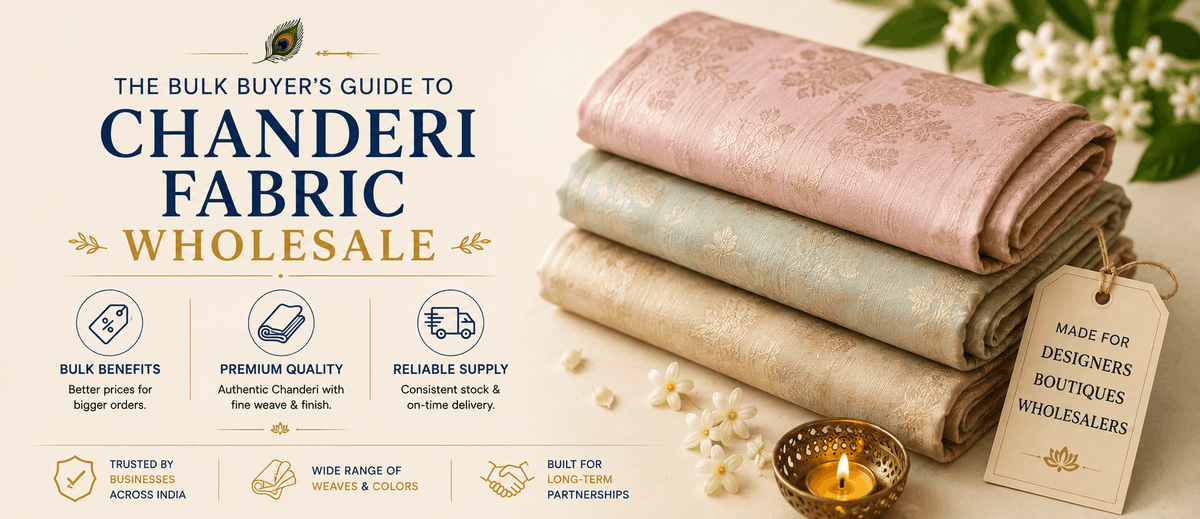
The Bulk Buyer's Guide to Chanderi Fabric Wholesale
A reseller once showed me a bill for forty metres of what the seller had written as chanderi. The rate was Rs 62. She wanted to know why her customers were returning the dupattas saying the fabric felt plasticky. I held one piece up against my counter light. The ground was too even. The buti was printed on, not woven in. I burnt a thread from the selvedge and it curled into a hard bead instead of turning to ash. She had bought a polyester imitation at a fair polyester price under a chanderi name.
That happens more with chanderi than with almost any other fabric on the counter, because the word sells and the real thing is hard to fake only if you know what to look for. So here is the reference I give bulk buyers before they book chanderi.
Quick answer: Buying chanderi fabric wholesale means purchasing by the thaan at trade rates. Genuine chanderi is a fine sheer fabric woven in Chanderi in Madhya Pradesh, most often as a silk cotton mix with a glossy transparent ground and woven buti. Delhi trade rates run roughly Rs 90 per metre for cotton chanderi up to Rs 900 for pure silk handloom. Rates fall as your thaan count rises.
What genuine chanderi is against what the market sells under the name
Chanderi takes its name from a weaving town in Madhya Pradesh. The cloth carries a geographical indication, which means the name legally belongs to fabric woven there. What makes it recognisable is the yarn. Traditional chanderi uses a very fine unbleached or lightly degummed yarn that keeps its natural gloss, so the finished cloth looks glassy and stays transparent even at a decent count. That transparency is the point of the fabric rather than a defect in it.
The second identifying feature is the buti. On real chanderi the small motifs are woven into the ground using extra weft, often in zari or in contrast cotton. Turn the cloth over and you will find the motif on the reverse too, with the small float threads visible. On an imitation the buti is printed or embroidered onto a plain sheer base, so the reverse stays blank.
What the wider market sells as chanderi covers a much broader range. Some of it is honest powerloom chanderi woven outside the town on the same construction principle, which is a perfectly usable fabric at a lower rate. Some of it is a polyester or poly-viscose sheer with a chanderi look and no chanderi content. Both have their place in a price list. Neither should be billed to you as pure chanderi. If you are buying greige chanderi to dye in house, that is a separate calculation involving shrinkage and dye uptake, so treat it as its own line rather than mixing it into a finished goods order.
Chanderi qualities worth stocking at wholesale
This is the comparison sheet I run through with new bulk buyers. Choose by the garment and the customer, not by the rate line alone.
| Chanderi quality | Composition | Hand feel and body | Best garment use | Delhi trade price (per metre) |
|---|---|---|---|---|
| Cotton chanderi | Cotton warp and weft | Matte, crisp, least sheer | Summer kurtis, daywear suits | Rs 90 to Rs 150 |
| Silk cotton chanderi | Silk warp with cotton weft | Glossy, sheer, light body | Dupattas, suit sets, light sarees | Rs 180 to Rs 350 |
| Pure silk chanderi | Silk warp and weft | Highest gloss, fluid fall | Occasion sarees, bridal dupattas | Rs 400 to Rs 900 |
| Embroidered chanderi | Silk cotton base with thread work | Sheer with worked weight | Festive suits, layered dupattas | Rs 250 to Rs 600 |
| Chanderi-look poly blend | Polyester or poly viscose | Sheer but slick, less breathable | Volume dupattas, price-led lines | Rs 55 to Rs 95 |
These bands reflect Delhi wholesale rates as of this week for standard 44 to 46 inch widths. Silk yarn rates move with the season, so treat them as a working band rather than a fixed number. You can compare shades and buti patterns against live running stock in our chanderi fabric collection before you block a colour.
Five counter checks before you commit a thaan
Every one of these takes under a minute at the counter. Together they tell you exactly what you are buying.
- Burn one selvedge thread. Silk and cotton turn to soft ash with a smell of burnt hair or burnt paper. Polyester melts into a hard bead. This settles the composition argument in ten seconds.
- Turn the buti over. Woven buti shows on the reverse with visible float threads. A blank reverse means printed or embroidered motifs on a plain sheer base.
- Hold it against the light and read the ground. Genuine chanderi looks glassy with a slightly uneven yarn. A perfectly uniform ground with a flat white glow usually means a mill sheer.
- Crush a corner in your fist for ten seconds. Cotton chanderi creases and holds the crease. Silk cotton creases and recovers partly. A poly blend barely creases at all.
- Ask for the shrinkage figure and get it on the bill. Cotton-weft chanderi can pull in noticeably after the first wash. If your tailor cuts to size without allowance, every set comes back short.
Minimum order quantity, rate bands and boutique margin
This is the structure most Delhi suppliers work with, ours included. It is worth understanding before you negotiate, because on handloom goods the discount sits in quantity and in lead time rather than in argument.
| Order tier | Typical quantity | Rate movement | Who it suits |
|---|---|---|---|
| Sample cut | 1 to 5 metres | Retail rate | Designers matching a shade |
| Small bulk | 1 thaan (about 18 to 22 m) | 5 to 10 percent off retail | Boutiques running one suit design |
| Trade bulk | 5 to 20 thaans | 12 to 20 percent off retail | Resellers, repeat ethnic labels |
| Loom booking | 30 thaans and above, one buti | Weaver-linked rate on request | Exporters, labels with a signature buti |
The margin habit that works on chanderi is booking early against your festive calendar. Handloom output is limited by loom time, so a custom buti or a deep shade quantity needs weeks of notice rather than days. Buyers who place their Diwali and wedding season chanderi in the monsoon months get both the rate and the quantity. Buyers who wait until the season starts pay a markup for whatever is already on the shelf.
Stitching chanderi without losing the fabric's character
Chanderi is sheer by design, so lining decisions make or break the finished garment. A chanderi kurti needs a lining or a slip underneath for most customers, but the lining must be lighter than the chanderi itself. Attach a heavy cotton lining and the drape dies, which is exactly the drape your customer paid for.
For a dupatta, leave it unlined and finish the edge with a fine rolled hem or a narrow piping. A thick border on a sheer chanderi dupatta drags the whole piece out of shape. Use a fine needle in the machine too. A thick needle leaves visible holes in a low-density sheer ground that no press will close. Tell your tailor to pre-wash a metre if the chanderi carries a cotton weft, because shrinkage after cutting is the single most common chanderi production loss.
Where chanderi earns its keep in a boutique line
Its strongest use is the dupatta. A silk cotton chanderi dupatta lifts a plain cotton or plain rayon suit into a complete set for very little added cost. The sheer body means it drapes over the shoulder instead of sitting stiff. That single application is why chanderi turns over faster than most sheer fabrics on the shelf. You can see the range buyers build sets around in our dupatta collection.
The quieter earner is the transitional season suit. Chanderi is light enough for late summer while looking finished enough for early festive weeks, so it fills the gap between cotton season and heavy fabric season. Cotton chanderi is the value entry point for daywear lines while pure silk chanderi holds a place at the occasion end for buyers whose customers ask specifically for handloom.
Common mistakes bulk buyers make with chanderi
- Paying a chanderi rate for a poly sheer. Burn one thread before you book. It takes ten seconds and saves the whole lot.
- Accepting printed buti as woven buti. Check the reverse. Printed motifs are fine at a printed price, not at a handloom price.
- Cutting without a shrinkage allowance. Cotton-weft chanderi pulls in after the first wash and a short set cannot be fixed.
- Lining chanderi with heavy cotton. The drape is the product. A heavy lining removes the reason your customer chose the fabric.
- Ordering handloom shades late. Loom time is finite. Book your festive shades months ahead rather than weeks.
Questions bulk buyers ask me at the counter
How do I identify pure chanderi fabric?
Burn a selvedge thread first. Silk and cotton turn to soft ash while polyester melts into a hard bead. Then turn the buti over. Genuine chanderi carries woven motifs visible on the reverse with float threads. Held to the light the ground should look glassy with a slightly uneven yarn rather than flat and uniform.
What is the difference between silk cotton chanderi and cotton chanderi?
Silk cotton chanderi uses a silk warp with a cotton weft, which gives it gloss, more sheerness and a softer fall. Cotton chanderi is cotton throughout, so it is matte, crisper and less transparent. Cotton chanderi suits daywear kurtis while silk cotton is the dupatta and suit set choice.
What is the minimum order for chanderi fabric wholesale?
Trade rates usually start at one full thaan of about 18 to 22 metres. Below that you pay close to retail. The sharper 12 to 20 percent trade band typically opens at five thaans or more. Custom buti or loom-booked shades generally start at 30 thaans with a longer lead time.
Does chanderi fabric shrink?
Any chanderi with a cotton weft can pull in after the first wash. Pure silk chanderi moves far less. Ask for the shrinkage figure in writing and have your tailor pre-wash a test metre before cutting a production lot, because a short stitched set cannot be recovered.
Ready to order chanderi at trade rates?
If you run a boutique, a label or a reselling line, the fastest way to lock trade pricing is to join the wholesale programme. You get thaan rates, shade booking against your season calendar and loom booking for signature buti work. See the tiers and register on our wholesale fabric page to start your first bulk chanderi order.