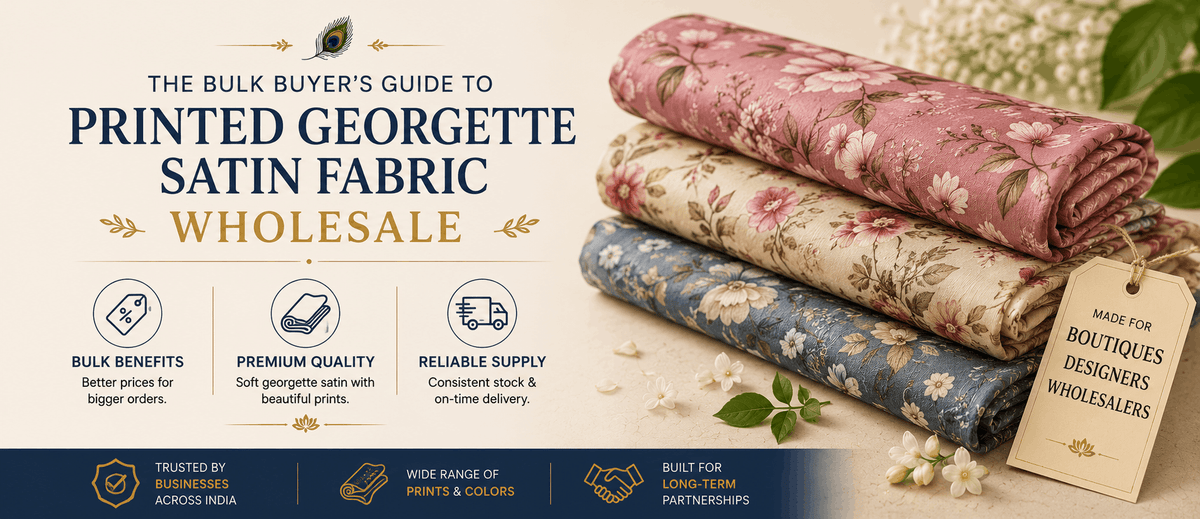
The Bulk Buyer's Guide to Printed Georgette Satin Fabric Wholesale
A boutique buyer came back to my counter last season holding two saree pieces cut from what she believed was the same design. Same floral. Same colourway on the swatch card. On one piece the print sat crisp on the surface. On the other the outlines had feathered slightly and the ground colour looked washed. She had booked two thaans a month apart from two different sources. One was rotary printed. One was digital. Nobody had told her the difference mattered.
That is the whole problem with printed georgette satin at wholesale. Buyers select the design and forget to select the print. So here is the reference I walk bulk buyers through before they block a printed lot.
Quick answer: Buying printed georgette satin fabric wholesale means purchasing by the thaan at trade rates. The base is a georgette woven with a satin face, generally running 90 to 130 GSM, then printed by digital, rotary or screen method. Delhi trade rates run roughly Rs 120 to Rs 320 per metre depending on print method and repeat size. Rates fall as your thaan count rises.
Why a print behaves differently on a satin face
Plain georgette has a grainy crepe surface. Light scatters off it, so a print looks matte and slightly softened. Georgette satin carries the same crinkled georgette body but the weave floats yarn across one face, which makes that face smooth. Light bounces instead of scattering. The same ink, the same design, the same colour recipe now reads glossier with deeper contrast.
Two working consequences follow from that. First, the satin float rewards fine detail. Small buti work, thin outlines and shaded gradients that would blur on plain georgette hold their edges here. Second, the satin float punishes sloppy printing just as visibly. A misregistered outline or an ink flood shows up on the glossy face where a matte georgette would have hidden it.
One more distinction worth carrying to the counter. Printed georgette satin is not printed satin. Printed satin is a smooth satin fabric right through the body, so it falls heavier with less movement. Printed georgette satin keeps the georgette bounce underneath the shine, which is why it drapes for a saree instead of standing like a gown fabric.
Print methods and what each one costs you at volume
This is the sheet that saves buyers money. Choose the print method by your order size, not by the sample that looks prettiest under shop lights.
| Print method | Detail quality | Works best at | Watch out for | Delhi trade price (per metre) |
|---|---|---|---|---|
| Digital print | Highest, unlimited colours | 1 to 10 thaans, many designs | Surface-sitting ink if not cured well | Rs 210 to Rs 320 |
| Rotary print | Good, limited colour count | 20 thaans and above, one design | Registration slip between colours | Rs 120 to Rs 190 |
| Flatbed screen print | Bold blocks, weak on gradients | 10 to 30 thaans, large repeats | Visible repeat joint down the length | Rs 140 to Rs 210 |
| Discharge print | Soft hand, muted colours | Daywear lines on dyed grounds | Ground shade shifting lot to lot | Rs 160 to Rs 240 |
| Foil or pigment overlay | Shine accent over a base print | Festive and party lines | Foil cracking after one wash | Rs 190 to Rs 300 |
These bands reflect Delhi wholesale rates as of this week for standard 44 to 58 inch widths. Yarn rates and ink rates both move, so treat them as a working band rather than a fixed number. You can compare live designs and current repeats in our printed georgette satin collection before you block a lot.
Six checks before you commit a printed thaan
A swatch tells you the design. These checks tell you whether the roll behind it is worth your money.
- Scratch the print with a fingernail. On a satin face, badly cured ink flakes. If any pigment lifts, that design will show wear lines at every fold in the stitched garment.
- Run a wet white cloth over a dark motif. Colour transferring means the print will bleed into pale grounds during the first wash. This is the single biggest source of printed saree complaints.
- Look at the print on the reverse. A properly penetrated print shows a faint ghost on the back. Zero trace on the reverse usually means the ink is sitting only on the satin float.
- Measure the repeat and count how many repeats you get per saree length. A 90 cm repeat and a 100 cm repeat sound almost identical until you cut 40 sarees and find you are wasting half a metre on each one.
- Compare the first metre against the last metre. Printed goods drift. Ground shade, ink density or registration can all shift down a long run, so check both ends before signing.
- Check the satin face for float pulls. Georgette satin snags where the yarn floats. Drag a nail across the smooth side. Any lifted thread means returns later.
Minimum order quantity, rate bands and repeat economics
This is the structure most Delhi suppliers work with, ours included. Understanding it before you negotiate helps, because on printed goods the discount sits in design consolidation rather than in argument.
| Order tier | Typical quantity | Rate movement | Who it suits |
|---|---|---|---|
| Sample cut | 1 to 5 metres | Retail rate | Designers testing a design |
| Small bulk | 1 thaan (about 18 to 22 m) | 5 to 10 percent off retail | Boutiques running one saree design |
| Trade bulk | 5 to 20 thaans | 12 to 20 percent off retail | Resellers, repeat ethnic labels |
| Mill print lot | 50 thaans and above, single design | Mill-linked rate on request | Exporters, large printed saree labels |
The margin habit that works on printed goods is design depth over design width. Ten designs at two thaans each puts you in the small bulk band ten times over. Two designs at ten thaans each puts you in the trade band twice with better rates on both. It also means your reorders actually match, since a repeat print run from the same screen or the same digital file stays consistent while a fresh design never does.
Where printed georgette satin earns its keep in a boutique line
Its strongest use is the printed saree that needs to look richer than its rate. The satin face lifts a mid-price print into something a customer reads as an occasion piece, while the georgette body keeps the pleats falling properly instead of standing away from the body. That combination is why the fabric holds so much shelf space in printed saree lines. You can see how buyers build silhouettes around it across our saree fabric range.
The quieter earner is the co-ord set. A printed georgette satin shirt with matching wide trousers reads dressy without embroidery cost, so it sells through the whole year rather than only in wedding weeks. Printed dupattas are the third use worth stocking, because a printed dupatta over plain cotton or plain rayon gives a boutique a complete set at very little added fabric cost.
Common mistakes bulk buyers make with printed georgette satin
- Booking by design and ignoring print method. Two thaans of the same floral printed by two methods will not match. Name the method on your order.
- Skipping the bleed test on dark motifs. A bleeding print on a pale ground destroys the garment on the first wash and the complaint comes back to you.
- Ignoring repeat size before cutting. Repeat mismatch quietly eats 3 to 5 percent of every printed lot in wastage.
- Ordering trend designs deep and house designs shallow. Trend prints date in one season while a clean floral or a small buti sells for years.
- Assuming printed georgette satin behaves like printed satin. They fall differently, so a pattern cut for one will not sit the same way in the other.
Storing printed georgette satin without damaging the print
Printed goods on a satin face suffer from friction and from light, not from damp. Keep rolls wrapped so nothing rubs the printed surface during loading, because a scuffed print catches light and cannot be pressed out. Store rolled rather than folded, since a fold line on a satin face stays visible on the finished saree. Keep printed rolls away from direct sunlight too, as strong light fades printed grounds unevenly and leaves you with two tones inside a single thaan.
Questions bulk buyers ask me at the counter
What is printed georgette satin fabric?
It is a georgette-base fabric woven with a satin face on one side, then printed. It generally runs 90 to 130 GSM. The satin float makes prints look glossier with deeper contrast than the same print on plain georgette, while the georgette body keeps the drape and the bounce.
What is the difference between digital print and rotary print on georgette satin?
Digital printing handles unlimited colours with fine detail and suits small orders, so it costs more per metre. Rotary printing uses engraved rollers with a limited colour count, so it costs less but needs 20 thaans or more of one design to make sense. Digital for variety. Rotary for volume.
What is the minimum order for printed georgette satin fabric wholesale?
Trade rates usually start at one full thaan of about 18 to 22 metres. Below that you pay close to retail. The sharper 12 to 20 percent trade band typically opens at five thaans or more, so consolidating into fewer designs helps you reach it faster.
Does the print on georgette satin bleed or fade?
A properly cured print does not. A surface-sitting print does. Test by rubbing a wet white cloth across a dark motif before you book. Reactive and discharge prints hold better than cheap pigment prints. Foil overlays are always the first thing to crack.
Ready to order printed georgette satin at trade rates?
If you run a boutique, a label or a reselling line, the fastest way to lock trade pricing is to join the wholesale programme. You get thaan rates, design blocking and repeat-run booking so your reorders match your first lot. See the tiers and register on our wholesale fabric page to start your first bulk printed georgette satin order.