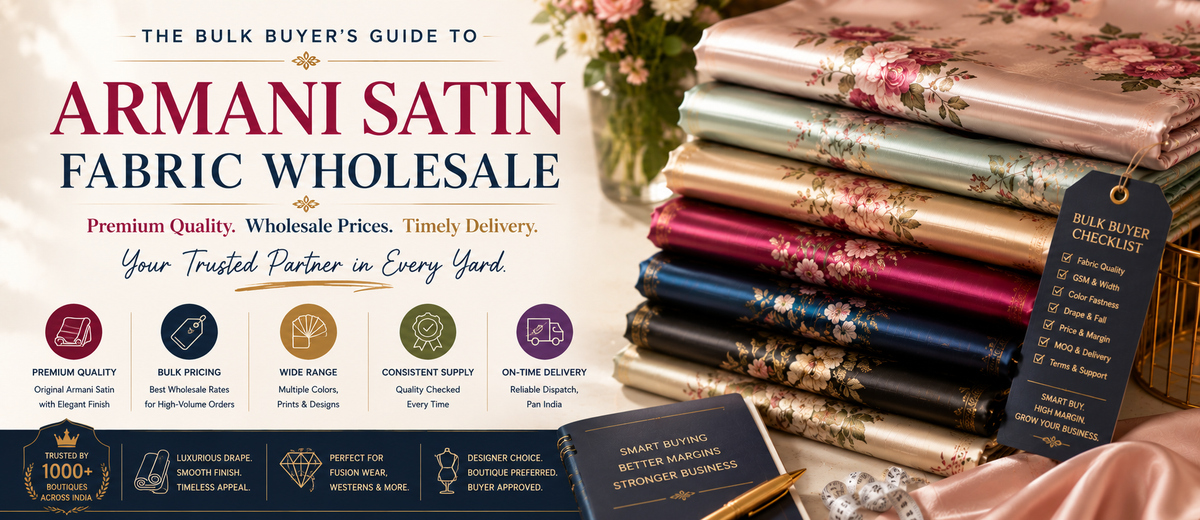
The Bulk Buyer's Guide to Armani Satin Fabric Wholesale
Every satin on the counter looks the same under shop lights. That is the trap. A buyer picks up two rolls at Rs 160 and Rs 240, sees the same shine, takes the cheaper one and then spends the season handling snag complaints on finished gowns. Armani satin is where that mistake costs the most, because it is the satin most boutiques build their heavy drape pieces from.
So here is the reference I give bulk buyers before they book armani satin. Not a product page. A working guide to what separates a satin you can stitch at volume from one that only looks good on the shelf.
Quick answer: Buying armani satin fabric wholesale means purchasing by the thaan at trade rates. Armani satin is a heavier poly-viscose satin with a glossy face and a matte reverse, generally running 120 to 180 GSM. Delhi trade rates run roughly Rs 140 to Rs 300 per metre depending on weight and finish. Rates fall as your thaan count rises.
What armani satin actually is (and where the name came from)
Armani satin is a trade name, not a brand fabric. It has no link whatsoever to the Italian label. Somewhere in the market a heavier satin quality picked up the name. It stuck. Now the whole trade uses it. Knowing that saves you from paying extra for a name that has no fabric behind it.
Technically it is a satin-weave fabric spun from polyester or a poly-viscose blend. The satin weave floats yarn across the surface, which is what creates the shine on the face while the reverse stays matte. Armani quality sits heavier than a dress satin or a bridal satin, so it falls with weight instead of clinging. That weight is the single reason gown and sharara stitchers keep asking for it by name.
One more distinction worth carrying to the counter. Silk satin, georgette satin and armani satin are three different animals. Silk satin is a natural fibre at a natural fibre rate. Georgette satin has the grainy georgette body with a satin face. Armani satin is the smooth heavy one. Buyers who use satin as a single word end up with the wrong fall for their design.
Armani satin qualities worth stocking at wholesale
This is the comparison sheet I run through with new bulk buyers. Choose by the garment, not by the rate line.
| Satin quality | Typical GSM | Hand feel | Best garment use | Delhi trade price (per metre) |
|---|---|---|---|---|
| Light armani satin | 120 to 140 | Soft with easy fall | Kurtis, inner layers, blouse linings | Rs 140 to Rs 190 |
| Standard armani satin | 140 to 160 | Smooth with clear weight | Gowns, shararas, co-ord sets | Rs 180 to Rs 240 |
| Heavy armani satin | 160 to 180 | Dense, holds a cut edge | Structured gowns, jackets, palazzos | Rs 230 to Rs 300 |
| Modal armani satin | 130 to 155 | Softer, more skin-friendly | Daywear kurtis, loungewear sets | Rs 200 to Rs 270 |
| Printed armani satin | 140 to 165 | Smooth with print on face | Printed gowns, dupattas, resort lines | Rs 190 to Rs 280 |
These bands reflect Delhi wholesale rates as of this week for standard 58 to 60 inch widths. Polyester yarn rates move, so treat them as a working band rather than a fixed number. You can compare shades against live running stock in our armani satin collection before you block a colour.
How to judge armani satin before you commit a thaan
Shine tells you nothing on its own. These five checks tell you everything.
- Run the snag test first. Drag a fingernail lightly across the satin face. If a float lifts or a line appears, that roll will snag on every hook, chair and bag your customer owns. This is the number one satin complaint and it is fully avoidable at the counter.
- Check the weight by feel, then by bill. Ask the GSM and write it on the invoice. A 130 GSM sold as heavy armani is the oldest rate trick in the satin trade.
- Test colour rub. Press a white cloth hard against a deep shade and twist. Colour transferring onto the white means the dye is sitting on the surface, so it will mark a lining or a blouse.
- Look at the matte back. A genuine armani quality shows a clean dull reverse. If both sides shine equally, you are usually looking at a lighter dress satin dressed up as armani.
- Compare two ends of the roll. Satin shows shade banding down a thaan more visibly than any matte fabric. Check the first metre against the last before you sign for a full lot.
Minimum order quantity, rate bands and boutique margin
This is the structure most Delhi suppliers work with, ours included. It is worth understanding before you negotiate, because the discount sits in quantity rather than in argument.
| Order tier | Typical quantity | Rate movement | Who it suits |
|---|---|---|---|
| Sample cut | 1 to 5 metres | Retail rate | Designers matching a shade |
| Small bulk | 1 thaan (about 18 to 22 m) | 5 to 10 percent off retail | Boutiques running one gown design |
| Trade bulk | 5 to 20 thaans | 12 to 20 percent off retail | Resellers, repeat ethnic labels |
| Mill lot | 50 thaans and above | Mill-linked rate on request | Garment exporters, large labels |
The margin habit that works on satin is shade consolidation. Pick four house colours you repeat every season instead of chasing twelve trend shades. Deeper quantity in fewer shades lands you a better band, cuts your dead stock and keeps your reorders matching. Boutiques that pool their four shades with other buyers reach a rate none of them would get alone.
Where armani satin earns its keep in a boutique line
Its strongest use is anything that needs weight in the fall. A standard armani satin gown hangs in a clean column without extra lining, which saves you both fabric cost and stitching time. The same weight makes shararas swing properly instead of flapping, which is why the fabric moves hardest through sangeet and reception lines.
The quieter earner is daywear. Modal armani satin stitches into kurtis that feel soft against the skin while keeping a finish customers read as dressy. That gives a boutique a piece it can sell year round rather than only in wedding weeks. You can see the silhouettes buyers build with it across our kurti fabric range. Satin also works hard as a contrast, so a satin border or a satin sleeve panel lifts a plain cotton set for very little added cost.
Common mistakes bulk buyers make with armani satin
- Skipping the snag test. This one mistake causes more satin returns than every other issue combined. Test before you take volume.
- Treating all satin as one fabric. Silk satin, georgette satin and armani satin behave differently in a cut. Name the exact quality on your order.
- Buying light and calling it heavy. Get the GSM written on the bill. Feel alone gets argued about later.
- Ordering deep shades without a rub test. Dark satins can mark linings and pale panels in a stitched set.
- Chasing too many trend colours. Satin trend shades date quickly. Build a base of four repeatable house colours and order trend shades to actual demand.
Storing armani satin without marking the face
Satin damages from friction rather than from damp. Keep rolls wrapped so nothing rubs the glossy face during handling, because a scuff on satin catches light and cannot be pressed out. Store rolled, never folded, since a fold line on a satin face stays visible on the finished garment. Keep the rolls out of direct sunlight too, as strong light fades deep satin shades unevenly and leaves you with two tones inside one thaan.
Questions bulk buyers ask me at the counter
What is armani satin fabric made of?
It is a satin-weave fabric spun from polyester or a poly-viscose blend, generally running 120 to 180 GSM. The name is a trade label with no connection to the designer brand. It sits heavier than dress satin, which is why it falls with weight instead of clinging.
What is the minimum order for armani satin fabric wholesale?
Trade rates usually start at one full thaan of about 18 to 22 metres. Below that you pay close to retail. The sharper 12 to 20 percent trade band typically opens at five thaans or more, so consolidating your house shades helps you reach it.
What is the difference between armani satin and silk satin?
Silk satin is a natural fibre fabric priced at natural fibre rates with a softer fluid fall. Armani satin is a poly or poly-viscose blend that runs heavier, holds a cut edge better and costs far less. For volume gown and sharara production, armani satin is the working choice.
Does armani satin snag easily?
A lower quality one does, because the satin weave floats yarn across the surface. A denser 160 GSM and above quality resists it far better. Always run a fingernail across the face before booking a thaan, since snagging is the complaint that comes back to you after delivery.
Ready to order armani satin at trade rates?
If you run a boutique, a label or a reselling line, the fastest way to lock trade pricing is to join the wholesale programme. You get thaan rates, house shade booking and colour pooling with other buyers. See the tiers and register on our wholesale fabric page to start your first bulk armani satin order.