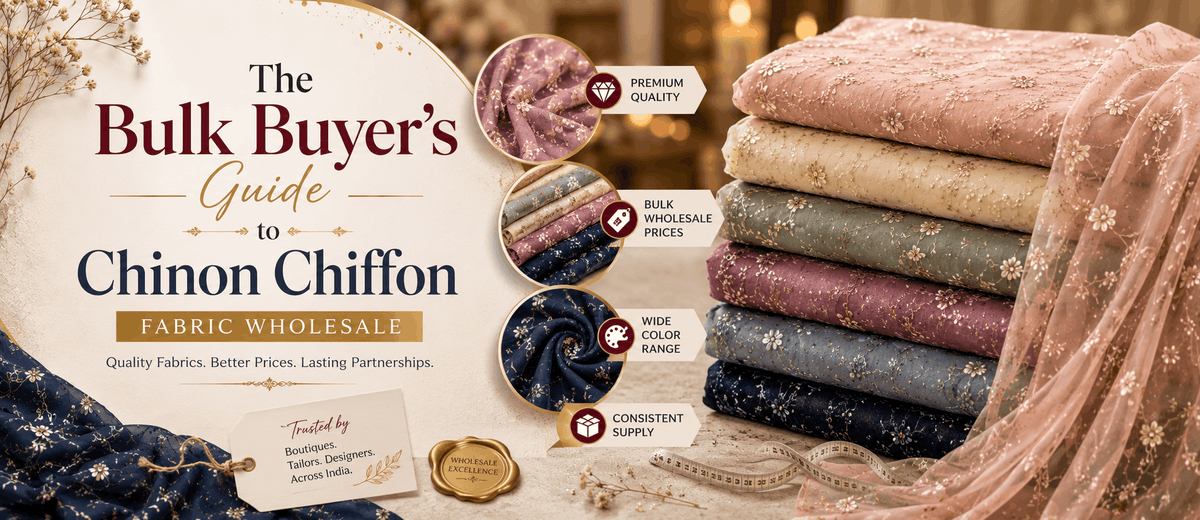
The Bulk Buyer's Guide to Chinon Chiffon Fabric Wholesale
Ask ten boutique owners in Delhi what chinon is and eight will tell you it is a type of chiffon. That is close enough to sell a dupatta but not close enough to buy forty thaans of it. I have watched buyers pick a chinon lot for a gown line, order it in a soft finish, then spend the rest of the season explaining why the panels hang differently on every piece. The fabric did nothing wrong. It was simply asked to do a job it was never built for.
Chinon has quietly become the workhorse of the Indian occasion market. Most of the sequin and thread work sitting in showrooms right now is stitched on top of it. Here is what I put in front of a bulk buyer before we open the rate book.
Quick answer: Chinon chiffon fabric wholesale means buying chinon by the thaan at trade rates instead of by the metre. Chinon is a low-twist sheer carrying a slub yarn, so it reads cloudy against light rather than clear, plus it falls softer than georgette. It is the volume embroidery base of the Delhi market because it takes a needle without splitting. Trade rates run roughly Rs 110 per metre for basic poly chinon up to Rs 280 for fine heavy quality.
Chinon is a slub, not a grade of chiffon
Plain chiffon is woven from fine yarns given a modest twist in alternating directions. The result is light, slightly gritty to the hand plus almost see-through. Chinon starts from the same family then changes one thing. The yarn carries an intentional slub, a thick and thin variation along its length, so the finished cloth has a faint uneven texture running through it.
That slub does three commercial things. It scatters light, which is why chinon looks milky against a window while organza looks like glass. It adds a small amount of body, so the cloth holds a soft shape instead of collapsing straight down. It also gives the surface something to grip, which is the reason embroidery units prefer it over flat chiffon for dense work. A slub-textured ground hides the small distortions that dense thread work always creates.
Buyers who understand that chinon is a texture decision stop comparing it against georgette on price alone. They are not the same product doing the same job at different rates.
Reading a chinon thaan before the rate is discussed
Chinon is sold under a dozen loose trade names and the labelling means very little. Four checks tell you what is actually in front of you.
- Hold a metre up against daylight. Real chinon shows an uneven cloudiness with faint streaks running weft-wise. If it reads perfectly even and glassy, you are looking at plain poly chiffon being sold as chinon.
- Crush a handful in your fist for ten seconds then open it. Good chinon recovers most of the way within a minute and leaves soft rounded creases. A weak lot keeps sharp fold lines, which will become permanent marks along the thaan fold in your godown.
- Stretch a square on the bias, corner to corner. Chinon should give a little then come back. Cloth that keeps the stretched shape has been over-finished with softener and will grow at the hem after cutting.
- Rub the selvedge hard between thumb and finger twenty times. If small fibres lift immediately, the lot will fray badly at the cutting table plus shed on the embroidery frame. Ask for a tighter construction before you commit the season quantity.
The chinon grades a Delhi counter will put in front of you
Weight, finish plus fibre content move the rate more than the name printed on the tag.
| Quality | Approx GSM | Hand and behaviour | Best garment use | Delhi trade price (per metre) |
|---|---|---|---|---|
| Basic poly chinon | 35 to 45 | Light, faint slub, quick to crease | Volume dupatta lines, inner layers | Rs 110 to Rs 145 |
| Standard chinon chiffon | 45 to 60 | Clear slub, reliable recovery | Embroidery base, saree layers | Rs 145 to Rs 195 |
| Heavy chinon | 60 to 80 | More body, carries weight of work | Sequin grounds, gown overlays | Rs 190 to Rs 250 |
| Crushed chinon | 45 to 65 | Set crush, narrows the usable width | Ruffle dupattas, tiered skirts | Rs 165 to Rs 230 |
| Fine viscose-rich chinon | 50 to 70 | Softest fall, deepest shade take | Designer dupattas, occasion sarees | Rs 230 to Rs 280 |
These bands reflect Delhi wholesale rates this week on standard 44 inch widths. Yarn cost plus finishing charges move the whole table together rather than one row at a time, so read it as a working band and confirm on the day. You can compare slub character, weight plus shade depth against live running stock in our chinon chiffon collection before blocking a colour.
Why embroidery units keep asking for chinon by name
Walk into any job-work unit in Shahdara or Mangolpuri and the frames are loaded with chinon more often than anything else. The reason is mechanical. A needle passing through chinon separates the yarns then lets them close again. On a tightly set flat chiffon the needle punches a hole that stays visible. On a high-twist georgette the ground drags against the thread tension plus pulls the design out of shape.
Two rules decide whether that advantage survives production. First, insist the unit uses backing paper or a dissolvable film under every dense panel. Chinon without backing puckers, plus puckering on a sheer cannot be pressed out later because the distortion is in the yarn spacing rather than the surface. Second, match the work weight to the ground weight. A heavy sequin panel on 40 GSM chinon will sag inside a month of hanging. Put dense work on the 60 GSM and above qualities plus keep the light qualities for scattered buti or thread outline.
If you are sourcing worked cloth ready to cut rather than plain thaans, most of the running designs across our embroidered fabric range sit on exactly this class of ground, so the same weight logic applies when you compare two pieces at the same rate.
Sheerness maths plus the lining call nobody costs in
Almost every chinon shade needs a lining, plus the lining is where boutique margins quietly disappear. A single-layer chinon kurti in a pastel will read transparent under showroom lighting no matter how good the cloth is. Budget for it at the quoting stage rather than at the tailoring stage.
Pale shades need a full lining in a matched santoon or crepe. Mid shades usually pass with a partial lining through the bodice only. Deep shades such as bottle green, wine plus navy often stand alone in a dupatta because the density of colour does the covering. That single decision changes your fabric consumption per garment by close to a metre, which on a two hundred piece run is a real number.
One more consumption point. Chinon frays fast on a cut edge, so add a slightly deeper seam allowance than you would on a crepe. Tell the cutting master to run a narrow overlock the same day the panels are cut, because a stack of chinon panels left open for a week comes back with fringed edges plus a shorter finished garment.
Trade bands, thaan sizes plus where the discount actually sits
Most Delhi suppliers work close to the structure below, ours included. On chinon the saving that matters is taking a shade in one dye lot, because a slub ground shows lot drift faster than a flat ground does.
| Order tier | Typical quantity | Rate movement | Who it suits |
|---|---|---|---|
| Sample cut | 1 to 5 metres | Retail rate | Designers testing drape and lining |
| Small bulk | 1 thaan (about 20 to 25 m) | 6 to 10 percent off retail | Boutiques trialling one style |
| Trade bulk | 5 to 20 thaans | 12 to 20 percent off retail | Resellers, embroidery job units |
| Dye-lot booking | 30 thaans and above, one shade | Mill-linked rate on request | Exporters, labels with a house colour |
Ask for the dye-lot number on the bill plus staple a snip of every lot into a file with the date. Nine months later, when a customer wants a matching dupatta for a kurti you sold in season, that snip decides whether you make the sale or lose the customer.
Where chinon buying goes wrong
- Quoting a garment without the lining in the costing. On pale shades the lining can add close to a metre per piece. Decide it before you price the style, not after.
- Sending light chinon for heavy work. Sequin and dori weight on a 40 GSM ground sags at the shoulder inside a season. Move up a weight instead of arguing with the unit.
- Storing folded thaans flat for months. Chinon sets a crease along the fold that survives pressing. Roll on tubes and turn the stock every few weeks.
- Accepting a crushed lot without measuring usable width. A crush finish can pull a 44 inch cloth down to 38 or less. Measure after the crush, never before.
- Pressing at a cotton setting. Poly-rich chinon glazes then goes shiny at high heat. Press from the reverse on low with a cloth between.
Questions I get across the table on chinon
What is the difference between chinon and chiffon?
Chinon is a chiffon-family sheer woven with a slub yarn, so it reads cloudy and textured against light where plain chiffon reads flat and even. The slub gives chinon slightly more body, better crush recovery plus a surface that hides the small distortions dense embroidery creates. Plain chiffon stays lighter and cheaper but marks more easily under a needle.
Is chinon chiffon good for embroidery?
Yes, it is the standard embroidery ground across most Delhi job-work units. The weave lets a needle pass without leaving a visible hole. Two conditions apply. Backing paper or dissolvable film must sit under every dense panel, otherwise the ground puckers permanently. The cloth weight must also match the work weight, so keep sequin and dori panels on 60 GSM and above.
What is the minimum order for chinon chiffon fabric wholesale?
Trade rates usually begin at one full thaan of about 20 to 25 metres. Below that you pay close to retail. The sharper 12 to 20 percent band typically opens at five thaans. A single shade booked against a dedicated dye lot generally starts around 30 thaans with a longer lead time.
Does chinon chiffon need a lining?
Pale and mid shades almost always do, because a single layer reads transparent under showroom lighting. Pale shades need a full matched lining in santoon or crepe. Mid shades often manage with a bodice lining only. Deep shades such as wine, navy plus bottle green can stand alone in a dupatta. Fix this at the costing stage since it changes consumption by close to a metre per garment.
Lock chinon chiffon at trade rates
If you run a boutique, a label, an embroidery unit or a reselling line, the fastest way to secure trade pricing is to join the wholesale programme. You get thaan rates, dye-lot numbers recorded against every booking, single-lot shade blocking for your festive calendar plus mill bookings for house colours. See the tiers and register on our wholesale fabric page to start your first bulk chinon order.